
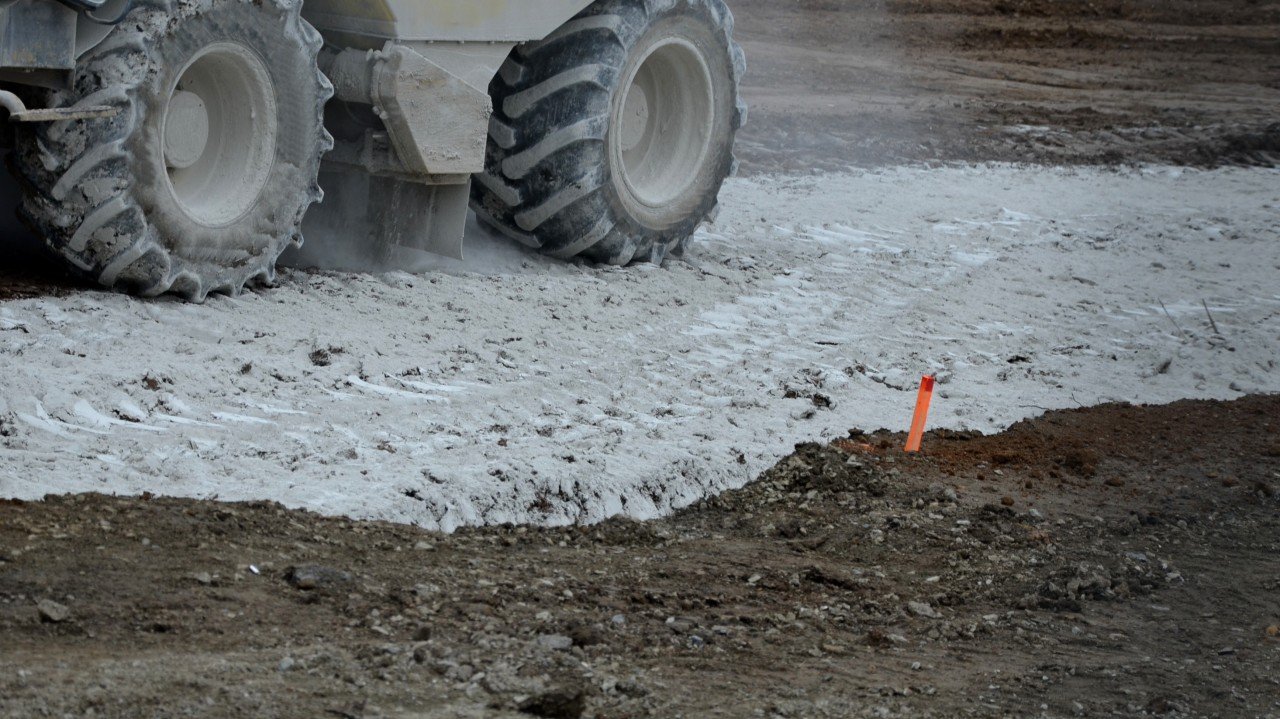
Lime and cement change what dirt is. Mixed into a clay or silty soil with the right amount of water, lime reacts with the fines, dries the material, reduces its swell and stiffens it into something a roller can compact and a truck can cross. Cement works faster and builds a harder, more rigid layer, which suits sandy and low-plasticity soils that lime cannot help.
The treatment is done in place. A spreader lays the powder in measured passes, a stabilizer mixes it to a set depth, a water truck brings the blend to the target moisture, a roller compacts it and the surface is cured, usually with a light water spray or a seal coat. The result is a treated layer under a slab, a yard or a road that is stronger than the soil it replaced and often cheaper than hauling it away.
We plan and coordinate soil treatment on pads, truck aprons and heavy-haul roads around Odessa, using specialist partners for the spreading and mixing and our own field lead for the checks.
Mixing, curing and the calendar
Treatment has three clocks: delivery of the material, the mix-and-compact window and the cure. Powder is ordered a few days ahead and arrives in bulk trucks that need a clear route in and a dry day to spread. Once mixed, the soil has to be compacted within hours, before the reaction stiffens it, so the roller and water truck stand ready before the stabilizer starts.
Cure time then decides when the next trade can start. Climate normals for the Odessa-Schlemeyer Field station list a July average high of 95.0 degrees F, a June average high of 95.5 degrees F and annual precipitation of 12.93 inches. Heat dries a treated layer quickly, so we keep it moist for the first days, and a January average low of 31.6 degrees F means cold mornings can slow a cement cure. We schedule around both.
Handling alkaline powders
Quicklime and cement are caustic. They burn skin and eyes and are dangerous to breathe, so operators and laborers wear respirators, goggles, gloves and long sleeves, and wash stations stay on site. Spreading stops in wind that would carry dust past the work area, and we post a wind limit before the day starts.
Water used in mixing makes lime hot. Workers do not stand near the mixing zone during the reaction, and spills are cleaned up dry whenever possible. Trucks are loaded and unloaded under a plan that keeps pedestrians clear. These routines are not unusual, but they matter most when a stiff wind changes direction midday.
Treatment next to other ground work
Soil treatment rarely stands alone. It is one choice among several for weak ground, alongside engineered fill and soil stabilization with imported material and, where the problem is deep, over-excavation and recompaction.
After treatment comes fine grading and the base layer, then the pour or paving. We hold the testing and the cure date in one schedule so the next crew starts on a layer that has already passed.
On roads, treatment ties to road subgrade preparation, and on building sites it ties to building pad preparation. The difference is mostly tolerance. A road subgrade is trimmed to a crown and a cross slope, while a pad is trimmed flat, and the treated layer is finished to match.
Pads that benefit
A distribution center slab and the truck court around it sit on large flat areas where treatment is economical, since a spreader covers acres in a day. A truck terminal needs treated lanes that resist rutting under channeled traffic.
Smaller buildings, such as shops and office pads, may use a thinner treated cap to control swell. In each case the depth, the percentage and the cure are set by the engineer from lab tests on the soil, not by a rule of thumb.
A trial strip is often worth the day it takes. We treat a small section, test it and look at how it compacts before the spreader covers the whole pad. If the soil behaves differently than the lab sample, the rate changes while the change is still cheap.
Roads, flooding and flat ground
The road system around Odessa is long and heavily used. US 385 meets Loop 338, SH 191 (42nd Street), SH 158 toward Goldsmith and I-20 at Pool Road toward Monahans and Midland, and US 385 and State Highway 329 pass through Crane, with US 385 running 32 miles north to Odessa and 21 miles south to McCamey. Treated subgrades are a common tool on roads like these because they stiffen soft ground cheaply over long distances.
Drainage is the other reason. Recurring flooding on Kermit's flat terrain led that town to build crown streets to carry water off, a reminder that flat ground holds water and weakens untreated subgrade. Treated soil resists that weakening, though it still needs a drainage plan.
Owners who ask for treatment
Logistics and warehouse developers ask for it under large slabs and truck courts because it cuts import and shortens the schedule. Oil, gas and midstream owners use it for lease roads, laydown yards and pad sites where the haul of stone would be long and the soil is suitable.
Public owners value the documentation. A treated layer is tested in place, and the record proves what the road or yard was built on. We keep the mix design, the application rate and the field tests in one file.
Yard managers also like the dust control. A treated surface does not rut and throw fine silt the way a loose clay lane does, so trucks stay cleaner and the neighboring work stays clearer. That matters on a lay-down area where trucks come and go all day.
Test the soil before you plan the pad
Send us the soil report or let us help order lab samples. We will tell you whether lime or cement suits the ground and what depth and rate it needs, then price the treatment next to replacement.
Common Questions
How do you know whether lime or cement is right?
A lab test on the actual soil decides. Clay and silt with a high plasticity index respond to lime. Sandy, low-plasticity soils usually take cement. Some soils need both, and the engineer picks the mix from sample results.
How deep does the treatment go?
Commonly six to twelve inches for pavements and pads, deeper for heavy-haul roads. The stabilizer mixes the layer in one pass, and a second pass or a second lift is used for greater depths. Depth is verified by probing and sampling.
Does wind stop the work?
Yes, for spreading. Powder in a gusting wind drifts off the pad and onto neighbors, so spreading stops until the air calms. Mixing and compaction can continue on material that is already on the ground.
Can treated soil be paved right away?
Not until it has cured to the engineer's strength or time limit. Lime-treated layers often take a mellowing period before the final mix. Cement layers must be compacted within a short window and then kept moist.
Will treated ground still need drainage?
Yes. Treatment improves strength but does not make the ground waterproof. Edges, ditches and slopes still need to move water away so the layer stays stable.