
A retail pad or office shell in Odessa gets its first real test when the first delivery truck backs onto the apron, usually before the last tenant has finished moving in. Commercial developers here lease to businesses that run trucks, trailers and service pickups, so the flatwork around a building carries as much weight in the pro forma as the floor inside it. We pour the slabs, drive aisles, aprons and walks that those tenants use every day. Oilfield service tenants, which oil, gas and midstream owners will recognize, are the heaviest users. We also line up the trade partners who handle the utilities and earthwork underneath.
Most developer calls start with a site plan that is mostly paved. The building is a small share of the lot. The rest is parking, truck turns, dumpster pads, sidewalks and accessible routes, and every one of those pieces has to drain, hold up under traffic and pass inspection. A shell building with a failing parking field is a leasing problem, and tenants notice it before they notice anything about the finishes.
We work with owners building retail shopping centers, office buildings and small commercial parcels along the main roads in and around the city. The goal is a concrete package that arrives on schedule, matches the engineer's sections and does not need a repair crew in the second year.
Concrete a commercial pad actually needs
On a typical commercial parcel the concrete scope breaks into four groups. The building gets footings, stem walls and a slab on grade, and the details are in our slab on grade work. The lot gets paving, curb and gutter, and the approaches where the site meets the public street. The perimeter gets sidewalks and accessible ramps. The back of the building gets the part nobody photographs for the leasing brochure: the truck apron, the dock approach and the dumpster pad.
That last group is where developers save money in the wrong places. A dumpster pad poured at sidewalk thickness will crack under a loaded hauler within a season. A rear apron poured without a base can pump fines up through the joints. We price those pieces by the axle load that will cross them, and we say so plainly in the bid so the owner can trace each dollar. For the parking field we lean on parking lot concrete sections that are matched to the traffic the tenant mix will bring.
Working beside open tenants and public roads
Commercial pads are rarely empty ground. One side of the parcel often sits against an open business, a drive-through lane or a public street, and the pour has to share that edge with customers. We fence the work, set up flagged routes for delivery trucks and keep the concrete trucks staged so they do not stack onto the roadway. Mixer drivers get a briefing on where to enter, where to back and where not to go.
Texas projects also bring state accessibility review. Ramps, landings, cross slopes and curb cuts get checked by an inspector, and a slope that is a quarter inch off is a rework item, not a debate. We form those pieces with the tolerance in mind and shoot them with a level before the trucks arrive. Concrete trade partners wear the protective gear the site calls for, and we keep silica dust controlled during any sawing or grinding so the neighboring tenant does not breathe it.
Concrete and site work responsibilities
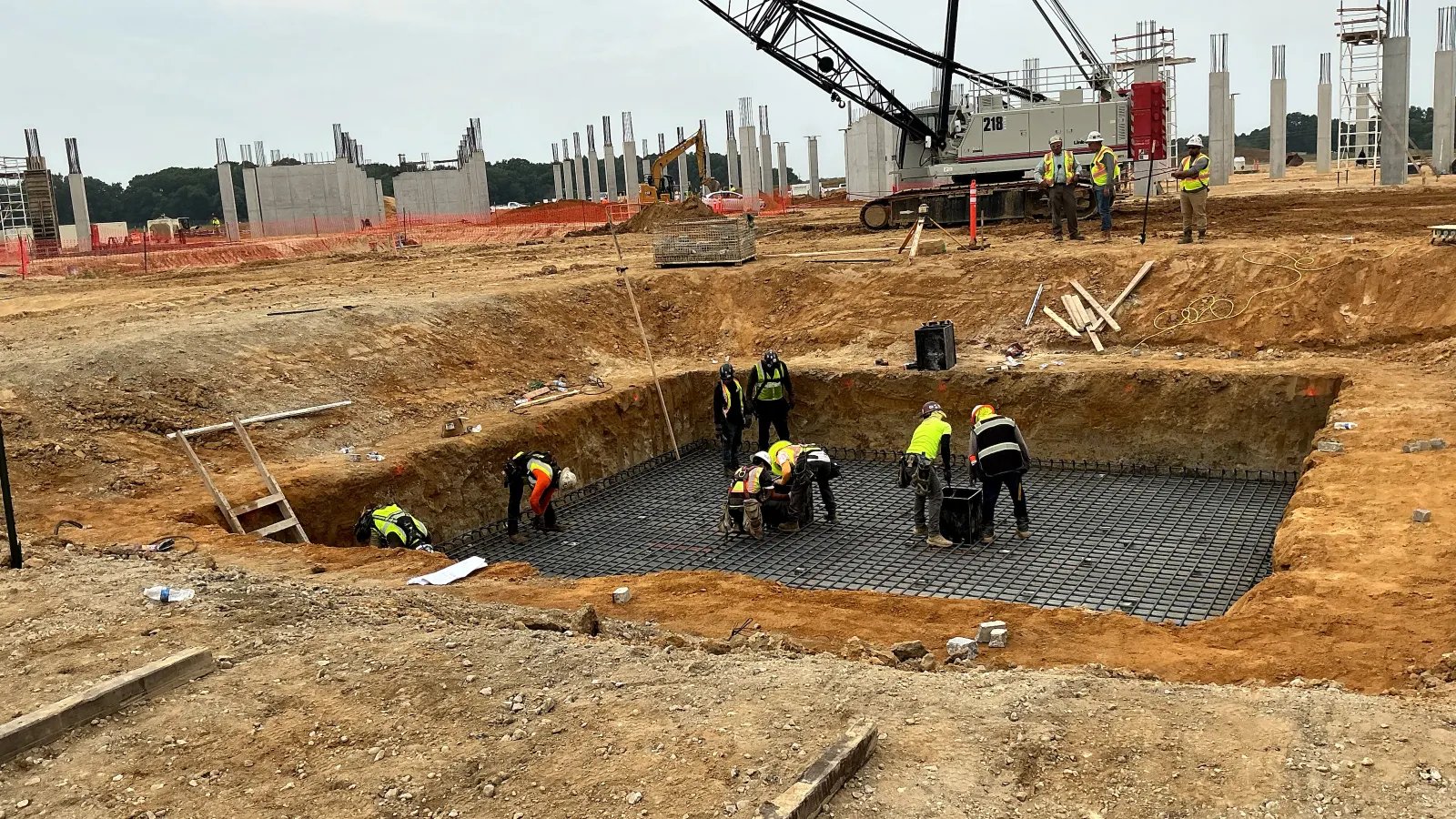
Concrete trade partners do the forming, placing and finishing. That covers formwork, reinforcing steel placement, the pour, the finish and the cure. We run the placement as one sequence so the same crew that sets the forms is accountable for the surface that comes off them. On a commercial pad that matters, because grade stakes, embedded items and sleeves all show up in the same week.
The utilities and earthwork that sit under the concrete are a different matter. We coordinate trade partners for that work. The developer gets one schedule, with excavation, underground utilities and base preparation sequenced ahead of the forms, and we hold the handoff points between each trade. When a partner finishes a trench, we check the backfill and the compaction record before we place anything on top. The related scopes include site utilities and building pad preparation, and we keep the pieces tied together rather than leaving the owner to chase three subcontractors.
Wind, sand and heat on a commercial pour
West Texas weather decides how a pour gets run. Monahans, not far down the interstate, averages about 13.54 inches of precipitation a year and has recorded a high of 120 degrees F, which tells you how dry and hot the stretch can get. A slab placed in the afternoon in that kind of heat loses surface water fast, crusts over, and cracks if nobody gets a curing blanket or compound on it in time.
We schedule large pours for early hours, keep ready-mix trucks moving so the load does not sit, and use evaporation retarders and curing blankets when the day calls for them. Wind-blown sand is the other problem. It blows into forms, onto fresh surfaces and into dowel sleeves. We clean the forms right before the pour, not the day before, and we protect finished edges. Our write-up of hot and windy weather concrete explains the same routine in more detail for owners who want to see how it is staged.
How Permian Basin growth shapes commercial demand
The Permian Basin spans more than 86,000 square miles, and Odessa is named with Midland as a headquarters city for activity across it. That shapes commercial demand in a specific way. Offices, clinics, restaurants and retail follow the people who work the Basin, and the developers who serve them tend to build in phases as leases come in. The pace is steady and sometimes sudden, so a concrete contractor who can mobilize quickly matters more than one with a long bid list.
Health and education add steady work. The newest building on the Texas Tech health sciences campus in Odessa is a classroom and research building of about 51,000 square feet, and it brings the sort of nearby medical office, housing and retail demand that developers watch. We follow those clusters when we look at where a new pad might land, and we mention them to owners who are weighing sites. For owners planning space near a hospital or school, our pages on schools and healthcare owners and the medical center district cover the local pattern.
Send the site plan before the bid is due
Send the civil set and the lease plan for the parcel. We will mark the concrete areas that carry trucks, call out joint and drainage questions, and tell you which pieces we can price from the drawings. Reach Concrete Contractors of Odessa to set up a plan review.
Common Questions
What should a developer budget for beyond the building slab?
Plan for the lot itself. Parking field paving, drive aisles, curb, sidewalks, ramps and the truck apron often add up to more concrete area than the building floor. We break these out separately in the bid so the owner can adjust thicknesses by use, such as heavier sections at the dumpster and the delivery turn.
When is the right time to call a concrete contractor?
Ideally while the civil set can still change. We can flag joint layouts, drainage that does not reach an inlet, and sections that look light for the expected trucks. A call during design costs far less than a field change.
Can you work around tenants who are already open?
Yes. We phase the pours so entrances stay available, fence the work and keep concrete trucks off the customer route. Some jobs run at night or on a closed-day schedule, and we plan the curing around whatever hours the tenant can give us.
Does hot weather change your schedule on a commercial job?
It changes the hour, not the finish quality. We start early in summer, keep the trucks moving and cure right behind the finishers. Large parking field pours may be split into smaller sections so each one can be finished and protected before the sun gets to it.
Who takes care of utilities and grading on a commercial parcel?
We coordinate trade partners for that work and manage the handoffs so the concrete crew gets a prepared base. The developer deals with us as the single point of contact for the sequence, and we report where each trade stands against the pour dates.