
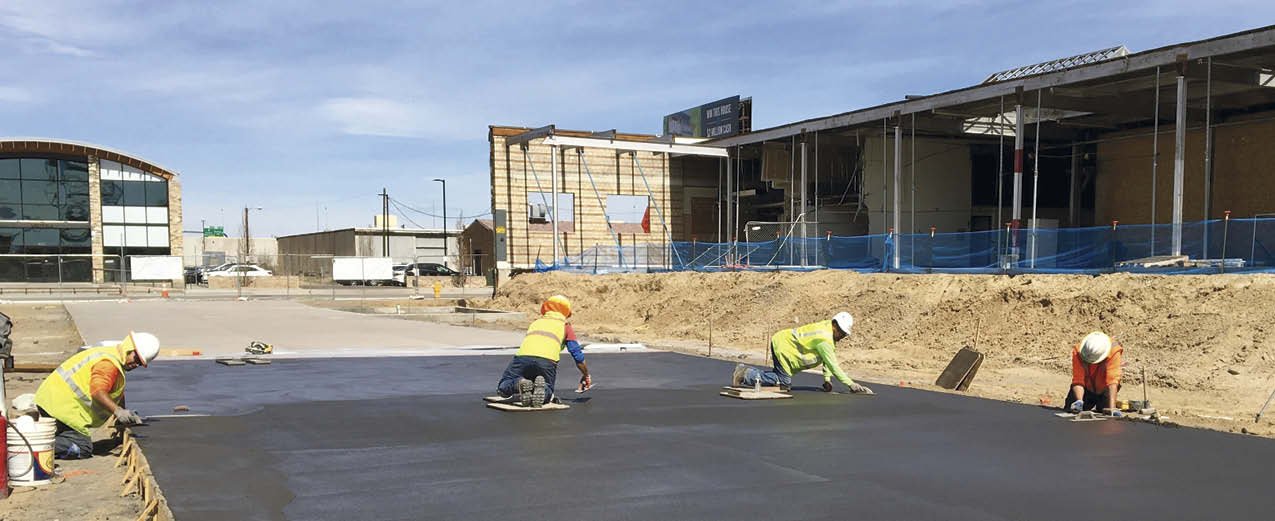
A commercial concrete scope in Odessa starts with the ground. Across Ector County the land is level to rolling, and under a thin layer of topsoil there is usually caliche, a cemented layer of gravel, sand and silt that forms where rain is scarce. It makes a firm working surface and a decent road base, but it does not like water, and its depth and hardness change across a single site. Whoever pours the slab has to read that ground before the forms go in.
Concrete Contractors of Odessa builds the hard surfaces and structural pieces that commercial owners in this part of the Permian Basin depend on: building foundations, slab-on-grade floors, truck aprons, yard paving, sidewalks, curbs and the pads under process equipment. The customers are general contractors, developers, plant owners, municipalities and utility companies. Most of them want the same thing from a concrete sub, which is a slab that is flat enough, strong enough and finished before the next trade needs the space.
Trade partners handle utilities and earthwork under our coordination, and we keep the concrete package tied to that sequence. Underground lines go in, the subgrade is shaped and proofed, and then concrete trade partners place and finish. The result is one point of contact for the flatwork and structure, even when several firms are working the same site.
What a commercial concrete package covers
A package normally opens with footings and stem walls and works up to the floor. Slab-on-grade floors for shops and warehouses, concrete foundations for office and light industrial buildings, loading areas, ramps, equipment pads and the sidewalks that connect it all. Outside the building line it extends to curb, gutter, drive approaches and parking.
Each element is priced and scheduled separately but planned together. A floor poured before the building is dried in has to be protected. A drive approach poured before the utility crew finishes will get cut, and the same goes for concrete paving laid ahead of a trench. We sequence around those facts and list the dependencies in the bid, so the general contractor can see where the concrete sits against steel erection, wall panels and roofing.
Where concrete trade partners work
Our home market is Odessa, and most of the work sits within Ector County. From there we mobilize crews to the surrounding Permian Basin communities, including West Odessa, Gardendale, Monahans, Kermit and Andrews. Distance matters for ready-mix, because a truck has a limited window before the load stiffens in the heat, so we plan batch plant selection and haul time before we commit to a pour date.
Public money is moving into the outlying communities too. The Andrews Economic Development Corporation received a federal grant of $1.5 million in 2022 for road and water work at its Northwest Business Park, matched by $2.4 million in local funds. Projects like that bring paving, curb and drainage concrete to places that did not have much of it before, and they favor contractors who can mobilize to small towns without padding the price.
Owners who buy concrete in this market
The largest buyer group is oilfield service and midstream: oil, gas and midstream companies that need yards, shop floors, containment areas and truck aprons. Next come the truck court and apron buyers, then general contractors building commercial and institutional work, who sub us the site concrete. Municipal public works departments buy sidewalks, curb and drainage structures. Utility companies need pads, vaults and equipment foundations.
For builders, general contractors and construction managers are our most frequent contract partner. They send a set, we send back a number and a sequence, and the two of us sort out access, laydown and inspection hold points before anyone mobilizes. Each of these buyers reads a bid differently, and we write ours for the person who has to defend it.
Working safely around trucks, wind and heat
An active yard is a hazardous place for a pour. Water trucks, loaders and hauling rigs share the same lanes mixer deliveries need. We agree on traffic routing with the site lead, set barricades, and walk the job with the yard manager before the first truck backs in. Concrete trade partners carry the protective gear each owner requires, and we follow the owner site orientation rules without asking for exceptions.
Heat and wind add their own risks. Summer pours are scheduled for early hours, with water, shade and rest breaks for the crew, and with cure measures ready before the surface starts to set. Wind-blown sand can fill a trench or foul a joint, so we cover prepared subgrade when the forecast turns and clean it again before placement.
Scheduling pours and deliveries
Commercial schedules in Odessa are short, and the owner usually wants to be operating soon after the slab cures. We confirm batch plant capacity, pump availability and testing lab visits before the pour date is fixed, and we avoid pours that require everything to go right at once. A realistic plan includes a backup date and a clear rule for when the crew goes and when it stands down.
Hot weather is the default case here, so the day is built around it. Placement starts early, finishing is timed to bleed water and set, and curing begins once the surface has firmed enough to hold a cure coat. Anything that slows the concrete down in July is planned for in advance, not improvised at ten in the morning.
How we run a commercial job
We read the geotechnical report, the civil sheets and the structural set together, because the three often disagree on elevations and joints. Conflicts get a written question before the forms are set. On site we lay out from the control points, check the subgrade against the plan, and photograph reinforcing before it is covered.
After placement we protect the slab with curing blankets or compound, keep the joints sawn on time and record what was placed where. The owner gets a clear turnover with the pour dates, test results and the location of every joint. If something is off, we say so and fix it at our cost when the fault is ours.
Buildings and sites we pour for
The common building types are warehouses, shop buildings, equipment storage, medical and office buildings, retail pads and public facilities. Industrial buildings need heavy, flat floors and dock aprons, while retail and office work leans on sidewalks, parking and clean edges.
Each type has its own load and finish expectation, and we ask about forklift traffic, wheel loads, chemical exposure and drainage early. A floor that will see tire-mounted equipment is not designed like a floor for an office, and the price should reflect that. We would rather settle it in the bid than discover it at the first crack.
Send the drawings for a commercial bid
Email the civil, structural and geotechnical sheets with the bid date and site address. A foreman who knows Ector County ground will read them and call you with questions about access, haul distance and the first pour window.
Common Questions
Can you take on the foundation and the site paving in one contract?
Yes, when the scope is clear. We price the structural concrete and the site flatwork separately inside one bid, so a general contractor can award both or split them. Utilities and earthwork stay with the trade partners we coordinate, and we keep the handoffs on the schedule.
Does caliche subgrade cause problems for slabs?
It can. Caliche is firm when dry and soft when it takes on water, and the depth varies across a lot. We look for soft pockets, proof-roll where the plan calls for it and ask the engineer about anything unusual. Good drainage away from the slab matters more than most owners expect.
How do you handle pours in summer heat?
We start early, order mixes with the temperature in mind, and have curing materials staged before the truck arrives. Finishing is timed to the set rather than to the clock. If a day is too hot and windy for good work, we move it.
What should we send to get a lump sum?
The civil and structural sheets, the geotechnical report if there is one, the schedule window and the site access plan. A rough footprint gets you a budget range, but a lump sum needs the drawings.
Can the crew pour beside an active yard?
Yes. We agree on lanes, hours and barricades with the yard manager, and we stage forms and materials where they do not block production. Pours are timed to the quietest window the owner can give us.