
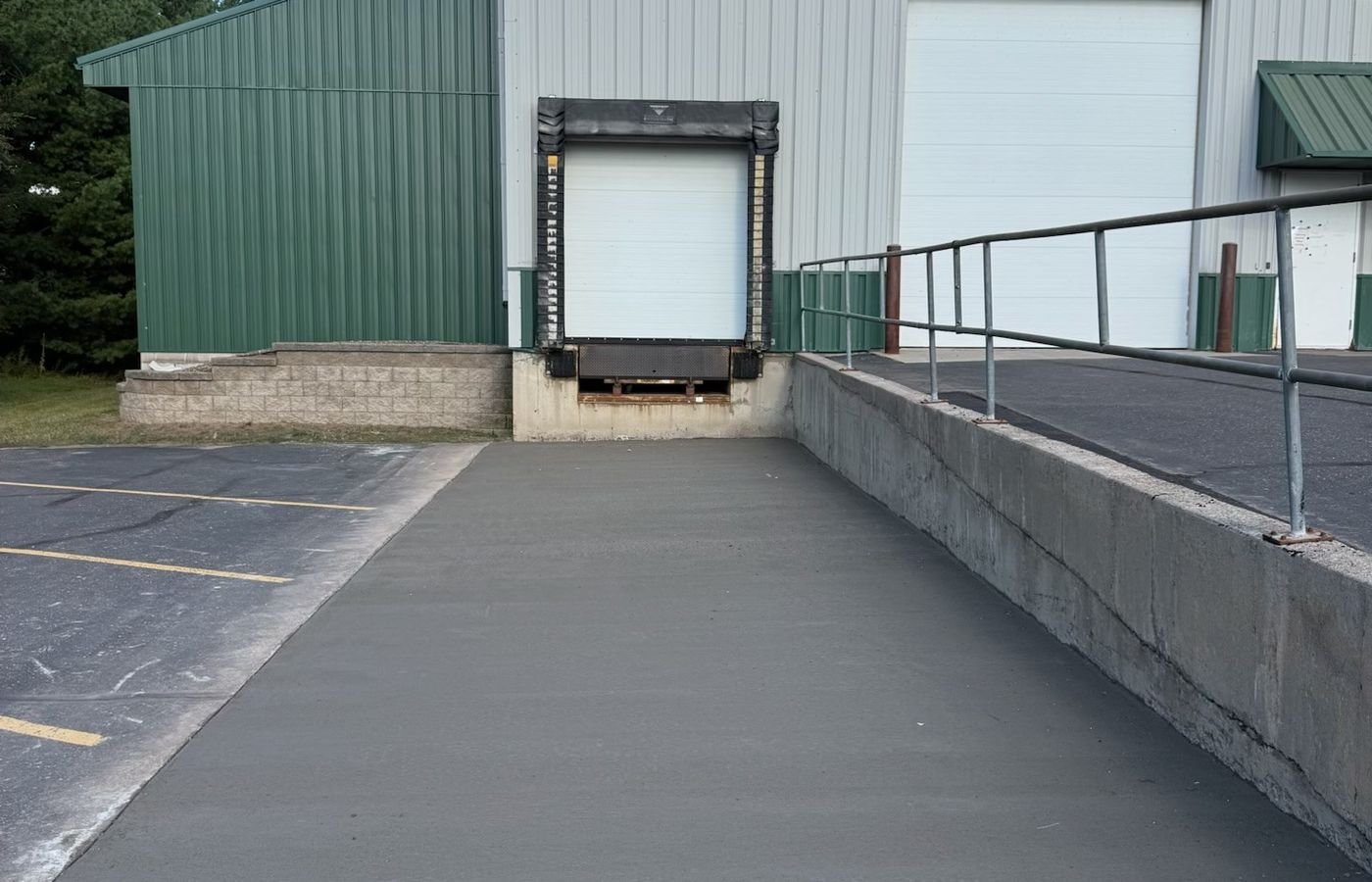
The apron behind a loading dock takes more abuse than any other piece of concrete on a site. Trailers back in, brake hard and sit with their landing gear planted on a few square inches of pavement. Tractors turn on the same patch again and again. Fuel, hydraulic fluid and brake dust soak into the surface. A dock apron built like a parking lot will rut, crack and break within a couple of seasons.
A truck court is the larger area the trucks use to get to the docks: the turning zone, the staging lanes, the scale approach and the trailer parking. It has to be flat enough to drain, strong enough for a loaded trailer and jointed so that panels do not step. The concrete section is thick, the reinforcement is heavy, and the joints are dowelled.
Concrete Contractors of Odessa builds truck courts and dock aprons for warehouses, truck terminals, oilfield service yards, plants and distribution buildings. We work from the engineer's pavement design, check the subgrade, and place the concrete in strips that the crew can finish before the surface sets.
Services that sit next to the apron
The apron meets the building at the dock. That is where loading dock pits and ramps come in, since the finished floor elevation, the leveler pit and the apron slope all need to line up. When a building uses tilt-up walls, the same crew often forms the panels, so we coordinate the tilt-up concrete panels schedule with the apron pour.
The apron also connects to drive lanes and parking, which are covered under concrete paving, and to storm drainage. A dock apron that sheds water toward the building will flood the dock. Slope away from the doors is the first rule, and the second is a drain at the low end.
Apron placement and related trades
Concrete trade partners form, place, finish, texture and cure the concrete. They set dowel baskets, tie bars, embedded plates and edge angles. They saw the joints and seal them when the specification asks for it. That is a lot of detail, and it is where an apron succeeds or fails.
Earthwork, base placement, utilities and drainage structures come from outside firms working to our schedule, and we never describe them as our own work. We do walk the base with the earthwork foreman, check elevations, and write down what we find before we release the concrete order. If the base is not ready, the pour is moved.
Specifications for truck pavement
A truck court specification normally names concrete strength, thickness, reinforcement, dowel size and spacing, joint pattern, curing and surface texture. The engineer ties them to the expected axle loads and the subgrade. Our job is to build exactly what the specification says and to flag items that conflict with the site conditions.
Permits come from the local permit office and cover the site plan, drainage and sometimes fire access. Fire lanes around a building have their own width and turning radius, and the apron has to leave them open. The approved plan stays on site, and every field change gets marked for the engineer and the inspector.
What the package includes
The usual package covers layout, base acceptance, forming, reinforcement, dowels, embeds, concrete placement, the finish, the cure, sawn joints with sealant, and cleanup. It may include trailer landing pads, bollards, wheel stops, scale pits, guard rail sleeves and trench drains at the edge of the apron.
Ector County is level to rolling land with elevations from 2,500 to 3,300 feet, so most sites drain easily, but the slope still has to be shaped precisely. A dock apron might drop only a small amount across its width, and an error of a quarter inch matters. We shoot grades with a laser at every grid point and again after the screed passes.
Planning the pour around deliveries
Apron pours are large and need a steady stream of trucks. We coordinate with the ready-mix dispatcher to line up deliveries, and we confirm the pump, the finishing crew and the saw crew. Inspections come before the pour: base, forms, reinforcement and dowels.
For buildings that are already operating, we phase the apron work in bays so that some docks stay in use. That means longer schedules, but it keeps the owner shipping. Gardendale, about 14 miles north of downtown Odessa, is one example of a place where logistics-minded owners build new buildings with long apron runs. In summer we start before sunrise and finish before the afternoon heat has done its worst.
Protecting crews and drivers
A truck court is a busy place, and the pour makes it busier. We set a traffic plan with the yard manager, close the area that is being poured and give drivers a clear alternate route. Barricades and signs show where the work zone starts. A spotter guides the mixer trucks and the pump rig.
Crew safety also means managing heat, dust and chemicals. Finishers kneel on boards in a hot slab, so we rotate them and keep water close. Saw cutting creates dust that is controlled with water. Chemical curing compounds are applied by trained crew members with the proper protective gear.
Design choices that pay off later
Andrews County has produced over one billion barrels of oil since the first well was drilled in 1929, and oil is still the economic foundation of the city. Many aprons in Andrews and across the Basin serve trucks hauling products tied to that industry, and those loads are heavier than a general warehouse sees. We take owner loading data seriously and pass it to the engineer.
Choices that pay off include dowelled joints at each panel edge, thickened edges at the dock face, a concrete apron that extends past the turning point and a cross slope that carries water off to the edges. Logistics and warehouse developers often ask how long a pavement should last, and the honest answer is that it depends on how well the base, joints and drainage are built.
Get a price for the apron and the court
Send the truck types, the dock count and the site plan. A crew lead will mark panel sizes, flag the joint layout and give you a price per square foot with the heavy sections listed separately.
Common Questions
How thick is a typical dock apron?
The engineer sets thickness from axle loads and the subgrade. Aprons for loaded trailers are noticeably thicker than parking lots, and they are reinforced and dowelled. We can review the design if you are unsure it matches your traffic.
Why do trailer landing gear damage pavement?
Landing gear puts a heavy load on a very small area, and concrete that is too thin or lacks reinforcement can punch or crack. A thicker section or a landing pad spreads the load. We build both as the design calls for.
Do I need a drain at the dock?
Often yes. Water should flow away from the building and toward an inlet or trench drain at the low edge. We can set a trench drain in the concrete or leave a block-out for one installed by a trade partner.
How long before trucks can use a new apron?
It depends on the mix and temperature. Foot traffic returns the next day, and loaded trucks wait for the strength the engineer specifies, confirmed by cylinders. Early trucking can damage the edges.
Can you repair part of an existing apron?
Yes. We saw out failed panels, check and rebuild the base, and place new concrete with dowels tied into the old. Matching the old surface exactly is hard, so we explain the appearance before we begin.