
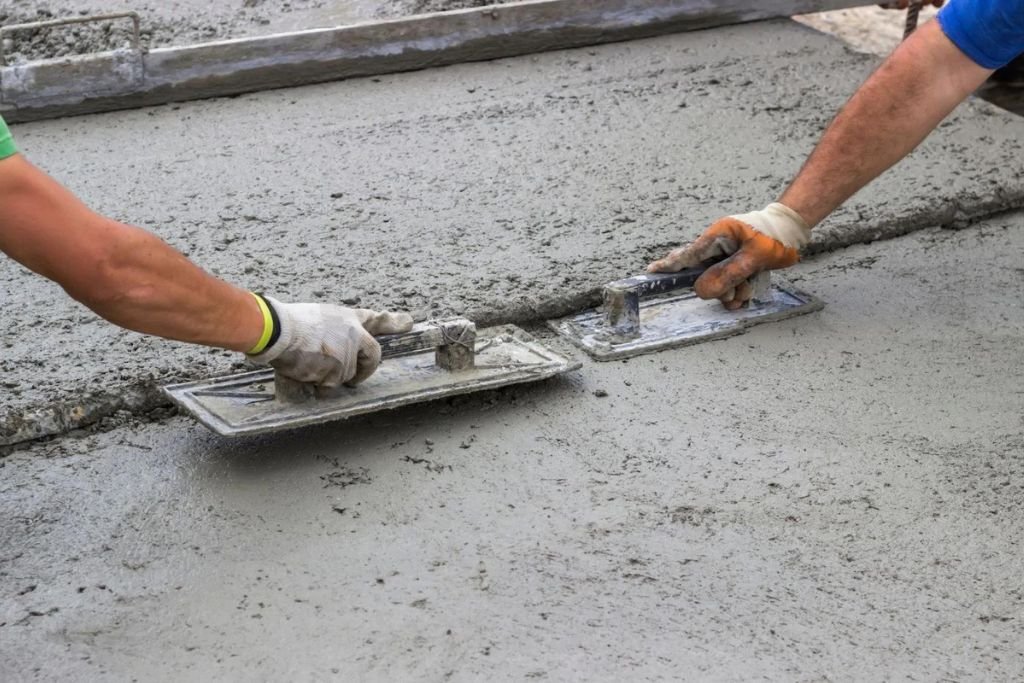
Asphalt softens in July. Anyone who has watched a loaded tank truck turn in a hot yard knows what happens next: ruts, shoving and a pavement that needs repair every season. Concrete paving does not soften, which is why heavy-haul roads, wash racks, fueling islands and loaded truck routes in the Permian Basin so often end up in concrete.
Paving is a different job from building slabs. The sections are larger, the volume is bigger, and the work runs in long strips across open ground. Joint spacing, dowels, thickness, subgrade support and drainage all matter more as the loaded axle count goes up. A paved yard that sees constant truck movement can wear out a weak section in a short time.
Concrete Contractors of Odessa places concrete paving for yards, haul roads, parking lots, truck aprons, plant roads and public streets. Concrete trade partners form, place, finish and cure the pavement, and we coordinate the trade partners who prepare the subgrade, install drainage and handle utilities. One schedule covers the whole chain.
A paving market tied to the highways
TxDOT is putting $424 million of improvements into I-20 through Midland and Odessa, adding main lanes, new interchanges and reconfigured ramps. The work is expected to be fully open to traffic in 2028. Highway work of that size changes where owners want to build, and it also changes how trucks reach their yards. New ramps and frontage roads bring new driveways, and every driveway needs a pavement section that matches the traffic it will carry.
Oilfield and supply companies contribute their own demand. Halliburton, with about 1,400 employees, is among the oilfield supply and petrochemical firms that make up many of Odessa's largest employers. Shops and yards that support that kind of business wear out paving, and replacement is a steady part of our work. A yard that was laid out for a handful of pickups ten years ago now sees tractor-trailers and crane carriers, and the slab or the asphalt was never designed for that. Owners often call us after the first deep rut forms.
Pavement work around moving trucks
Paving crews work beside live traffic, haul trucks and heavy equipment. We set up the work zone with barricades, signs and flaggers, and we agree with the owner on truck routes before the first form is set. Mixer trucks need clear lanes in and out, and the site lead should tell all drivers where the pour is.
Hot weather brings its own risks. Crews take water and shade breaks, and we start pours early to avoid the worst of the afternoon. Saw cutting makes dust, so crews use water or vacuums and wear respirators when needed. Fresh pavement is barricaded until it has the strength to open.
What controls a paving price
Thickness comes first, since a pavement section for loaded trucks can be much thicker than one for cars. Next is reinforcement, because heavy bar and dowels cost money and labor. Area is obvious, and so is the cost of mobilizing a paving train. The subgrade determines the rest: soft spots, poor drainage or unsuitable fill cause delays and extra material.
Joint layout also drives cost. More joints mean more sawing and sealing, but they also reduce random cracking. We design the pattern to match the traffic and the shape of the area, and we explain the tradeoff when owners ask for fewer joints. A paved yard with shorter panels, dowels at every joint and good drainage will last longer than a cheaper one.
Design choices for heavy traffic
Where trucks turn and stop, the pavement takes shear and fatigue loads that straight travel does not. Intersections, entry drives, fuel islands and loading spots get thicker sections or extra reinforcement. We flag those areas on the plan and discuss them with the engineer. Concrete aprons at the entrance of a gravel yard keep gravel and mud out of the street.
Drainage must be solved at the same time. Slope the pavement to inlets, trench drains or swales, and keep water away from the edge where the subgrade can soften. In caliche country, water at the pavement edge can undermine the base faster than any traffic. Our truck courts and dock aprons practice covers those details for the loading end of the site.
What a paving package includes
The scope starts with layout and subgrade acceptance, then forms or slipform lines, reinforcement, dowels, placement, finish, texture, curing and sawn joints. We also handle sealants, tie bars at longitudinal joints and connections to existing pavement. Associated work such as curb and gutter and parking lot concrete often shares the same bid.
For long runs, we use a paving machine or a laser screed. For smaller yards and irregular areas, we use manual forms and vibrating screeds. In every case, the line is checked as we go, and the surface is tested for smoothness before the crew leaves. Rough pavement beats up trucks and drivers, and owners notice. We check smoothness with a straightedge while the concrete is still workable, because a high spot is easy to knock down at that point and very hard to grind later.
Who buys concrete paving
Oil and gas companies are the biggest buyers in the market, and oil, gas and midstream operators order haul roads, yard paving and plant pads. Municipal agencies buy streets, alleys and intersections. Municipal and public works departments often prefer concrete for long-life pavement at intersections and bus stops.
Warehouse and trucking developers need paving for trailer parking and drive lanes. Truck terminals and cross-docks use concrete in the places where trailer landing gear would punch through asphalt. Developers of commercial centers use it for dumpster pads and drive entries. The common thread is that the pavement carries something heavy, and the owner wants it to stay put.
Send the traffic loads and the site plan
Give us the truck types, daily trips and any turning areas that carry the heaviest loads. A paving foreman will mark the sections, price the joints and tell you what to ask the engineer.
Common Questions
Should a truck yard be concrete instead of asphalt?
For heavy, slow or standing loads, usually yes. Concrete resists rutting, handles hot weather and does not shove under turning wheels. It costs more to install, but it lasts longer and needs less maintenance. Light-duty lots can be fine in asphalt.
How thick should a heavy-haul pavement be?
The engineer sets it from axle loads, traffic counts and subgrade strength. Heavier traffic means thicker concrete and more reinforcement or dowels. We can advise if the plan looks light for the traffic you describe.
Why do concrete roads have joints?
Concrete shrinks and moves with temperature. Joints let it crack in straight lines where we can seal them, instead of in random places. Dowels carry load across the joint so panels do not step.
How soon can trucks use new paving?
Foot traffic returns quickly, light vehicles wait several days, and loaded trucks wait for the strength the engineer specifies. We confirm it with cylinder breaks and give you a date range at the start of the job.
Can you replace failed asphalt in an active yard?
Yes, in phases. We saw cut, remove, prepare the base and pour in sections so part of the yard stays open. Staging and lane planning are agreed with the yard manager ahead of time.