
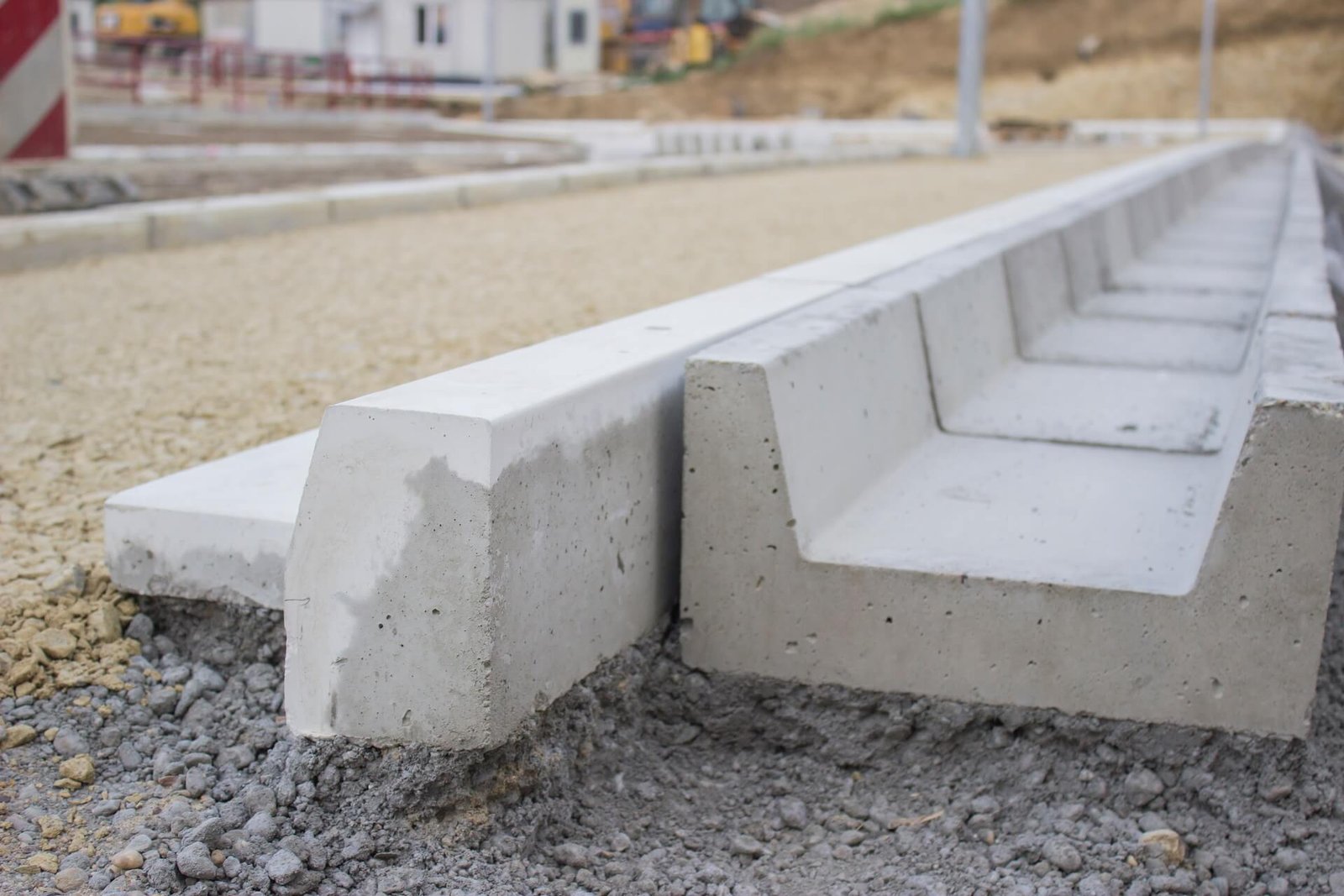
Rain does not come often in Odessa, but when it does, it comes hard, and the ground is too dry and compacted to soak it up. A gutter line even a quarter inch high will keep water standing for days. A curb that was poured without a firm base will lean or crack under the first loaded truck that clips it. That is why curb and gutter work gets measured with a level and a string line, not with a tape and an eyeball.
Curb and gutter is the edge of paving. It sets the boundary between a lot and a landscape bed, channels water to an inlet or a drive, and protects asphalt and concrete from the vehicles that run along them. In commercial work it appears around parking lots, entry drives, truck courts, medical campuses and subdivisions. In public work it lines streets, alleys and drainage swales.
Concrete Contractors of Odessa forms and places curb and gutter by hand and by slipform machine, depending on length and detail. We coordinate trade partners for grading, utility crossings and subgrade preparation, and concrete trade partners set the line, pour the concrete and finish it.
Where curb work is needed
West Odessa is bounded by Interstate 20 on the south, State Highway 302 on the north, FM 866 on the west and the city of Odessa on the east. As the area grows, lots along those roads gain driveways, parking and drainage, and each needs a curb line that ties to the public street. West Odessa and the areas along the US 385 and SH 302 corridor have this kind of growth.
We mobilize crews to those communities and to Gardendale, Andrews, Monahans and Kermit, and we confirm the haul distance from the batch plant before accepting a pour schedule. Long runs of curb need steady deliveries, because a gap in trucks means a cold joint in the gutter.
Timing a curb run
Curb is poured after the subgrade and base are accepted and before the final paving. That puts it in the middle of the schedule, between earthwork and surfacing. We confirm base readiness, set the line from survey stakes, and release the pour only when the inspector approves the forms or the string line.
Machine runs go fast. A slipform crew can place a long length in a day, but the layout, the base trim and the finishing behind the machine all need staffing. Hand-formed work is slower and used where the curb curves, steps or meets structures. Hot weather speeds up the set, so we pour curb early and apply curing compound right behind the finishers.
Details that decide whether a curb works
Where does the water go? That question comes before any form is set. A gutter needs a minimum slope, usually specified on the plans, and it has to line up with inlets, drive aprons and grade breaks. We shoot elevations at every critical point and flag conflicts before we pour. A flat spot in a gutter is a permanent puddle.
Other details include curb ramps at crossings, drive cuts, sleeves for irrigation and electric lines, expansion joints at structures and dowels or ties where curb meets slab. Mountable curbs, barrier curbs and roll curbs each serve a different purpose. We confirm which type is wanted for each run, since mixing them up is an expensive mistake.
What curb costs
Price follows length, profile and complexity. A long, straight run of standard barrier curb with a machine is the least expensive per foot. Short runs with many curves, returns and ramps are more expensive because they require hand forming. Reinforcement and dowels add steel and labor.
Base preparation and the condition of the grade are the large unknowns. If the base is wet, soft or off grade, the curb crew will wait for it or the concrete will pay for it later. We ask for the base acceptance in writing and price the curb as if the base is right. If it is not, we write a change order before we go forward.
Curb with drainage and paving
Curb rarely stands alone. It leads water to inlets and trench drains, and it protects pavement edges. Our storm drain installation trade partners place the inlets and pipe, and we form the curb to meet them. Where surface water has to cross a drive, trench drains and concrete drainage can carry it under the traffic lane.
Concrete curb is paired with parking lot paving as well. A lot that uses concrete for parking can have a monolithic curb cast with the slab, which is faster and avoids a cold joint. In asphalt lots, curb is poured first and the pavement is placed against it.
Water supply and the case for tidy drainage
Odessa draws water from lakes on the Colorado River through the Colorado River Municipal Water District, with wells in Ward and Ector counties adding to the supply. In a place where water is that valuable, uncontrolled runoff and ponding at curbs look like waste. Owners and cities want gutters that deliver stormwater to the right place, and they want landscaping to take advantage of it where possible.
The city is also developing quickly, with homebuilders and multifamily developers adding subdivisions and apartments along the main corridors. Each new street needs curb, and each new lot needs a driveway apron that connects to it. That volume of work favors contractors who can pour many short runs without losing quality.
Working beside traffic
Curb work often takes place next to live traffic, either in a street or in a parking lot with customers. We set traffic control according to the plan, use barricades and cones, and assign a flagger when lanes are reduced. The concrete partner wears high-visibility gear and keeps trucks and equipment inside the work zone.
Slipform machines and mixer trucks need turning room, and we plan their route so they do not back across a pedestrian path. Fresh curb is protected with barricades and warning tape until it has gained enough strength. Vandals, cyclists and dogs all find wet concrete, and we guard against them.
Send the paving plan and the curb profile
Mark the curb types on the site plan, include the base details and tell us the order of work. A crew lead will check the lines, note the inlets and give you a unit price per foot with the extras listed.
Common Questions
How does curb and gutter differ from a plain curb?
Curb and gutter is cast as one section, with a vertical or sloped face and a flat pan that carries water. Plain curb is only the raised edge. Gutter pans help move runoff, so they are common along streets and drainage paths.
Do you use a machine or hand forms?
Both. Machine placement is efficient for long straight or gently curved runs. Hand forms are better at corners, short runs and transitions. We pick the method by the layout and the budget.
Can you tie new curb to an existing street?
Yes. We saw cut the old pavement, drill and set dowels as required, and match elevations at the joint. Public streets usually need a permit and traffic control, which we coordinate with the city.
How long before curb can take vehicle traffic?
Foot traffic can return the next day. Light vehicles usually wait several days, and heavy trucks wait until the concrete reaches the strength required. We tell you the earliest safe time when we schedule the pour.
What causes curb to crack or lean?
A soft base, poor compaction behind the curb, trucks climbing over it and missing joints. We set the base, trim it, and place joints at regular intervals so the curb cracks where we planned.