
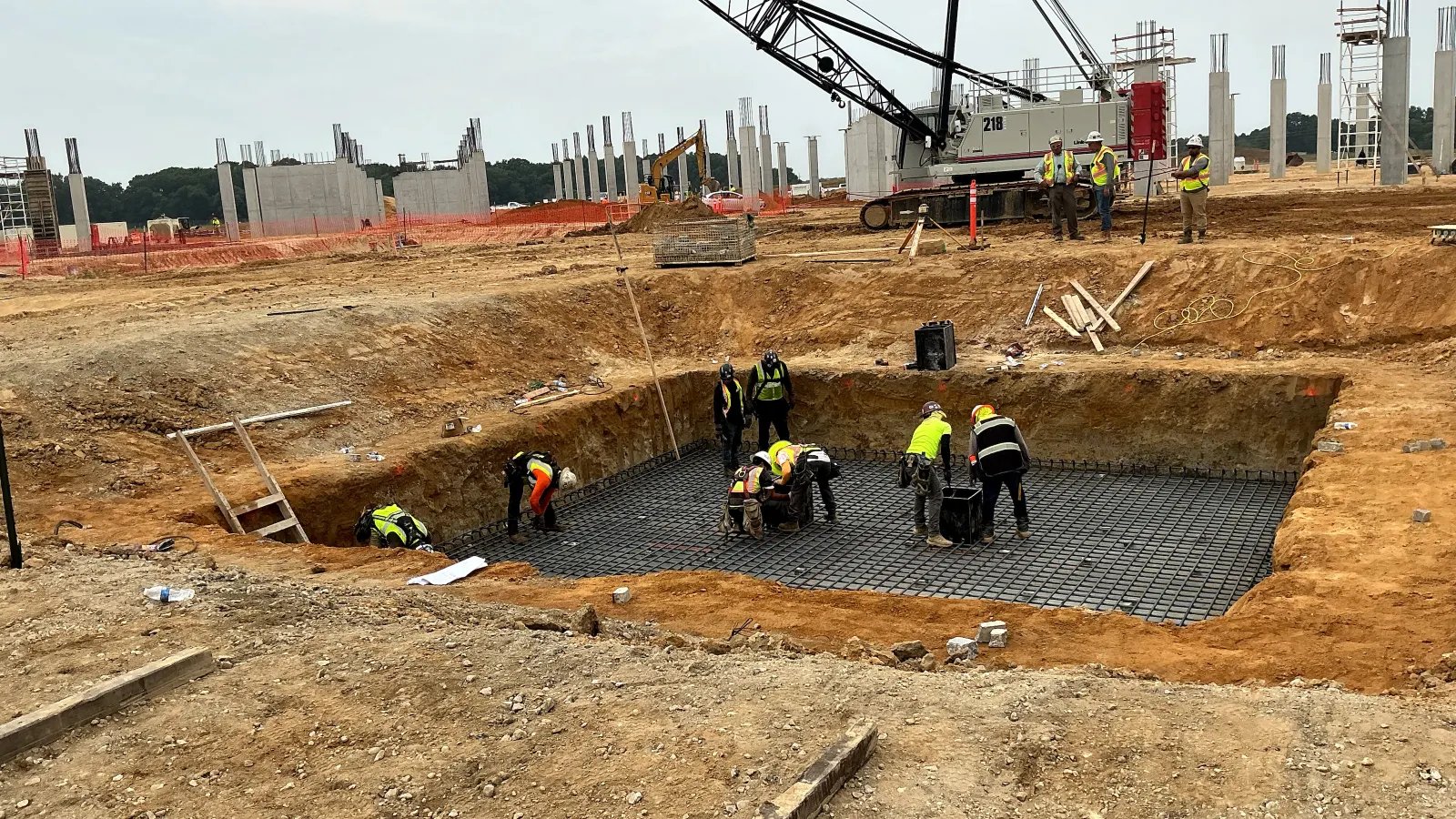
A general contractor who bids a job in the Basin wants a concrete sub who picks up the phone, arrives on the date and does not make the superintendent explain the weather twice. That is the job we aim at. We place foundations, slabs and flatwork for general contractors and construction managers, and we coordinate the trade partners who set the grade and the utilities before the forms go in.
The calls we get fall into two kinds. Some come in at bid time, when the GC needs a number for the concrete package and a straight answer on what the drawings leave out. Others come after award, when the schedule is tight, a second pour has been added and someone has to be on site Monday. We try to be useful in both situations, and we put estimating time into the first so the second is less common.
Our work leans toward industrial and public sites around Odessa, and it carries the plain commercial buildings that surround them. A GC who needs a yard slab one month and a clinic floor the next does not have to find a new subcontractor for each. The pages on industrial and manufacturing owners and commercial developers show the owners we most often build beside.
Where we mobilize crews for general contractors
Odessa is the Ector County seat, and its road network sets how trucks reach a site. Interstate 20 runs along the south side, US 385 comes through as Andrews Highway and Grant Avenue, 42nd Street carries SH 191, and Loop 338 circles the city. A GC planning a delivery route for concrete trucks, rebar and form material should check which of those roads the site touches, because haul time between the plant and the pour is the first thing that goes wrong on a hot day.
From Odessa we mobilize crews to the surrounding Basin towns. That includes West Odessa, Gardendale, Monahans, Kermit and Crane, and the longer runs out to McCamey. Kermit is served by State highways 18, 302, 703 and 115, which is useful to know when a site sits between towns and the access road has to be sorted before the first truck rolls. For work along the interstate we use the I-20 and Loop 338 corridor page as the quick reference on how trucks reach those sites.
Site safety that fits a GC safety plan
General contractors carry the site safety plan, and we work inside it. We submit our own job hazard analysis for the concrete work, attend the morning briefing and follow the badge, orientation and traffic rules the GC sets. Drivers of ready-mix trucks get the same orientation we do, because they are the people moving the heaviest equipment through the site.
Basin roads carry a lot of heavy vehicles. TxDOT reports that heavy vehicles make up about 22 percent of the traffic on SH 302, and that traffic between US 285 and SH 115 roughly doubled from 2015 to 2019. When a GC picks a staging area near one of those roads, we ask where the trucks will queue and how a mixer enters and leaves without blocking a through lane. Hot-weather work gets water and shade breaks written into the plan, and silica controls go in for any sawing, coring or grinding. On long hauls, we confirm that the batch ticket time and the pour time leave room for a safe, unhurried placement.
What we place, what we coordinate
Concrete trade partners place and finish concrete: forms, reinforcement, pour, finish and cure for foundations, slabs, aprons and flatwork. That is the work a GC hires us to own, and we sequence it ourselves. We schedule the pump, the finishers, the testing technician and the saw crew so no one waits on another.
Utilities and earthwork run on another track. Trade partners we coordinate do that work, which means we set the order, confirm the grade and base are ready, and keep the superintendent informed of the dates. A GC does not have to choose between a concrete sub who ignores the dirt work and a package that hides it. Our commercial concrete contractor work and our building pad preparation coordination give the GC one point of contact for the pour and the ground it sits on. When a trade partner is behind, we say so the same day and offer a recovery plan.
Buildings we pour for general contractors
The buildings that come through a GC in Odessa are mixed. Shops and warehouses for service companies, offices and clinics, school additions, self-storage, small retail and the occasional large equipment building all show up in a bid year. We pour warehouses, manufacturing plants, medical offices and self-storage facilities, along with the paving and flatwork around them.
Each type has its own concrete problem. A warehouse floor lives or dies on joint layout and flatness. A plant floor needs the right reinforcement and a surface that stands up to wheels and chemicals. A medical office needs a level slab for tile and accessible routes with no surprises. Self-storage has long, repetitive slabs that reward a tight pour sequence. We tell the GC which problem is the real one on a given building and put our attention there rather than treating every job as a generic slab.
Concrete packages we price for a bid
A concrete bid for a GC usually has several lines: foundations and footings, curb and gutter, exterior flatwork, slab on grade, paving, equipment pads and the items that get added late, such as bollards and dock pits. We price each line against the drawings and list what we assumed. Soil conditions matter here. Upton County, for example, has sandy loam with exposed limestone, and caliche and limestone are the local mineral resources, so a base course often comes from nearby material and a drilled pier or footing may meet hard rock earlier than the geotech expects.
Our estimators read the geotechnical report before they set unit prices, then note the places where rock, caliche or loose sand could change quantities. We will not hide an allowance. When the drawings call for concrete foundations on questionable soil, we ask for the engineer's direction in writing before the footing goes in. The same applies to rebar placement where a revised detail has not made it to the field set.
Send the bid set for the concrete package
Send the drawings and the bid date and we will walk the concrete scope with your estimator. We will mark where soil, access or sequence could change the number and tell you what we can hold firm. Contact Concrete Contractors of Odessa to start the takeoff.
Common Questions
How do you handle a concrete bid when the geotech report is thin?
We price from what is known and list the assumptions that could move the number. In caliche and limestone country the thin spots are usually rock depth, bearing at the footing and the thickness of the base. We ask the GC to carry an allowance or an alternate for those items, so a surprise does not become a fight.
Can you mobilize quickly for an add-on pour?
Often yes, because concrete trade partners move between jobs in the same part of the Basin. Tell us the quantity, the access and the date, and we confirm the form material, the pump and the mix before committing. We would rather give a firm date a day later than a loose one now.
Who is our contact once the concrete package is awarded?
A project lead for your site handles the schedule, the submittals and the field questions. Our superintendent on site speaks for the crews. You do not have to chase separate people for forming, placing and testing.
How do you coordinate with the dirt and utility subs?
We confirm the grade, compaction record and utility inspections before forms go in, and we ask the superintendent to hold a short pre-pour meeting on larger placements. When the base is not ready, the trucks get moved to another day instead of pouring over a doubtful surface.
What if the schedule slips after our pour date is booked?
Let us know as soon as you do. We can hold the crew, move to a nearby job and come back, or split the pour into smaller placements. Moving a ready-mix order is easier with notice, and early notice helps the plant plan around the heat.