
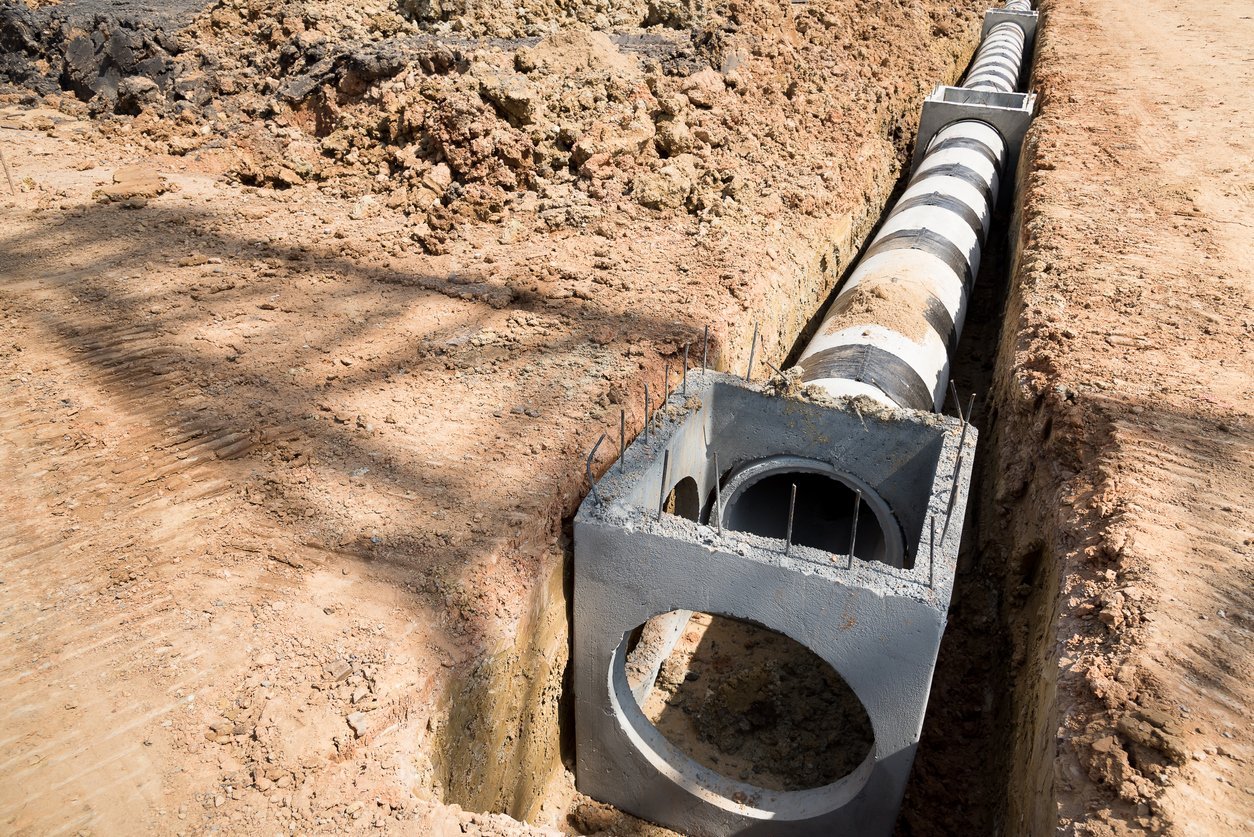
It rains rarely in Odessa, and that is the trouble. A yard can sit dry for months, then take an inch in an hour with nowhere for it to go. Water finds the low corner of the apron, backs up under the dock doors and soaks a caliche base that was fine when dry. Storm drain installation is the work that gives that water a path before the first big storm shows up.
We coordinate storm drain packages for service yards, commercial lots, plant sites and public projects: curb inlets, grate inlets, junction boxes, pipe runs and the outfall or detention basin at the end. Utility partners excavate and lay pipe. Concrete trade partners build the inlets, aprons, headwalls and flumes, and pave the surface so the slope that was drawn is the slope the water sees.
What changes a storm drain budget
Pipe size and depth are the headline numbers, and large reinforced concrete pipe costs far more per foot than small diameter plastic. But the grade is what makes budgets grow. In flat country, getting the pipe to an outfall at the right elevation may require a long run, a deeper trench or a detention basin sized to hold the flow.
Inlet count and type matter as well. A big yard with grate inlets spaced for sheet flow carries more structure cost than a curbed street. Cast-in-place boxes cost more than precast but fit odd angles and bring us in as the pouring crew. Traffic loading affects the lid and frame selection. We price rock excavation and dewatering as allowances so the owner is not surprised, and we list the items that depend on the final geotechnical report.
Drainage first, paving last
The drain system must be in before final grading and paving, because the grade of every inlet sets the finished elevation of the slab around it. We schedule pipe and inlets right after the utilities that sit deeper, then backfill, then fine grade and base. Precast structures can be set quickly, but cast-in-place work needs form time and curing before the surrounding backfill goes in.
A planned wet-weather response keeps the project safe. Silt fences and inlet protection go in as each structure is set, and we check them after every rain. A trench that stays open over a weekend in the monsoon months is a risk, so we close each run before we leave, even if it means working a long day. Paving crews can then follow without waiting on repairs.
The concrete in a storm system
Excavation, pipe placement and compaction belong to partners we coordinate. Concrete trade partners do the concrete: inlet boxes and tops, throat and curb-opening transitions, headwalls, wing walls on culvert ends, flumes, aprons and the swale lining that carries water to a basin. We also pour the trench drains inside buildings and across truck lanes.
Details at the edges decide how long a drain system lasts. An inlet that settles below the pavement collects water at a sag and creates a bump for every truck. A pipe that enters a box without a grouted collar leaks soil in over time. We check each structure for elevation, alignment and joint condition before it is backfilled. The page on trench drains and concrete drainage explains the surface side of the same system.
Drainage by building type
A warehouse or distribution center has a large roof and a large apron, and the combined runoff needs a pipe system that can accept it at the dock doors, the truck court and the car park at once. A truck terminal adds fuel spill and wash water concerns, which may require oil-water separation before the outfall.
Offices and schools generate less runoff per acre of pavement but face stricter accessibility and visibility requirements around inlets. Public roads use standard inlets and trunk lines set by TxDOT or the city. Each type has a different mix of structures, pipe and surface, so we begin by asking who owns the drainage downstream and what they will accept.
Where we mobilize for storm work
We build storm drainage in Odessa and across Ector County, and send crews to Midland, Monahans, Andrews, Kermit and Crane. West Odessa is a typical case. Interstate 20 forms its southern edge, State Highway 302 its northern one, FM 866 runs along the west and Odessa lies to the east, with interchanges at exits 104, 108, 112 and 113. Its land is flat enough that drainage design is a matter of inches.
For sites near West Odessa, we plan trucks and pipe deliveries around those exits and avoid the busiest hours on the interstate. A Midland project connects through Interstate 20 and Business I-20, and the same routes serve the drainage trade partners we coordinate when they head from one to the other.
Ground that moves
Drainage in the Permian Basin has a hazard most regions do not. On June 3, 1980 the Wink Sink opened, and inside a day it was 360 feet wide and 110 feet deep, the result of salt dissolving in the Permian Salado Formation. Water that gets into soluble ground can open a void, and owners with a site in the western Basin take that seriously.
We do not engineer sinkholes. But we do avoid concentrating discharge near areas the geotechnical engineer has flagged, and we make sure outfalls spread flow instead of cutting a channel. The same principle holds on ordinary Odessa sites: a leaking storm pipe in sandy soil can wash out the bedding and drop a slab. We test joints, grout around entries and point out any concern before the pavement covers it. Municipal and public works buyers often add their own drainage review for these reasons.
The pieces of a storm package
A complete storm package includes the pipe network, the inlets and junctions, the outfall structure, any detention or retention basin and the pavement or grading that directs flow into the system. It also includes erosion control during construction and a stabilized outfall after.
We review the drainage plan against the site grading sheet and flag spots where the two do not match. A sag with no inlet, an inlet on the wrong side of a crown or a pipe that crosses a footing are common clashes. Resolving them in the shop drawing stage costs a few phone calls. Resolving them in the field costs a weekend and a change order.
Connected drainage work
Storm pipe ends somewhere. Often that is a basin, and the detention and retention ponds page describes the excavation and the concrete outlet structures. Where a pipe passes under a road or drive, culverts and headwalls explains the structures at the ends. Underground lines share the corridor with sewer and water, which we cover under site utilities.
On a larger development, drainage ties into land development infrastructure, where the layout of roads, lots and ponds is decided together.
Send the drainage sheets
Provide the storm drain plan, the grading sheets and the soils report. Our reply will mark the structures that need concrete, point out grade conflicts and suggest a sequence that keeps pavement from waiting on pipe.
Common Questions
How big should the pipe be?
The pipe diameter comes from the civil engineer's design-storm calculation and drainage-area assessment. We install the specified system and flag conflicts, including utilities found in a different position, before proceeding.
Can a storm system be added to an existing yard?
Yes, but it involves saw cutting and removing pavement along the pipe route, then patching. We plan the work in sections so the yard keeps operating, and we match the slab thickness and joints when we repave.
Do inlets need to be concrete?
Many are precast, and some are poured in place, especially where the shape is unusual or the loads are high. The engineer chooses, and we build either type.
What about erosion at the outfall?
We pour or place stabilization at every outfall, such as an apron, rock or a flume, so the first storm does not scour a gully. Owners should check these after major rain events.
How do you protect the work during construction?
Inlet protection, silt fence and sediment traps go in as each structure is set. We inspect after rain and clean out before the system is accepted.