
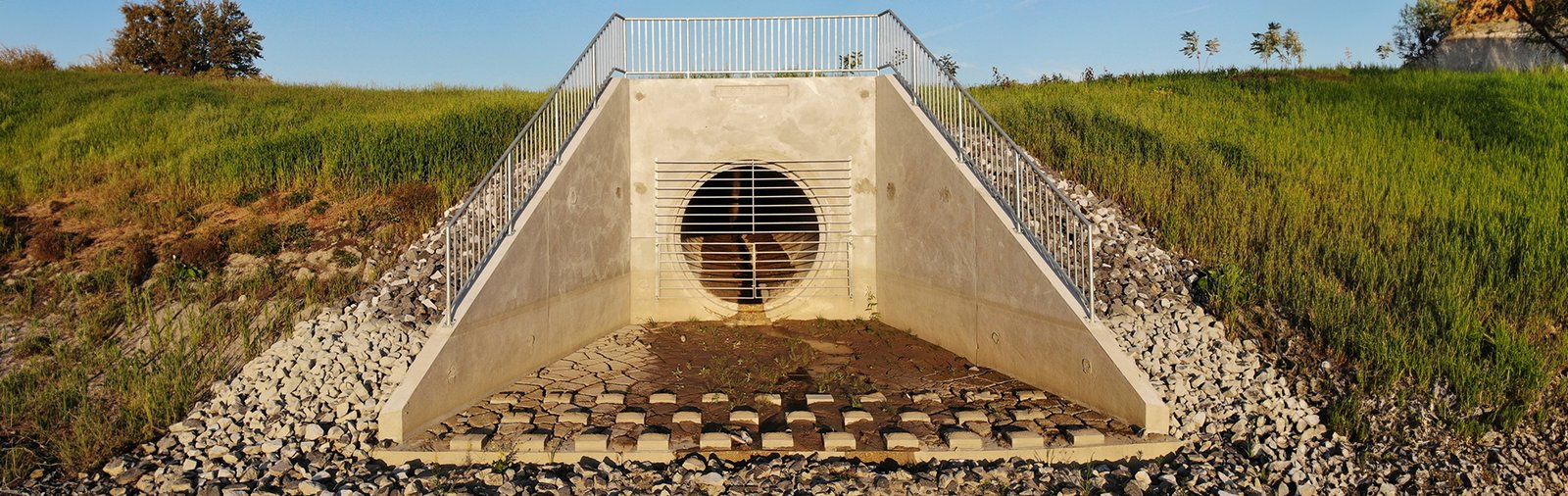
Where a road crosses a ditch, the road wins and the water goes through. A culvert is the pipe or box that lets it. At the ends, a headwall holds the embankment, directs flow and keeps the pipe from being undermined. Most of the culverts we build are on commercial drives, yard entrances, access roads and public streets, and they get used by every loaded truck in the neighborhood.
We coordinate culvert and headwall installation for owners, general contractors and public agencies. Excavation and pipe-setting partners work to the profile. Concrete trade partners form and pour the box sections, headwalls, wing walls, aprons and channel linings. We build them to the drainage plan and to the weight that will drive over them.
Where crossings come up in the Basin
Crossings come up wherever a road meets a drainage path, and the Basin has plenty. We take culvert work in Odessa and mobilize to Andrews, which is served by US Route 385 and State Highways 115 and 176, and to Monahans, Crane, Kermit and McCamey. TxDOT identifies a 3.7-mile stretch of southwest Loop 338 between West I-20 and South US 385. We check the drainage design and the property entrance before establishing a culvert placement sequence along that road network. Each of those corridors crosses drainage paths that need pipes or boxes.
Local streets in Odessa and rural roads outside Andrews show the range. Within city limits, culverts sit under driveways and alleys. Outside, they sit under lease roads and farm roads that carry heavy equipment. We check the load rating for each case.
Drainage that runs through the crossing
A culvert is one piece of a drainage chain. Storm drain installation collects water from inlets and delivers it to the culvert or channel. Detention and retention ponds hold it before or after the crossing, and dewatering keeps the trench dry while we set the pipe.
The culvert also meets the road. When the road surface is concrete, we form the slab over the culvert to match the pavement thickness. For concrete paving on yard drives, the culvert crossing is often the thickest and best-reinforced section, and the first place cracks show if the base is not firm.
What concrete trade partners build
Concrete trade partners form and place cast-in-place box culverts and the concrete parts of pipe culverts: collars, headwalls, wing walls, toe walls, aprons and flumes. We set reinforcing to the drawings and form to the dimensions, then pour and finish the concrete. When precast boxes are used, we prepare the bedding slab, coordinate the crane and seal the joints.
The pipe, bedding and backfill work is performed by earthwork and utility partners we coordinate. We hold a short meeting with them before the setting day so the order is clear. The pipe goes first, then our headwall forms, then backfill in lifts on both sides at the same time so the structure is not pushed out of line.
Culverts at the buildings and campuses that need them
A truck terminal has multiple drive entrances and often a ditch along the frontage, so culverts under each drive are routine. Logistics and warehouse developers see this often. Warehouses, plants and campuses have similar needs. Education and school projects often add culverts under bus loops and parking access drives, where the loading is heavy but the schedule is firm around a school year.
The University of Texas Permian Basin has a 644 acre main campus in Odessa, with the Mesa Building, the Science and Technology Building and the J. Conrad Dunagan Library/Lecture Center among its main-campus buildings. Campuses of that size have internal roads and drainage paths of their own, and culverts and headwalls are small pieces of the larger grounds system. The petrochemical complex, which started up in 1957 and 1958 as an integrated synthetic rubber plant, represents the industrial side, where culverts carry process-area runoff under plant roads.
Building the crossing
The work starts with the profile. The invert elevations at each end must match the channel, and the pipe must have enough cover for the traffic. We stake the alignment, excavate to bedding grade and place bedding material. The pipe or box is set, joined and checked for line and grade. Headwalls are formed at each end, with the wing walls splayed to match the channel.
After the concrete reaches strength, backfill goes in on both sides in lifts, and the road base and pavement follow. We then pour an apron and toe wall at the outfall, and rock or paving armor for the channel to prevent scour. A final check shows flow depth at the invert and confirms that water leaves the pipe without ponding.
Sand, caliche and weak ground
Soils in the Basin vary widely. Winkler County has a diagonal belt of active windblown sand dunes rising 30 to 40 feet above the surrounding surface, and rainwater collects in playas. A culvert there may sit in loose sand that migrates, and a headwall can be undermined if the apron is too short.
The McCamey area teaches a different lesson. A million-barrel earthen oil tank that crews tried to build there in 1928 and 1929 could not be completed, because the limestone beneath it would not carry the crude. It is a vivid reminder to confirm bearing before loading a structure. We rely on the geotechnical report for the allowable bearing and check the bottom of the excavation for soft spots or voids. If we find any, the engineer decides whether to dig out the soft zone and rebuild it with compacted fill or select base, and we resume only after the correction is accepted.
Fitting crossings into the road schedule
A crossing interrupts traffic. On a lease road or a yard entrance, we usually build half at a time or build a temporary detour. On a public street, the city sets the closure window and the traffic control plan. We stage precast boxes, forms and rebar before the closure starts so the open time is short.
Concrete needs time to cure, and the road cannot carry traffic until it does. We can use higher early-strength mixes to bring that time down when the owner needs the road back. Rain is rare, but when it comes, runoff may fill the crossing quickly, so we watch the forecast and avoid leaving a pipe open in the channel. A clear sequence avoids having to redo work.
Show us the crossing
Send the plan and profile sheet or a photo of the crossing with the road width and expected loads. We will check cover and apron length, estimate the concrete and sketch a closure plan that suits your traffic.
Common Questions
How do you size a culvert?
Sizing is the civil engineer’s decision, using the required flow capacity and permitted headwater level. We install the size shown. If field conditions suggest the design needs a change, we raise it right away.
Do all culverts need headwalls?
Not all, but most benefit from them. A headwall protects the pipe end and the embankment. Some owners use flared end sections for small pipes, and the engineer chooses.
How much cover does a culvert need?
Enough to carry the traffic load above it. The pipe manufacturer and the engineer set the minimum. Loaded trucks need more cover than cars, and shallow cover is a common cause of cracked pipe.
Can culverts be built in dry weather only?
The best time is dry weather, which is most of the year here. When water is present, we use diversion or pumping to keep the work area dry.
Who maintains the culvert afterward?
The owner of the road or drive. We give them the as-built, a note on inspection points and a list of items to watch, such as debris at the inlet and scour at the outlet.