
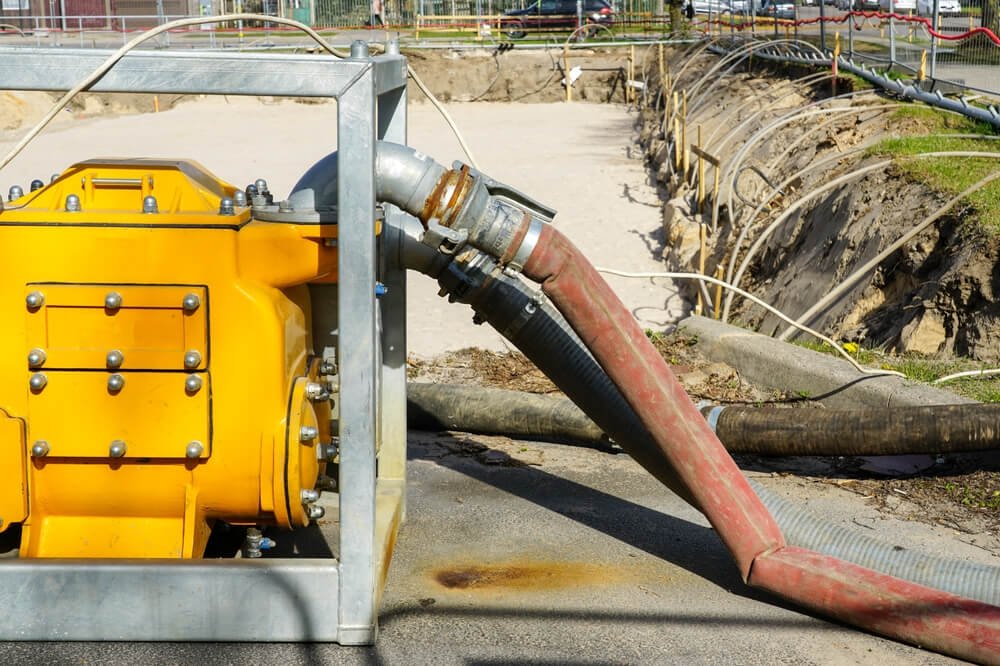
Dry ground covers most of the Basin, and that lulls contractors. Then a trench hits a perched water layer, a storm fills a pit overnight or a leaking line turns the bottom of an excavation to soup. Concrete will not set properly in standing water, pipe will not hold grade in mud and a footing placed on saturated soil settles. Dewatering is the work of keeping the hole dry long enough to build in it.
We coordinate dewatering for utility trenches, vaults, foundations, basins and structures. Specialty partners supply and run the pumps, well points and filters. Concrete trade partners plan around them, form and pour in the dry and keep the discharge where the regulators and neighbors expect it. The aim is a stable subgrade at the time the concrete arrives, with no shortcuts that leave a soft bottom.
What we run and what partners run
Dewatering equipment and operation belong to trade partners with the pumps, the experience and the monitoring. We coordinate them with the excavation schedule, the concrete pours and the inspections. Concrete trade partners handle what surrounds the water: sumps and pits lined with stone, concrete slabs for pump pads, discharge aprons and the pour of the structure once the bottom is dry.
We also manage the daily log. Water level readings, pump hours and discharge points are recorded which shows the engineer and the owner how the system performed. If a pump fails, the trench can flood within hours, so we require spare equipment on site and a named contact who answers at night.
Reading the ground and the water
Water in the Basin comes from several sources. Shallow groundwater occurs in places, especially near draws and playas. Rain collects in low spots, and a pit becomes a basin. Leaks from water and sewer lines supply a third source that nobody plans for. Each calls for a different response, from simple sump pumping to well points set around the excavation.
An elevation of roughly 2,861 feet and hot, arid conditions characterize Kermit. The airport in Winkler County records only 11.71 inches of precipitation in an average year. Even in a place that dry, a utility trench near a leaking line can hit water at any depth. Windblown sand forms a sheet about 70 miles long and 20 miles wide between Crane County and Andrews County, and dunes at Monahans Sandhills State Park reach 70 feet. Sandy soils pass water fast and cave quickly, so a dewatering system there has to control both flow and sloughing, usually with filters on the pumps and shoring in the trench.
Owners who bring dewatering to the table
Utilities and energy companies run deep trenches and vaults where water entry is a constant concern. Oil, gas and midstream operators dig pits and foundations for tanks and equipment. Municipal and public works agencies build lift stations, storm structures and water lines that go below the water table in low areas.
The University of Texas Permian Basin shows what campus work involves. Its Science and Technology Building, opened for the Fall 2011 semester, covers 70,000 square feet and houses 41 labs, and buildings of that kind have deep footings and mechanical spaces below grade. Any such project in Odessa, from a lab to a plant, has to deal with water in the excavation at least once.
Where we mobilize for dewatering
We take dewatering coordination in Odessa and mobilize to West Odessa, Monahans, Kermit, Crane and Andrews. West Odessa, in the center of Ector County, spreads over about 62.7 square miles and falls in Ector County Independent School District. Monahans is 36 miles southwest of Odessa on Interstate 20, in the northeast corner of Ward County.
Water conditions differ from one place to the next. In West Odessa, where growth is pushing new utilities into the ground, trench dewatering is usually a matter of storm water or leaks. In Monahans, windblown sands raise stability concerns. Distance matters for pump rentals and fuel deliveries too, so we plan the equipment and the standby arrangements before the crew leaves town.
A dewatering plan before the dig
Before excavation starts, we ask what the geotechnical report says about groundwater, what the weather forecast is and how long the hole will be open. We choose the method to fit: sumps and trash pumps for surface water, well points for sandy soils with a high water table and deep wells for large excavations. The plan names the pump capacity, the discharge location and the backup.
On the day, we install the system before the final dig, confirm that it holds the water level below the bottom and then excavate. We keep pumping until the concrete has cured enough for the structure to resist uplift, because a basement slab or a deep vault can float if water pressure returns early. Then we remove the equipment in a planned order and restore the discharge area.
Water on the critical path
A dewatering system takes time to set up and time to take down, and its cost is by the day. That pressure helps focus the sequence: stage materials ahead, dig fast, build quickly and backfill, as laid out in our trenching and backfill practice. We set the order so formwork, rebar and concrete are ready when the hole reaches grade, rather than waiting a week while pumps run.
Weather can flip the schedule. A rare heavy rain can fill the pit and require pumping that was not planned. We track the forecast and protect the open excavation with berms around the edge, which divert surface flow. When the schedule allows, we choose the dry months for deep excavations. If pumps must run through a cold night in January, we protect lines against freezing and keep fuel and power supplies topped up.
How dewatering is priced
Dewatering is priced by duration and by system. A few sump pumps for a short trench cost little. A well point system around a large excavation costs a great deal more and has a mobilization and demobilization cost on top. Fuel, monitoring, discharge treatment and standby labor are separate items.
Unknowns drive the risk. Without borings that report groundwater, the quantity cannot be known. We include an allowance in the proposal, state the assumptions and describe how the allowance gets adjusted. An owner with a clear geotechnical report can reduce the allowance. The Santa Rosa Aquifer listing in Kermit dates to July 2017, when EPA named part of the aquifer a Superfund priority. The reported groundwater plume extended about one mile lengthwise and 1.5 miles across. Where an owner or regulator is concerned about groundwater quality, discharge may have to be treated or hauled, and that can change the budget a great deal.
Pumps, power and open water
Pumps and power cords near water create electrical hazards. We use ground-fault protection, keep connections elevated and out of puddles and require qualified people to handle power. Fuel for pump engines is stored in containment and away from the discharge path.
Wet excavations are weaker. Water softens soil, and the walls of a trench can collapse faster than in dry ground. We require shoring or sloping based on the wet condition, not the dry one, and keep people out of the trench when pumps are down. Discharge must go where it will not erode, flood a neighbor or enter a storm drain with sediment. Silt bags, stilling basins and hoses that reach a safe outfall are standard on our jobs.
Tell us the depth and the water
Send the boring logs, the excavation depth and the planned duration. We will recommend a method, line up the pump partner and show where the discharge goes and who signs off on it.
Common Questions
How do I know if a site needs dewatering?
The geotechnical report shows groundwater depth, and utilities can leak. If the excavation will go below the reported water level or if storm risk is significant, plan for it. Adding a line item is cheaper than stopping a job.
Where does the pumped water go?
To a designated outfall that does not erode soil, flood neighbors or carry sediment into a storm drain. Silt bags or settling basins are used. Some sites need a permit, and the engineer tells us which one.
Can I pour concrete in water?
Not as a rule. Concrete placed in standing water loses cement and strength. We dewater first and place in the dry, or use specialized methods only when the engineer approves them.
How long does a system run?
Until the structure is built, cured to strength and backfilled to a safe level. For a small trench that may be a day. For a deep vault it can be weeks.
What does it cost to have a pump on standby?
Often little compared to a flooded excavation. Standby pumps run on call and cost by rental period. We consider the standby pump part of the plan for any deep or long-open hole.