
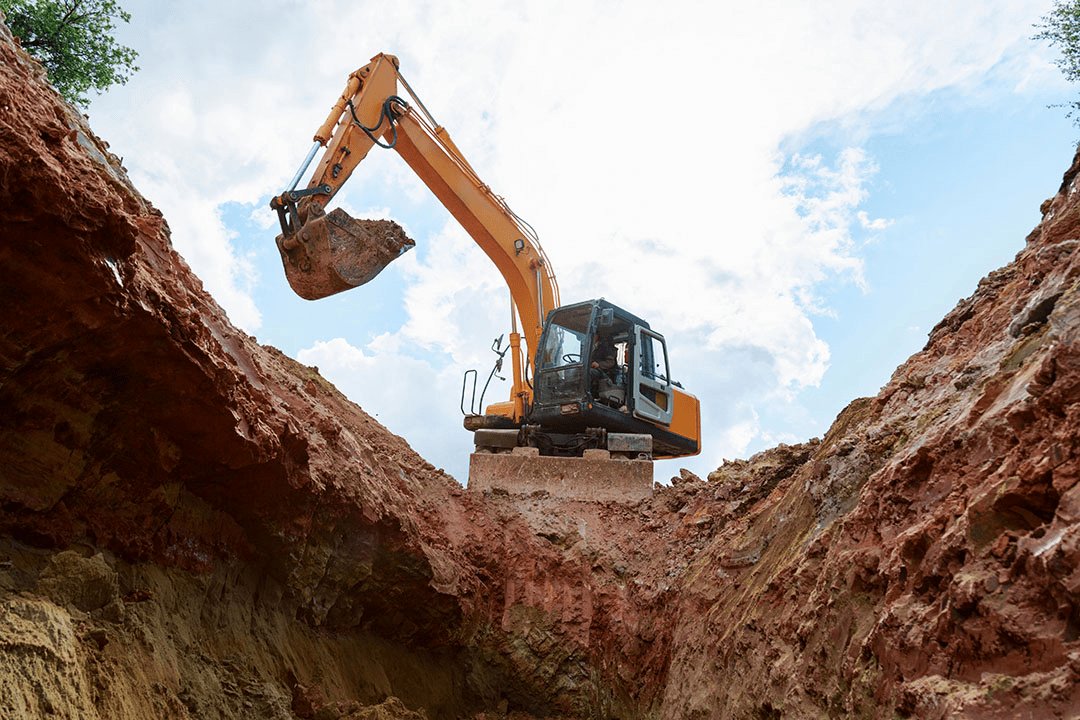
Every excavation starts with a hole that somebody else has already dug a smaller version of. A pipeline may have crossed this strip, a tank battery may have sat on that corner, a water line runs along the fence. Before a bucket touches ground on an Odessa yard, the first job is finding what is already in it.
Excavation is the removal of soil and rock to a planned depth and shape: footing trenches, equipment pits, vault excavations, pad cuts, sumps and utility corridors. The depth is set by the design, the walls are set by the soil and the safety rules, and the spoil has to go somewhere that is planned in advance. Hard caliche, sand that slumps and clay that stands straight until it rains all behave differently, and the machine and the method change with them.
We plan and coordinate excavation for concrete and utility work around Odessa, using trade partners who run the equipment and a field lead who stays on site until the hole is accepted.
Digging safely
The trench and excavation rules decide how a hole is made. At five feet of depth and more, a protective system is required, either sloping, benching or a box, and a competent person looks it over before anyone enters and again after rain or wind. Spoil is kept back from the lip so its weight cannot push the wall in.
Before digging, underground lines are located and marked, and where a line is near the cut it is exposed by hand or by vacuum. We keep an access ladder within reach of every worker in a trench and confirm atmospheric checks where a pit is near a process line.
How we plan a dig
We start with a walk and a set of drawings, then compare the two. We mark the dig limits with paint and stakes, call for utility locates and pick a spoil location that does not block the next trade. The excavation partner gets a sequence, not just a depth, so the cut that serves the first pour is finished first.
During the dig we check depth with a laser or a rod, not an eyeball, and stop when the bottom is reached. If the soil at the bottom is soft, loose or wet, we call the engineer before going deeper, since over-digging a footing costs more to put back than it did to remove.
Services that dig or follow a dig
Many excavations lead directly into other work. A trench opened for pipe becomes trenching and backfill once the line is laid. A cut that exposes poor soil may need over-excavation and recompaction to replace it.
Pits for vaults and sumps tie to manholes, vaults and structures, and footing excavations lead to formwork and a pour. We sequence these so the same hole is not opened twice.
Owners and what they dig for
The oil, gas and midstream side asks for pits, pump pads, containment excavations and trenches for lines between equipment. Their schedules move with rig activity, so the call often comes with a date already attached.
Municipal and public works buyers dig for water and sewer extensions, manholes and drainage structures, with documentation requirements for every foot. Both ask for a field lead who stays on site, because a hole left open overnight is a liability.
Trade responsibilities and handoffs
The excavation itself is done by partners who own the equipment and hold the operators. We coordinate them, manage the locates and the sequence and verify depth and bottom conditions. Acceptance of the hole releases it to the concrete contractor for placement and finishing. We keep that transfer close to the end of excavation so the handoff stays short.
When a job needs a different capability, such as a dewatering system or a rock-breaking attachment, we bring in the specialist rather than stretch a general excavator past its limits.
Ground across the Basin
Odessa and Midland are named as the headquarters cities for activity across a Permian Basin of more than 86,000 square miles, where the Delaware Basin and Midland Basin are split by the uplifted Central Basin Platform. The ground under all of that varies a lot: caliche and limestone on the mesas, sand in the dunes, clay along draws.
The variation shows up in digging conditions across short distances. The June 1994 heat record in Monahans reached 120 degrees F. At roughly 2,621 feet above sea level, the city has annual precipitation averaging 13.54 inches, so a dig in July can be wetted down in the morning and bone dry by noon. A dig at Wink, on State Highway 115 seven miles southwest of Kermit, also means a longer mobilization from Odessa, which we plan into the schedule.
What a dig costs
Excavation is priced on cubic yards, machine class and haul. Soft, sandy soil digs quickly but needs shoring or sloping, which adds width and cost. Caliche and cemented layers slow production and wear teeth. Wet ground adds dewatering. Spoil that must be trucked away costs more than spoil that stays on site.
Unforeseen conditions are the main budget risk, which is why we ask owners to approve unit prices for rock, over-depth and disposal before the dig. A line on the bid for each condition lets the work continue without a pause to negotiate.
Buildings that start with a dig
A manufacturing plant needs excavation for foundations, equipment pits, trench drains and utility corridors, often inside an existing building. A warehouse needs footing and dock pit excavations, and utility trenches to the slab.
Healthcare and education campuses, like the new classroom building at the Texas Tech health sciences campus in Odessa, bring excavations for basements, storm structures and utilities. Whatever the building, the dig is the first physical step and the one most affected by what is found in the ground.
Tell us what is going in the ground
Send the plans, the depth and the date the pit or trench is needed. We will schedule locates, line up the excavation partner and quote the dig with unit prices for rock and over-depth.
Common Questions
Can a trench stay open without shoring?
In stable soil under five feet, a protective system may not be required, but a competent person decides. At five feet or more, a protective system is required. In loose sand or wet clay, we use sloping or a box even in shallower cuts.
What do you do when you hit hard caliche?
We stop and look at how thick the layer is. Thin layers can be ripped with a heavier machine. Thick or cemented layers may need a hydraulic hammer. We tell the owner about the rock price before we start hammering, not afterward.
Who handles utility locates?
We request the locate and verify the marks against the drawings. Where a line is near the cut, we expose it by hand or vacuum before using a machine. Private lines inside a yard are the owner's to identify, so we ask for any as-built drawings.
Where does the spoil go?
Clean spoil can be stockpiled for backfill or hauled to an approved place. Contaminated or unsuitable material is a separate decision with the owner and the engineer. We plan the spoil path before the first bucket.
How long does an open excavation sit?
As short a time as the schedule allows. We try to schedule the dig, the form or pipe work and the backfill in one sequence so the hole is open only while work is under way.