
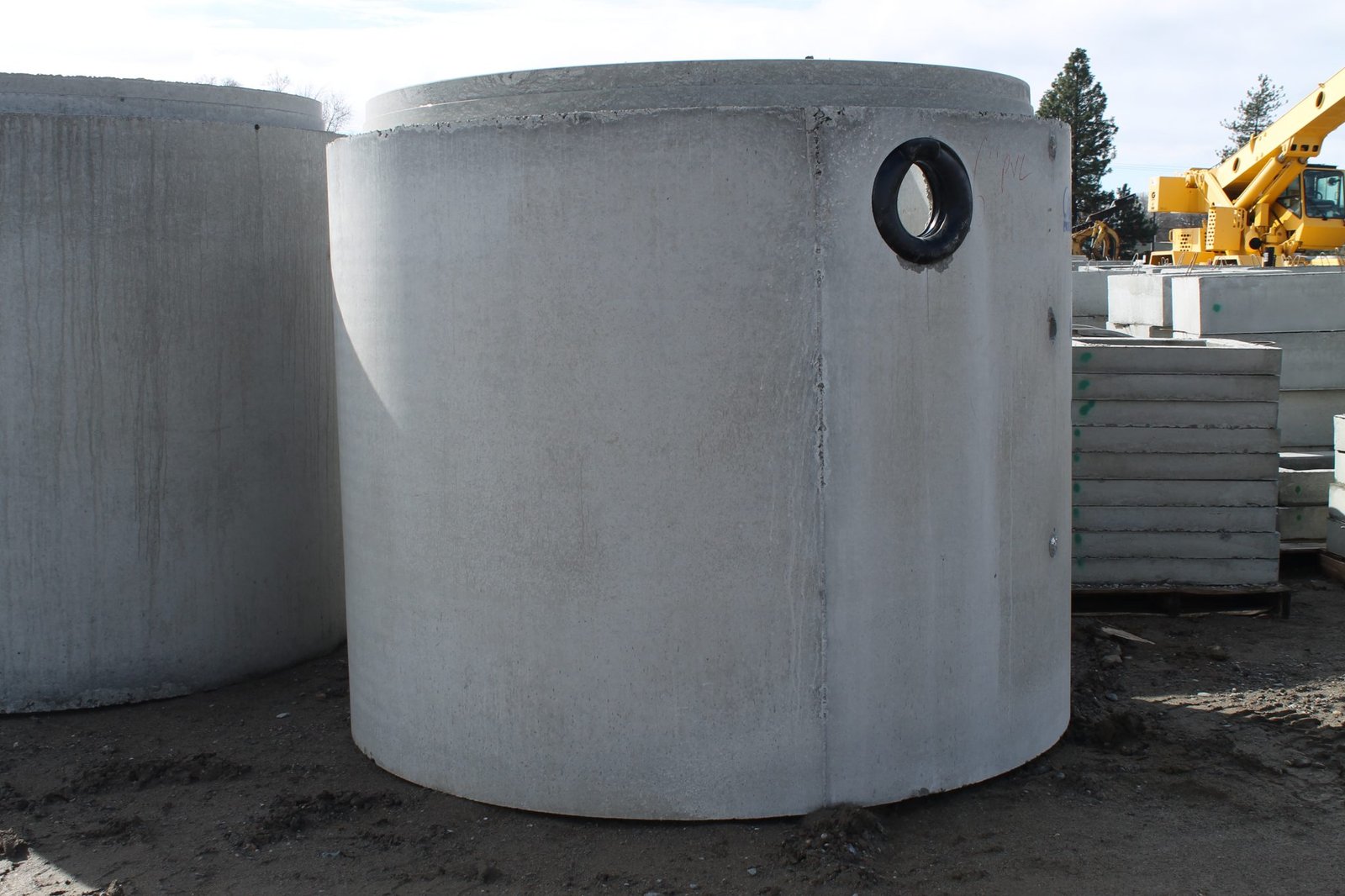
A manhole cover in the middle of a truck lane is a test of everything beneath it. The frame has to sit flush with the pavement, the ring has to survive the turn of a loaded trailer and the barrel has to stay watertight against soil that shifts with every wet and dry season. When it fails, the yard feels it in rattling axles and cracked slab around the cover.
We build and set manholes, utility vaults, junction boxes, valve pits, meter vaults and drainage structures for service yards, plants, commercial lots and public works. Some are precast and set by crane, and others are cast on site where the shape or the load demands it. In both cases concrete trade partners pour the bases, benches, collars and surrounding slab, and we coordinate the pipe partners who connect the lines.
Structures within the larger underground package
Manholes and vaults are the access points of other systems. Sanitary sewer installation needs manholes at every change in direction, grade or pipe size. Storm drain installation depends on inlets and junction boxes at the edges of pavement. Electrical duct banks use pull boxes and vaults to make cable pulls possible.
Fire and water lines have their own boxes: valve pits, meter vaults and backflow enclosures. Each of those has a floor, walls and a lid, often with a drain or sump. We coordinate the structure schedule across all those trades, because setting a manhole at the wrong elevation forces the pipe crew to rework or the paving crew to adjust. The structure elevation is fixed by the lines, and the pavement elevation is fixed by the drainage plan, so we check both before setting a box.
A Basin where structures carry heavy loads
The Permian Basin spreads across more than 86,000 square miles, with the Delaware and Midland sub-basins divided by the raised Central Basin Platform. Odessa and Midland serve as headquarters cities for the activity. Everything from sand haulers to water trucks to heavy-haul rigs moves through the region, and that traffic reaches the structures in our slabs.
Industrial investment shows up in the shops and yards that need them. An energy services company opened a new Odessa facility in May 2026 that puts over 1,400 employees in one building, along with room to test equipment for a power generation line that is growing. A facility like that carries utility vaults, drainage structures and test areas, all of which sit in or beside pavement that loaded vehicles use daily. Other large owners, including those behind government and municipal buildings, such as the school district and the hospital system, build on the same principle: the structure has to stay level with the finished surface. Industrial and manufacturing owners set the standard, and we meet it.
Poured and set by concrete trade partners
We form and pour cast-in-place bases, walls and tops for vaults and larger structures. For precast manholes, we prepare the base slab, level it, set the sections with the crane, seal the joints and grout around pipe entries. Concrete trade partners also pour the collars and reinforced rings around frames in pavement, and the benches and inverts inside the manhole.
Pipe partners cut the openings and connect the lines, and an earthwork partner excavates and backfills. We coordinate who is where each day, because a manhole pour cannot happen with a trench box in the way. When a structure is large, a pump or a crane is required, and we link the schedule with concrete pumping and placement to reach the form. Reinforcing, form ties, waterstops and embeds are placed to the shop drawings, and we inspect them before the pour.
Curing needs attention in dry wind. A vault wall poured on a July afternoon loses moisture quickly through the exposed face, so we strip forms on the schedule the specification allows, apply curing compound right away and keep blankets over the top slab. Cold January mornings call for the opposite care, with covers to hold heat until the concrete gains strength. Backfill waits for the engineer's strength target, and we place it evenly on all sides so the walls are not pushed in one direction.
Confined spaces and deep excavations
A manhole is a confined space once it is complete, and a deep excavation before that. We use trench boxes or shoring for any excavation that requires protection, and we keep ladders and egress within reach. Before anyone enters a structure we check the air, ventilate and keep a person at the opening. Gas can collect in a below-grade box in an oilfield town, so the monitor goes in first.
Heavy precast sections create their own risks. Rigging has to be matched to the weight, and the crane is set on ground that can take the load. We keep people out of the swing radius, and we check the lift points and hardware before every pick. Wind affects precast picks in the Basin, and we stop when gusts exceed the limits of the rigging or the crane. Open structures are covered or fenced at day's end.
Specifications for structures
Structure specifications cover concrete strength, reinforcing, joint sealing, lids and frames, and load rating. A cover in a truck lane needs a heavy-duty rating, and a cover in a sidewalk does not. The engineer also specifies watertightness tests, which for manholes are usually vacuum or water exfiltration tests.
Monahans offers a reminder of the range of conditions: it sits near 2,621 feet, takes about 13.54 inches of precipitation in a typical year and logged a 120 degree high in June 1994. Concrete placed in that heat needs hot-weather measures, and the joint sealant needs to tolerate wide temperature swings. We submit product data for precast units and frames, shop drawings for cast-in-place boxes and mix designs for the concrete, and we keep a record of each structure's rim and invert elevations for the as-built. The local permit office or utility inspector verifies the finished structure before backfill is completed.
Send the structure schedule
Provide the structure schedule, inverts and the paving grades. We will line up the precast order or the forms, set the pour dates and confirm every rim elevation before the pavement crew starts.
Common Questions
Should a structure be precast or poured in place?
Precast is quick and consistent for standard manholes. Poured in place suits odd shapes, large vaults, special loads and tight sites where a crane cannot reach. We build either and advise on the trade-offs during bidding.
How do you keep covers level with the pavement?
The frame elevation is set from the finished grade, then a reinforced collar is poured around it. We check it against the paving grade before concrete is placed so that the cover sits flush rather than high or low.
Do manholes need to be tested?
Usually yes. Vacuum tests, water tests or both, depending on the specification. We schedule the test before backfill is complete so that a leak can be fixed while it is reachable.
What loads should a cover be rated for?
The engineer sets it based on traffic. Truck lanes call for heavy-duty ratings. We confirm the rating on the submittal and keep the data sheet for the owner.
Can you add a structure to an existing line?
Yes, though it takes planning. We cut into the line, build the structure around it and restore the surrounding slab, usually in a short shutdown window.