
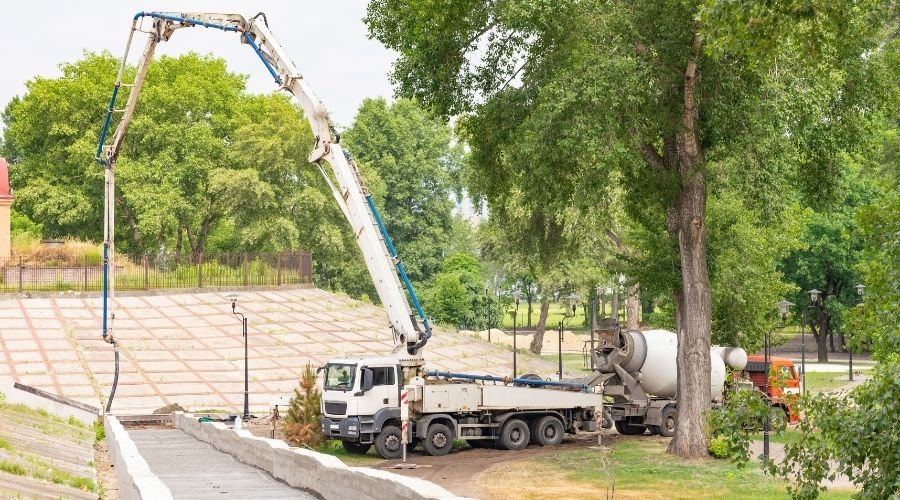
A pump truck solves one problem: the ready-mix truck cannot get where the concrete has to go. On a service yard that problem shows up as a fenced lay-down area with a shop already standing at one end, a containment pad boxed in by tanks, or a footing line behind a building the chute cannot reach. We bring the pump, the placing crew and the finishers to the pour so the concrete moves off the mixer and into the form with no buggy relay and no cold joint.
Placement is also where a Basin pour is won or lost. West Texas wind pulls moisture off a fresh slab faster than the finishers can close it, and sand blows into the surface of anything left open. We plan the pump set-up, the truck sequence and the finishing crew count together, so each placed yard of concrete is struck off, floated and covered in the order the weather allows.
This page describes how we handle pumping and placement for general contractors, yard owners and public works buyers who need concrete delivered into tight or elevated spots and finished to a surface that holds up under loaded trucks.
What the drawings and the permit office expect from a pour
The structural drawings set the mix, the slump range at the point of placement and the required cure. A pumped mix is not the same as a chute mix. It needs enough paste to travel through the line without segregating, and the batch plant has to know a pump will be on the job before it designs the load. We confirm the mix with the supplier against the project specification, and the testing agency samples at the pump discharge so the numbers reflect what actually goes into the form.
Permit and inspection steps stay with the local permit office and the engineer of record. Footings, slab reinforcement and embedded items get inspected before the first truck backs up. On public work, the city or TxDOT inspector may also want to watch the placement itself. We keep the pour schedule ahead of those inspectors, so nobody is waiting on a sign-off with trucks idling on a hot lot. Our concrete testing and quality control work covers how cylinders and slump checks are taken during these pours.
Where a pump earns its place
Shop and warehouse floors are the most common pumped pours we see. A large floor panel has to be placed continuously, and a pump boom walking backward across the slab keeps the finishers working on a fresh edge instead of a stiffened one. The same logic applies to manufacturing plant floors, where equipment bases, trench drains and slab edges are poured in tight sequence.
Elevated work, thick footings behind existing structures, medical center additions and school expansions all lean on pumps because there is no room to park a truck beside the form. Yard pours go the other way. A distribution center apron or truck court is wide open, so a direct chute often works, and a pump is only added when the slab is thick, congested with dowels or reached across a drainage swale. We tell the buyer honestly when a pump is not needed, because the line charge belongs on the bid only when it saves time.
Reaching sites across Ector County and the Basin
We mobilize crews and pump equipment to Odessa, West Odessa, Gardendale, Goldsmith and Notrees, and out along the roads that tie the Basin together. State Highway 302 carries a heavy share of truck traffic, about 22 percent of its current volume being heavy vehicles, which matters for delivery windows when a pour needs a steady string of mixers. Interstate 20 is also under a major widening program through Midland and Odessa, a $424 million TxDOT effort that runs into 2028, so lane closures and ramp changes can lengthen a haul.
We plan the truck route with the batch plant before pour day and hold an alternate in reserve. For a remote pad near Kermit or Monahans, the pump travels on a lowboy and sets up the night before, so first light is spent placing and not rigging.
Wind, heat and sand at the pump
Annual rain in Ector County runs near 13.77 inches, with July highs close to 96 degrees and January lows near freezing. Those numbers do not describe pour day. They describe the span the placing crew has to be ready for. A July afternoon with a steady wind can set the top of a slab while the bottom is still plastic, so we start early, keep the pump line wet and cool, and bring curing blankets and evaporation retarder to the site before the first truck arrives.
Upton County and the rest of the Basin sit on sandy loam with caliche and limestone near the surface. Pump outriggers need firm, level ground. A pad on loose sand or soft caliche can shift under the load of a boom and a full line, so we put down mats or plan the set-up on the compacted base the earthwork crew has already finished. Sand also gets into pump hoppers and fouls the line, so the hopper stays covered between loads. These details sound small and they decide whether the pour finishes at dusk or sits for a second day.
Pumping inside a larger yard or plant package
Pumping rarely stands alone. It follows the base and forms and comes ahead of curing and saw cuts. When a yard owner wants a new heavy-haul truck apron and a sloped containment pad in the same mobilization, we schedule the pump around both so the second pour goes in before the first has fully set up. For a slab with a thick cross section, mass concrete pours add control of heat and placement lifts that the pump crew needs to know about in advance.
The pump also helps utility work. A manhole base, a vault floor or a duct bank encasement in a trench the truck cannot straddle gets concrete through the boom. Our site utilities page lays out how those trench pours tie into the rest of the underground package, and we coordinate trade partners for the pipe and conduit that sit under them.
Send the drawings and the pour date
Give us the plan set, the target pour date and the truck access. We will confirm whether a pump is needed, how many pours the slab should be split into and what the placing crew needs from the site before the first mixer arrives.
Common Questions
How early do you need to know a pump is required?
Tell us when the bid is requested if you can. The batch plant needs a few days to adjust the mix and book a boom, and in busy weeks pumps in the Basin are scheduled tightly. A pour with a firm date and a confirmed pump size will move better than a call the afternoon before.
Can you pump in high wind?
Wind affects the finishers more than the pump. Booms have wind limits set by the manufacturer, and we stop if gusts exceed them. Past that, the question is whether the crew can keep the slab from drying faster than it can be finished. On bad mornings we shift the pour start earlier or move it a day.
Will pumping change the strength of the concrete?
A properly designed pump mix reaches the same specified strength as a chute mix. What changes is the paste content and the aggregate size so the mix can move through the line. The testing agency breaks cylinders from the pump discharge, and the result is the number the engineer sees.
What does a pump add to the quote?
The line item covers the boom or line pump, its minimum hours and travel to the site. For a large slab it often saves labor and finishing time that offsets the charge. For a small apron near the road it may not pay, and we say so before the pour is booked.
Do you place concrete on weekends or at night?
We do, if the owner needs it. Oil and gas operators often schedule yard work around shutdowns, and hot-weather pours in summer often start before dawn, and yard shutdowns sometimes land on a weekend. Inspectors, testing technicians and the batch plant have to be lined up for those hours, so we confirm each of them before the date is set.