
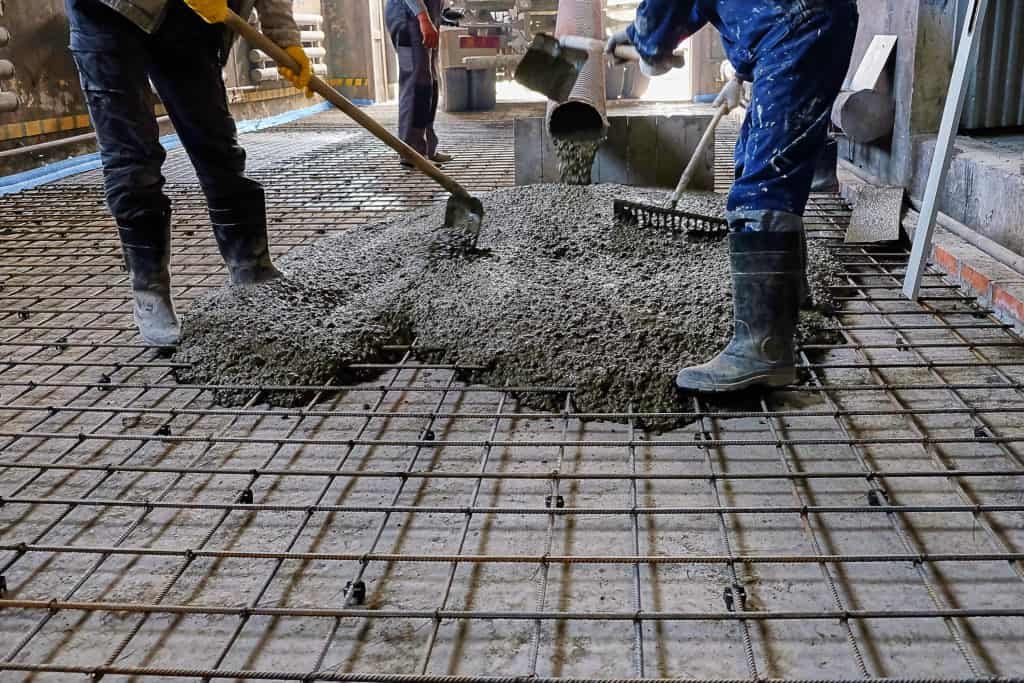
A mass pour is thick enough that heat becomes the main problem. Hydration releases heat, and in a thick block the middle has no way to shed it. The core gets hot while the outside stays cool, and the difference pulls the block apart from the inside. The cure for that is a plan, not a bigger crew.
We place mass concrete for large equipment mats, tank bases, thick foundations, pump and compressor blocks, crane pads and heavy pits around Odessa. The volumes run from a handful of truckloads to continuous placements that last a full day. In every case the owner is paying for a block that behaves as one piece, with no cold joints and no thermal cracks, and with the surface flat enough for the equipment base plate.
The start is a conversation with the engineer and the supplier. They set the mix, the placing temperature and the allowable temperature difference. We build the logistics around those numbers, including truck spacing, pump capacity, form strength and the crew needed to keep placing, vibrating and finishing without a gap.
Work that comes with a big pour
Mass pours are built on heavy steel and strong forms. Rebar placement for a thick mat is its own project, and concrete formwork has to hold lateral pressure from a deep lift. Many mass pours are equipment pads and machine foundations under rotating machines.
Hot, dry, windy days add risk, so we apply the practices in hot and windy weather concrete to every mass placement, including cooled mix, sunshades and early starts. Large slabs of this kind also need a stronger subgrade than the average yard pad, which is why base preparation is priced with the pour and not as an afterthought.
Where mass pours happen
We mobilize crews to Odessa, Gardendale, Monahans, Kermit and the industrial sites in the Basin. Large pours need trucks that can reach the site without a long wait, and at remote sites we confirm the plant capacity, the haul time and a backup plant before committing to a date.
Recurring flooding on Kermit's flat terrain led the town to build crown streets to carry water off. A flat site means a big pour has to be drained from the start, so we check where water will go during and after the placement, and we place pumps and trucks so a storm does not trap them. Access roads are checked for soft spots, since a loaded truck that bogs down on the way in can close the whole schedule.
One day, no gaps
Mass pours run on delivery. We reserve the plant capacity, fix the truck spacing, line up backup trucks and schedule the pump with a spare. Crews arrive before dawn so placing begins in the coolest part of the day and wraps up before sundown.
Cure time is long. Thick concrete stays warm for days, and form removal, backfill and loading wait for the temperature to settle. Those dates go on the schedule at the very start. Normals for the Odessa-Schlemeyer Field station put June highs near 95.5 degrees F, July highs at 95.0 and January lows at 31.6, so the same block faces very different conditions depending on the month. In summer we use ice or chilled water in the mix when the specification calls for it. In winter we watch the opposite problem, a cold surface over a hot core, and cover the block to even it out.
Thermal control plans and testing
Many specifications for thick concrete require a thermal control plan. It lists the mix, the maximum core temperature, the allowed difference between the core and the surface and the way temperature will be monitored. Sensors are placed in the block and read until the engineer says the risk has passed.
Testing adds cylinders, slump and air checks at the truck and temperature checks on each load. We keep the results with the placement log. Because a failed mass pour is hard to repair, owners usually want a preconstruction meeting before the date is set. We bring the foreman, the pump operator and the supplier's dispatcher to that meeting so everyone hears the same plan.
Basin heavy infrastructure
Midland International Air and Space Port lies in the gap between the cities, and Midland Airpark handles general aviation on the northeast edge of Midland. Aviation, power and process facilities near those places call for heavy foundations of the kind we build.
The Permian Basin campus of Texas Tech University Health Sciences Center dates to 1979, trains health professions, medicine and nursing students for both cities and had 295 enrolled in fall 2024. Campus growth brings mechanical plants and thick structural pads, and those jobs feed the local supply of concrete, steel and labor. When several large pours land on the same week, we book the plant early and keep a second source in mind.
Where thick concrete is used
Industrial and plant structures use most of the mass concrete in the region, including manufacturing plant foundations and pads for process units. Hangars and heavy shops use thick floors and column bases, and aircraft hangar projects bring their own door and apron loads.
Owners in oil, gas and midstream and industrial and manufacturing owners are the main buyers. Each wants a block that does not crack and a delivery plan that does not stall. Some of the work is repeat business with the same engineer, which helps because the thermal plan and the sensor layout can be reused with small changes.
Pour plan and truck schedule
Tell us the volume, the thickness and the day you want to pour. We will review the thermal plan with your engineer and set a truck, pump and crew schedule that holds.
Common Questions
What counts as mass concrete?
There is no single thickness. The test is whether heat from hydration can cause damaging temperature differences inside the block. Many specifications set a size threshold, and engineers may apply thermal control to anything that looks risky. Ask the engineer for the requirement.
How do you keep a thick pour from cracking?
We use a mix designed for low heat, control the placing temperature, keep the pour continuous and insulate or cool the block while it cures. Sensors in the concrete show what is happening so the crew can react.
Can a mass pour be split into lifts?
Yes, if the engineer allows it. Each lift is treated as a separate pour, with a planned joint and surface preparation between them. Splitting helps with heat but adds labor and risk at the joint.
What if the truck supply is interrupted?
We plan for it with a backup plant, spare trucks and a clear stop point if the gap grows. A planned joint is better than a surprise cold joint. We agree on the stop rules with the engineer before the pour.
How soon can equipment be installed?
Wait for strength and temperature to reach the values in the specification. Thick blocks take longer than slabs. The installer's date should be set after the placement, not before, so there is room for adjustments.
Do mass pours need special finishing?
Usually the top is screeded, floated and cured, not polished. The surface may be left rough for grout or a later topping. Curing is the critical step, with insulation, blankets or water holding in moisture and temperature for the time the plan sets.