
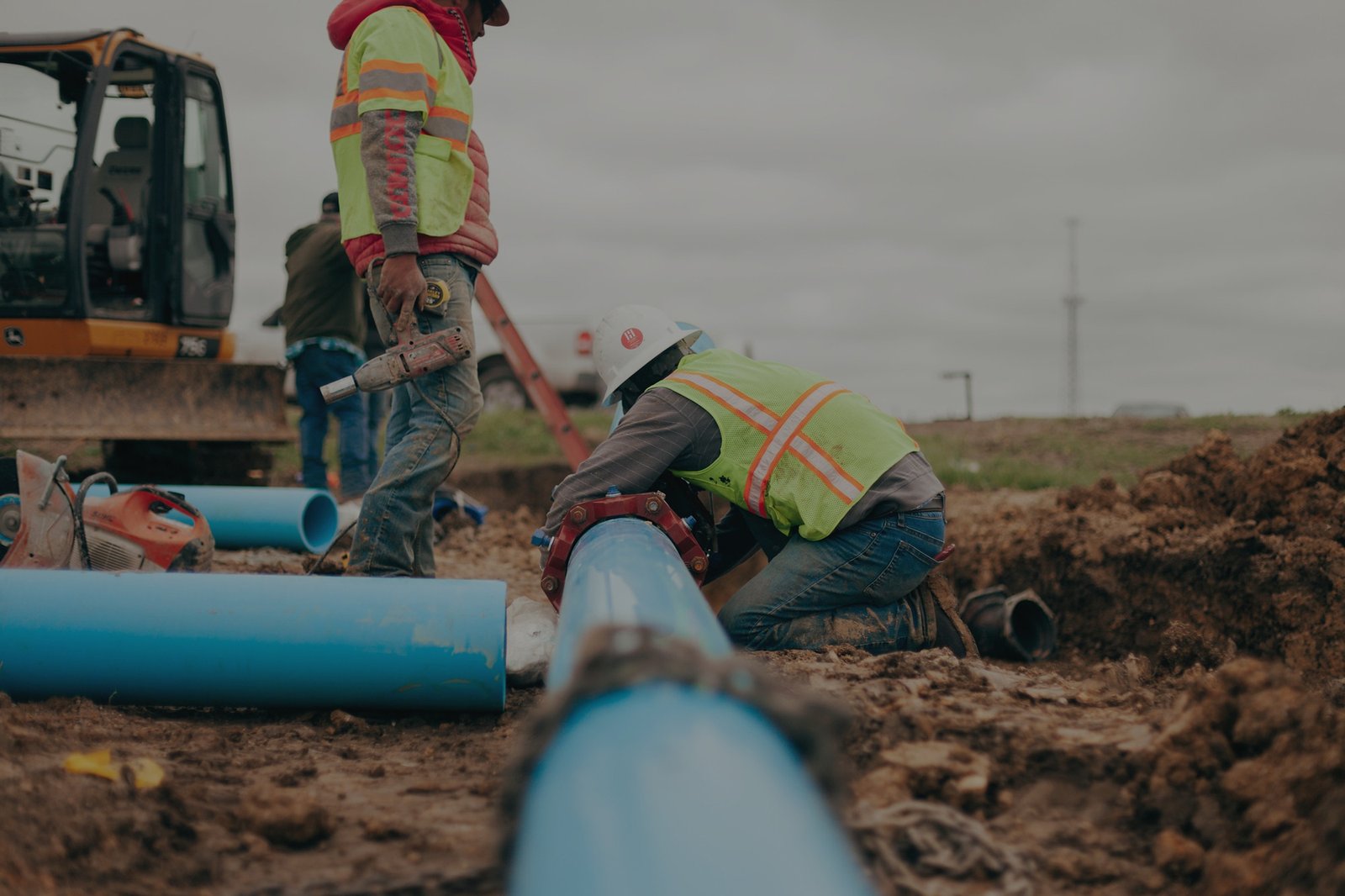
Nothing slows a yard job like a slab poured over a pipe nobody finished. Site utilities are the lines that go in before the concrete: water for the shop and the wash bay, sewer for the office, storm drains for the apron, fire service for the building and conduit for power and data. On most Basin projects these lines run through caliche and limestone, cross an existing easement or two and have to land at an elevation the slab can sit on.
We coordinate the utility trade partners, sequence their work against the grading and the concrete, and keep the schedule honest so the slab crew is not waiting on a tie-in. Concrete trade partners pour the structures, thrust blocks, pads and encasements that belong to the underground package. The utility contractors lay the pipe and conduit. The owner deals with a single schedule and a single contact, and the inspector sees finished work in the order the plans require.
What the ground decides
Soil and depth set the tone for every utility run. Shallow limestone slows trenching and may call for rock excavation, while sandy loam can cave unless it is sloped or shored. Caliche is a common base around the Basin and it holds up in dry conditions, but it softens when wet, so a leaking joint or an open trench during a rain can undermine the bedding.
Existing lines complicate every site. Odessa has a long oil and gas history, with production in Ector County starting in 1926 on the W. E. Connell ranch, and an old field can have flowlines, abandoned pipe and unmarked easements that appear on no current drawing. We plan utility potholing and locating before the first trench is opened so crossings are found in daylight, not by a bucket tooth.
Utilities for the buildings that need them
Shop and warehouse owners want reliable water, fire service and drainage that keep a yard operating. A warehouse with dock doors needs storm drainage that moves water off the apron before it ices or ponds, and a fire line sized for the sprinkler demand. A truck terminal adds oil-water separators and heavy-duty structures at drive aisles.
Offices, schools and medical buildings bring domestic water, sanitary sewer and backflow equipment, plus conduit for controls and telecom. The utilities for a government or municipal building often tie into city mains, which means the city inspector sets the pace. Whatever the use, we lay out the underground work in a single coordinated plan and note the elevations that matter to the slab crew.
The underground package, line by line
Each piece has its own page. Water main installation covers pressure pipe, valves and testing. Sanitary sewer installation covers gravity lines, grades and manholes. Storm drain installation handles inlets, pipe and outfalls, and fire line and hydrant installation covers the supply the building and the fire marshal require.
Electrical and communications lines come through electrical duct banks, which are concrete-encased conduit runs that protect cable under traffic. When a site has existing lines in the way, utility relocation moves them out before the slab goes down. A package that mixes several of these is cheaper to build when the trench is shared.
Where we mobilize for utility work
We take utility packages in Odessa and Ector County and mobilize crews to West Odessa, Gardendale, Goldsmith, Notrees, Andrews, Monahans, Kermit and Crane. Notrees, in Ector County, hosts a wind and battery hybrid plant with 152.5 MW of wind capacity that started operating in April 2009, plus a 36 MW battery that came online in December 2012. Sites that tie to power generation and storage need underground electrical work coordinated with the owner's engineers.
State Highway 302 ends at the Loop 338 interchange with Interstate 20 near Odessa, and many of our north-side sites sit along it. For work near West Odessa or Gardendale we plan equipment staging near the highway, which keeps trucks and trench boxes off residential streets.
Trench safety and utility strikes
Excavations deeper than a few feet need protection, and the competent person on site decides when to slope, shore or use a trench box. We require that decision to be recorded on the daily report and that spoil is set back from the edge. Trenches near traffic get barricades and flagging, and open ditches get covered or fenced when the crew leaves each day.
A locate request is required in Texas before any digging, and we file it early because tickets take time to clear. Locating marks fade fast in wind and traffic, so we repaint them before excavation resumes. Where a gas line or an electrical duct is close, the work shifts to hand digging or vacuum excavation. A strike is a safety event first and a cost event second, and the schedule should never tempt a crew into skipping the pothole.
Sequencing pipe, backfill and concrete
The order is rarely negotiable. Rough grade, then the deepest lines, then the shallow ones, then structures, then backfill in lifts, then finished subgrade. Pressure tests, camera inspections and compaction tests are held between steps, and a failed test restarts the clock on that segment only if it is caught before backfill.
We schedule the concrete pours for manholes, inlets and thrust blocks so that they cure before backfill loads them. Weather matters. A rain event in the Basin is short but can flood an open trench, and a windstorm can fill one with sand. We lay out each run so open trench stays short and the day ends with the pipe covered. That keeps the yard working and the owner's trucks moving while construction continues beside them.
Plans, permits and the people who approve them
Utility work answers to several reviewers. The city or county utility department approves the main connections and the pipe material. The fire marshal reviews fire lines and hydrant locations, and the local permit office reviews building connections. On state right-of-way, TxDOT permits the crossing. We assemble those approvals early because each one has its own review time, and a missing sign-off can stop a trench.
As-builts matter more than people expect. We record invert elevations, pipe lengths, valve locations and connection points as the work goes in, so the owner receives drawings that match the ground. Those drawings are the reference the next contractor needs when the yard grows. For work in the oilfield support area, oil, gas and midstream owners often add their own standards on top of the city's.
Bring the civil sheets
Send the utility plan and the site grading sheet. We will mark the conflicts with the slab layout and propose a sequence of trenching, testing and pours that fits your opening date.
Common Questions
Who installs the pipe, you or a subcontractor?
Utility and earthwork specialists install pipe and conduit under our coordination. Concrete trade partners build the concrete structures, thrust blocks, encasements and pads that go with them.
How do utilities affect my slab schedule?
They come first. Any line under the slab must be in, tested and backfilled before the base goes down, and any sleeve through a footing must be set before the pour. We schedule this so the concrete crew starts on a finished surface.
Can you tie into the city system?
Yes, in coordination with the utility department. We apply for the tap or connection, schedule the city inspector and plan shutdowns so the neighbors are notified in advance.
What happens if we find an unknown line?
We stop, mark it, notify the owner and the line operator, and agree on a plan before work continues. The pothole step is designed to find such lines before the trench machine does.
Do you handle yard drainage as part of utilities?
Yes. Storm drainage for a yard is part of the underground package, and we coordinate it with the paving slope so water leaves the lot without crossing traffic lanes.