
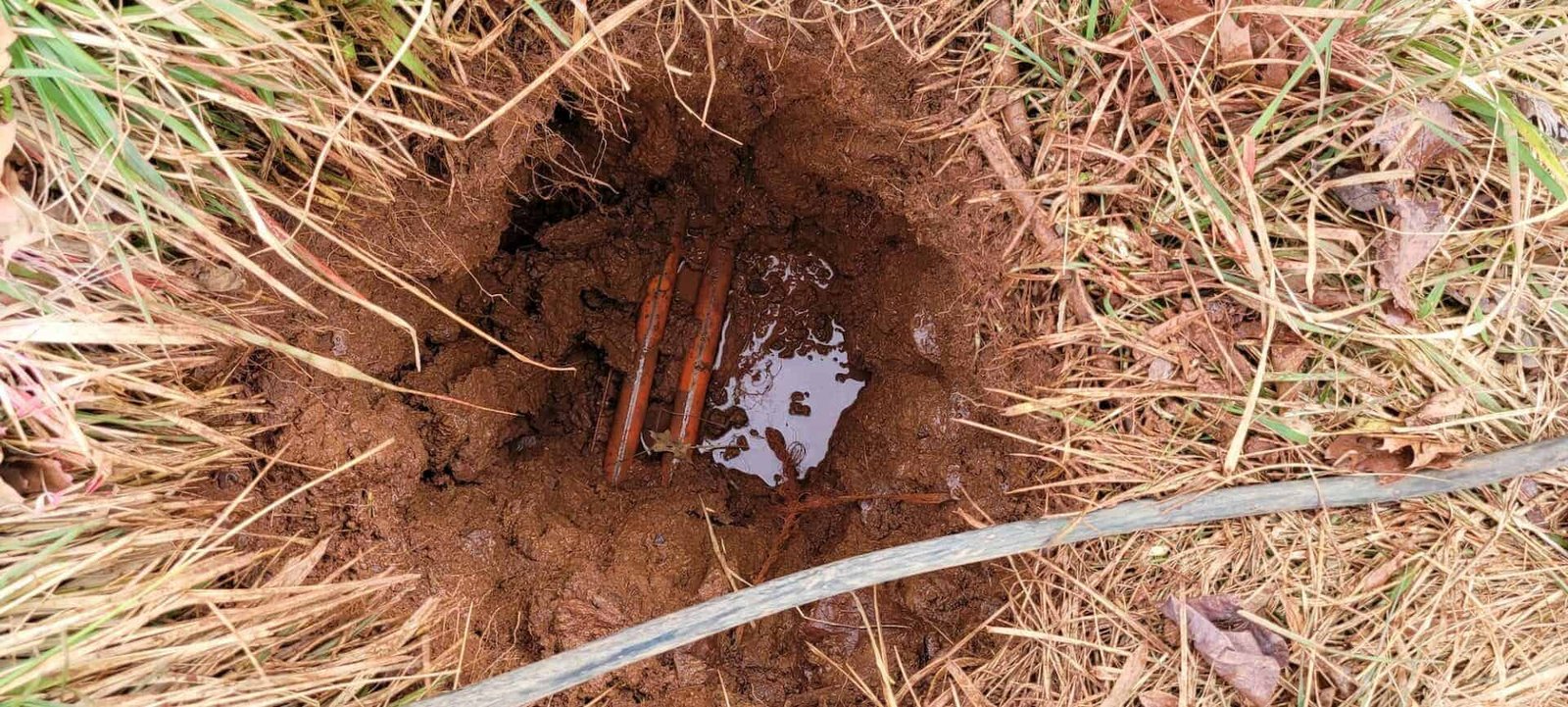
The cheapest utility repair is the one that never happens. A pothole is a small hole, a foot or two across, dug carefully to expose a buried line so its depth, size and material are known before a trench or pier goes through it. In an oilfield town, where many years of pipe, cable and flowlines share the same ground, that small hole can prevent a stopped plant, a fire or a very bad day.
We coordinate utility potholing and locating for yards, plants, campuses and public corridors, ahead of trenching, drilled piers, slab cuts and grading. Locating partners mark the lines and vacuum crews expose them. Concrete trade partners then pour the patches and fill the holes so they leave no soft spot in a slab or road.
What we do and what partners do
Locating and potholing are specialist work. Partners with electromagnetic locators, ground-penetrating radar and vacuum excavation equipment mark and expose the lines. We coordinate them, tell them where the trench or foundation will go and review the results with the engineer and the owner.
Concrete trade partners finish the job. When a pothole is in pavement, we restore it with concrete and dowels, or with flowable fill and a concrete cap, depending on the slab. In yards where trucks run, a poorly patched pothole becomes a pothole in the other sense within months. We form the cap to the thickness of the surrounding slab, finish it flush and cure it under cover. The location is recorded with a survey point, depth and line type, and added to the project drawings.
Sites where this matters most
Industrial yards and manufacturing plants are the most common because they have many years of installed lines, many without current drawings. Airports, hospitals and campuses are close behind, for the same reason. Midland International Air and Space Port lies between Midland and Odessa, and general aviation traffic uses Midland Airpark on the northeast side of that city. Airfields have lighting circuits, fuel lines and drainage under their pavement, and any work near them starts with a record review and an exposure.
The Permian Basin campus of Texas Tech University Health Sciences Center dates to 1979, offers medicine, nursing and other health programs for Midland and Odessa, and had 295 students in fall 2024. A healthcare hospital or teaching campus has medical gas, power and data lines threaded between buildings. Those lines tolerate no surprise, so the pothole comes first.
Where we send potholing crews
We take potholing and locating around Odessa and mobilize across the county and beyond, from Thorntonville to Andrews. Thorntonville covers 0.80 square miles at an elevation of 2,605 feet, a small area where a single unmarked line can matter a great deal. Andrews is working to bring in new business. In 2022 its Economic Development Corporation landed a $1.5 million federal grant for roads and water at the Northwest Business Park, with $2.4 million in local money alongside it, and new lines in a business park mean new crossings with the existing ones.
For work in Thorntonville or Andrews, we plan travel time into the schedule, since a vacuum truck is not a quick call away. We also confirm that utility owners have responded to locate tickets before we mobilize.
What potholing costs
Potholing is priced per hole, with a mobilization charge for the truck and the crew. The depth of the hole matters, as does the surface: grass is easy, asphalt requires cutting, and thick concrete requires coring and a repair. Sites with many crossings need many holes, and every hole adds to the bill.
The cost is small compared with a strike. A cut electrical line, a ruptured water main or a damaged fiber route costs many times a pothole, and may cost lives. Some owners try to save money by potholing only at the most obvious crossings and trusting the rest of the line. We recommend a pothole wherever the trench crosses a line of unknown depth, and wherever a drilled pier or bore will pass through known pipe. We separate the cost of locating, exposing and restoring, so the owner can adjust the scope with open eyes.
Do this early
The best time to pothole is right after the design is firm and well before construction. That gives the engineer time to revise the plan if a line is in the wrong place. A pothole done the day before trenching leaves no room to react to what it shows.
Locate tickets and utility responses take days. Utilities and energy companies often want their own representative at the pothole, which adds a coordination day. We start the process as soon as the work area is defined, and we keep copies of the responses. If marks are old or faded, we ask for new ones. Vacuum excavation depends on weather: very high winds make the work difficult and dusty, and freezing conditions complicate the soil and the water in the truck. We schedule potholing on mornings with the lowest wind, and we cover open holes at the end of each shift with plates or barricades.
Caliche, limestone and the way marks last
Caliche is a soil layer where calcium carbonate cements gravel, sand and silt. It develops chiefly in country that gets under roughly 26 inches of rain a year, a line well above Odessa's average of roughly 12 inches, and builders commonly use it as road base. It does not hold up well to moisture. That affects potholing in two ways. It can be hard to vacuum when it is dry, and it softens around a leaking line, which can make the hole larger than expected.
At the Odessa-Schlemeyer Field station the normals show June highs averaging 95.5 degrees, July highs averaging 95.0, January lows averaging 31.6 and yearly precipitation of 12.93 inches. Hot, dry and windy weather bleaches paint marks and scatters flags, so a locate that was good last week may not be good today. We verify marks against the ticket before digging and re-mark when needed. For conflicts discovered in the field, utility relocation describes how lines get moved, and the site utilities page describes the underground work that follows a clean exposure.
Locate before you excavate
Share the proposed trench and pier layout. We will schedule the locate crews, choose the holes that matter most and set aside a day for the restoration pours once the results are reviewed.
Common Questions
Does a locate ticket replace potholing?
No. A locate ticket marks approximate positions of lines whose owners respond. Private lines, abandoned lines and lines with inaccurate records may not appear at all. Potholing confirms what is actually down there.
How deep can you pothole?
Vacuum excavation reaches the depth of most utility trenches, and deeper holes take longer. The partner crew tells us the limit for the soil type, and we plan for it.
What happens to the hole afterward?
It is backfilled and compacted, and in pavement it is capped with concrete or asphalt. We record the location and depth and add it to the as-built so the next contractor benefits.
Will you find abandoned lines?
Sometimes. Ground-penetrating radar and electromagnetic equipment find many, but not all. We treat any unexpected pipe or conduit as live until the owner proves otherwise.
Who is liable if a line is hit?
That depends on the contract and on whether locates and exposures were done. Following the process protects everyone. We document each step so that, if there is a problem, the record shows the care taken.