
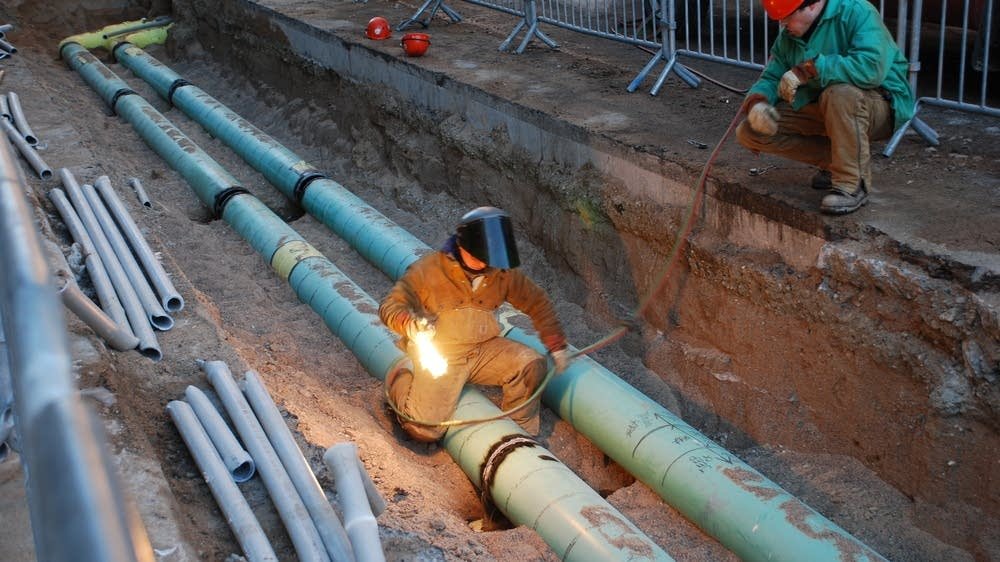
Some utilities are in the wrong place the day a project starts. A water line runs under the footprint of a new shop. An old duct bank crosses the future truck apron. A storm sewer sits where the road is going to be widened. Moving them is not optional, and it has to be done without cutting service to the neighbors, the yard or the plant next door.
We coordinate utility relocation for owners, general contractors and public agencies in Odessa and the Basin. The work involves the line owner, a utility installation partner, the engineer and usually a regulator or two. Our part is the schedule, the sequence, the shutdown windows and the concrete that goes with the new alignment: thrust blocks, encasements, vault floors and the pavement we restore afterward.
What we coordinate and what we pour
Line owners and their approved contractors do the work on their own facilities. Gas, electric and telecom carriers each insist on this, and municipal departments often do as well. For private lines on the owner's site, we coordinate utility and earthwork partners who excavate, cut and cap old lines and install new ones.
Concrete trade partners handle the concrete. That includes encasements where the new line crosses under traffic, thrust blocks on pressure pipe, manhole and vault bases, protective slabs over shallow lines and the final patching of pavement. We also pour the temporary bypass pads and ramps that keep trucks moving while a trench is open. The point of splitting it this way is accountability. The owner knows which party holds each piece, and the inspector sees the right work performed by the right hands.
Why relocations are priced differently
A relocation has more unknowns than a new line. The existing line may not be where the drawings say, its condition may be poor and the shutdown window may be only a few hours long. Overtime and night work can add to the labor cost, and standby crews sometimes wait for the line operator.
We separate the price into the parts the owner can control and the parts they cannot. Controlled costs include pipe, conduit, structures and restoration. Uncontrolled costs include unforeseen conditions, rock and third-party delays. Material lead time is a cost driver too, because a special valve or a transformer can set the date. We ask the owner to release long-lead items as soon as the design is final, and we confirm delivery dates in writing to protect the shutdown. Making the new line live before the old one is cut is the best way to hold the cost down.
What goes wrong on a relocation
The common failures are not technical. They are the missed locate, the unannounced shutdown and the mark that was washed out. Odessa roads and yards have many years of oilfield lines in them, and a site that looks open may have lines nobody has a record for. Earlier TxDOT work on State Highway 302 in Winkler County built an overpass at State Highway 115 and added Super 2 passing lanes along a stretch of about 24.3 miles, and projects of that length always turn up crossings that were not on the plans.
Our habit is to expose the line first and confirm its size, material, depth and service before designing the connection. Utility potholing and locating is the step that saves the schedule. Then we cut the shutdown plan down to the shortest span we can, with materials staged and the crew rehearsed. Wind and dust make live-line work awkward, so we put up shields and cover openings.
Build the new line first, then cut over
The preferred sequence is to install the new line alongside the old one, test it, connect it and only then retire the old line. That keeps service on for as long as possible and shrinks the shutdown to the tie-in. It does not always work, because the new route may be blocked by the same building that forced the relocation, but it is where we start.
When it cannot be done, we plan a temporary bypass: a surface pipe, a temporary pump or a generator for a power feed. We agree on notification with every affected neighbor and the line owner, and we post the cutover date at the site. After cutover, the old line is cut and capped or removed, and we record both locations on the as-built. An abandoned line left in the ground without a record becomes someone else's surprise later.
Typical relocation packages
Packages range from a single service line to a block of road corridor. Common elements are a new alignment around a building or slab, new vaults and manholes at the connections, new thrust blocks and a pavement restoration to match. Odessa's road network gives the context: Interstate 20 with Business I-20 along 2nd Street, US 385 (Andrews Highway), SH 191 (42nd Street), Loop 338 and Spur 450 (Kermit Highway) all carry utility corridors of their own, and any road widening in those corridors triggers relocation.
The pavement and slab around a relocation matter. We build heavy-haul truck aprons and concrete paving to carry what drives over the new line. We also coordinate with the sanitary sewer installation and water main installation partners when the moved line is a gravity or pressure main, since those have grade and separation rules.
Where relocation work lands
We take relocation work around Odessa and mobilize to the corridors where growth and road projects press on existing utilities. The airport area is one: The city owns Odessa-Schlemeyer Field, a general aviation airport roughly 5 miles to the northeast, with three asphalt runways, the longest 6,200 feet, at an elevation of about 3,003 feet. Airfield projects bring their own rules for work near runways and taxiways.
The Ector County Airport area and the I-20 and Loop 338 corridor are two places where we expect relocations to cluster, because both see new development and road changes. We stage equipment near the work, plan truck routes to avoid active runways and keep the cutover windows short.
Start with the conflict list
Utilities and energy companies usually bring a representative to the first meeting. Send the drawings that show the conflict and the dates your slab or road crew needs the ground. We will list each line that has to move, who owns it and what the cutover needs from you.
Common Questions
Who decides when a line can be shut off?
The line owner. We request the shutdown in writing, agree on a window and give notice to affected parties. Dates can shift when the owner cannot staff the work, so we plan buffer days.
Do I have to pay for the old line removal?
Old lines are often abandoned in place if the owner and utility agree, but there may be a conflict with the new work. The engineer decides. We price removal and abandonment separately so you can see the difference.
Can you relocate a live gas or electric line?
Those lines belong to their operators and are moved by their crews or approved contractors. We coordinate the schedule, excavate and restore around their work, and provide the concrete protection.
What if the line is not where the plans show?
Expect that. We expose it by potholing before design is finalized, and the engineer updates the plan. If it turns up during the trench, we stop, protect the line and contact the owner.
How do you keep a yard operating during relocation?
We phase the trench in short segments, plate it overnight and build temporary ramps and bypass lanes. The yard manager helps set the sequence so loaded trucks always have a path.