
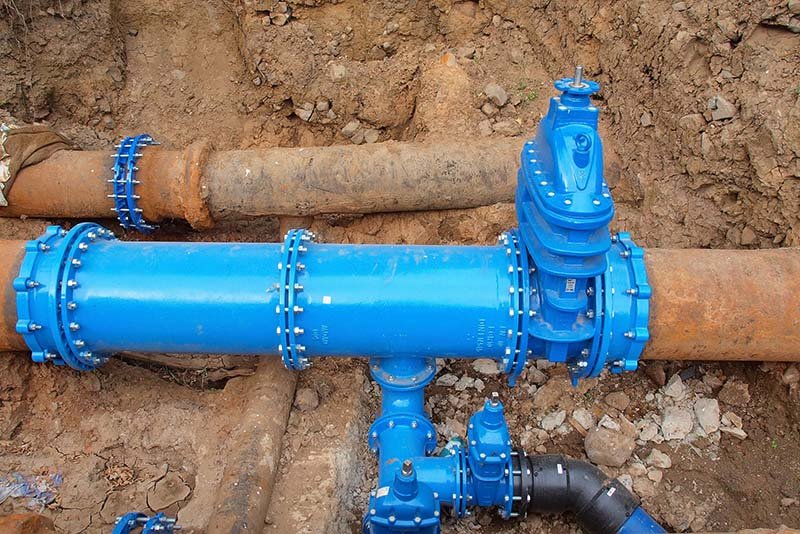
Ector County put $17 million of state money into connecting West Odessa homes to Ector County Utility District water lines, since area wells are failing as the community grows more urban. That one project shows what water is worth in the Basin: a line in the ground is a prerequisite for almost everything else a site owner wants to build.
We coordinate water main installation for commercial lots, service yards, plants and public works, as part of wider site utilities packages, from the tap at the street to the meter vault, the fire riser and the hose bibbs at the wash pad. Pipe is laid by utility partners under our schedule. Concrete trade partners pour the thrust blocks, valve boxes, vault floors and pads the line depends on, and we leave the trench open no longer than the inspector and the test demand.
What moves the price of a water line
Length and depth come first, but the soil under the line often matters more. Limestone near the surface means rock excavation and slow production, and a trench in loose sand needs wider cuts or shoring. Groundwater, where it appears, brings in dewatering on top of that. Pipe diameter and material change the unit price, and so does the number of fittings, valves and hydrants on the run.
Tie-in conditions are the hidden driver. A hot tap on a live main requires a shutdown window or a specialty tapping crew, and some utilities charge for inspection time. Road crossings add boring or open cutting, with traffic control and pavement repair on top. Long hauls of imported bedding sand or select backfill, common where native caliche will not meet the specification, can be a major line item. Those unknowns get their own lines in our pricing, which lets the owner tell which costs hinge on what the trench turns up.
From tap to meter
A typical commercial water package starts at the connection to the utility main. A tap and a gate valve go in, then the service line is laid at the depth the utility requires, with warning tape above. The line ends at a meter box or vault, a backflow preventer and, where the building needs it, a separate fire line. Valves are set so the owner can isolate sections, and thrust blocks are poured at bends, tees and dead ends where pressure would otherwise push the pipe apart.
After the pipe is laid we flush, pressure-test and disinfect it, then collect the samples the utility wants. Only after those results pass do we connect to the building. For sites where the water serves a yard wash bay or a rinse pad, we coordinate the slab drainage so used water reaches the proper system. The fire line and hydrant installation page covers the fire side of that work.
Working next to live pressure
A water main carries energy. A fitting that fails under test or a trench that collapses next to a pressurized line will hurt people. We keep a competent person on the excavation, require protective systems for the depth and slope, and keep the test sections restrained and fenced while pressure is on.
Disinfection chemicals have their own safety rules, and discharge from flushing must be directed away from pavement and neighbors. Cold mornings are rare but real in January, and freezing can crack exposed pipe on a newly built site, so we cover the stub-outs and drain temporary connections. In summer, heat is the greater hazard for the crew working in a steel trench box with a sun-baked spoil pile beside it, so we plan water, shade and early starts, and cut the shift when the temperature index climbs.
Water in a dry basin
Odessa sees about 12.93 inches of precipitation a year at the Schlemeyer Field station, and July highs average 95 degrees. The city's supply comes from Colorado River lakes through the regional water district, while wells in Ward and Ector counties add supply. That means the municipal utility treats every connection seriously, and developers have to prove their demand and their fire flow.
The growth is real. Oilfield service owners are consolidating yards, and companies are building shops and offices on the north side along US 385 and Loop 338. Where municipal mains do not reach, owners have to fund line extensions, and the utility district often sets the rules. Municipal and public works buyers across the county are coordinating similar extensions, and we work from their specifications rather than ours.
Fitting the line into the build
Water is usually among the first underground lines, because it runs deepest on some sites and ties to everything else on others. We schedule water around sewer and storm drain lines that must hold grade, then lay it above or beside according to the separation rules. Pressure tests fall on a day when the inspector can attend, and we avoid Friday afternoons that push a failed test into Monday.
Material lead times matter on large pipe and specialty valves. We ask for submittals early and release orders as soon as the engineer approves, so the trench is not waiting. Thrust-block concrete needs to be cured before the pipe is pressurized, which gives us a reason to pour them as soon as the fittings are set. A good sequence takes the utility from tap to flush in a few working days instead of a few weeks.
Water package responsibilities
Utility and earthwork specialists lay pipe and excavate under our coordination. Concrete trade partners handle the concrete portions of the water package: thrust and restraint blocks, meter vault floors, valve pads, pump pad bases, and the pavement or flatwork restored over the trench.
This split lets each crew do the work it does well. Pipe installation progresses along the trench first. After fittings are installed, we arrange the forms and concrete placement with the concrete specialists. We coordinate locates, inspections and the testing hold points. If the trench crosses a drive that carries loaded trucks, we pour the restoration with the thickness and joint spacing of the surrounding slab, since a patched crossing is the first place a yard fails. See concrete pumping and placement for how we reach structures in tight corridors.
Where we mobilize for water work
We take water packages in Odessa and across Ector County, and mobilize to Crane, McCamey, Andrews, Monahans, Kermit and Rankin. US 385 ties several of those together: it runs 32 miles north from Crane to Odessa and 21 miles south to McCamey, and in Odessa it meets Loop 338, State Highway 191 on 42nd Street, State Highway 158 toward Goldsmith and Interstate 20 at Pool Road.
That corridor is the route the water-line trade partners we coordinate use, so a job in Crane or McCamey is staged from the same pipe supply that serves Odessa. The corridor also guides site selection: a lot that fronts US 385 is more likely to find a main in the right-of-way, while a parcel further out may need an extension that the water supplier has to approve.
Tell us where the main stops
Send the site plan with the nearest main marked and the demand figures from the engineer. We will lay out the tap, valve and meter locations, the length of any extension and the days the line will be open.
Common Questions
Do I need a separate fire line?
Most commercial buildings with sprinklers do, and the fire marshal sets the sizing. The fire line and the domestic line often share a trench but must be separately valved. We coordinate the details with the fire protection engineer.
How long does a typical commercial tie-in take?
The physical work can take a week or two for a short service. Approvals, shutdown scheduling and testing add time, so we ask for the utility review early and confirm the shutdown date in writing.
Who pays for pavement restoration over the trench?
Restoration is part of the proposal, and we describe the pavement section we will replace. If the utility requires a particular repair standard in the street, we follow it.
Can you work in the wind?
Yes. Wind is more of a problem for concrete finishing than for pipe, but dust at the trench and sand blowing into open pipe ends call for caps and covers at every stop. We keep the ends closed so clean pipe stays clean.
Will the water district inspect your work?
Yes, and often more than once. Inspectors watch bedding, pipe joints, thrust restraint and the pressure test. Each hold point is booked so the inspector looks at the work ahead of the backfill.