
A yard slab fails slowly. The first sign is a hairline crack at a dowel, then a spalled joint edge where loaded trucks turn, and a year later a repair crew with a saw. Most of those failures trace back to a pour day when nobody measured what went into the form. Testing is how a pour gets a paper trail. It tells the yard manager and the engineer that the concrete delivered matched the mix design and that the placement conditions were inside the limits.
We schedule the testing agency before the truck is dispatched, brief the technician on the pour sequence and give them clear access to the discharge point. Concrete trade partners place and finish; the independent laboratory samples, tests and reports. That separation matters on projects where the owner, a general contractor and a design engineer all want the same data and none of them wants to take our word for it.
What gets tested and when
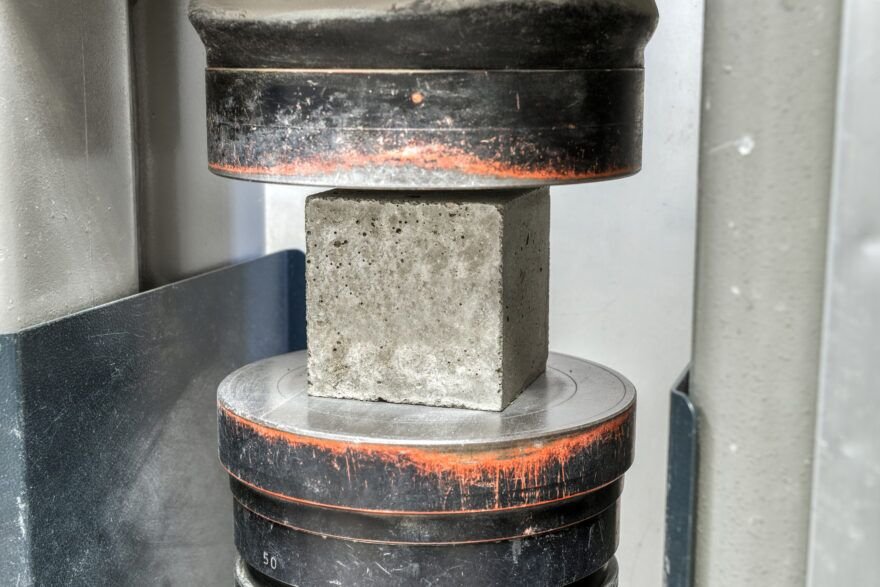
Testing starts before concrete. The agency checks compaction and moisture on the base and verifies the forms, reinforcing steel and embedded items against the drawings before a truck rolls. On pour day the technician takes slump at the discharge, measures air content where the mix calls for it, records the concrete temperature and the ambient conditions, and casts cylinders for breaks at the ages the specification names.
Hot-weather and windy days add their own checks. The technician logs the time between batching and discharge, because a mix that sat in a drum on a long haul in July is a different mix than the one the plant designed. When the evaporation rate climbs, we adjust placement and curing, and the testing record shows what was done. Cylinders are cured in the lab or on site under the conditions the specification requires, then broken, and the reports are sent to the engineer and the general contractor, with a copy to our office.
What drives the testing line on a bid
Testing cost follows the pour volume, the number of separate pours, the distance the technician travels and the age of the breaks. A single large yard slab is cheaper to test than the same area split into many small placements, because the technician makes fewer trips and fewer sets of cylinders are needed. Remote sites out toward Gardendale or Notrees cost more in mileage and wait time.
Retests are the number to watch. A low break, a missed slump or a failed subgrade proof-roll leads to extra coring, extra visits and sometimes a demolition and replace. We keep the cost down by catching problems early: confirming the mix ticket against the design, rejecting a load that arrives too wet, and holding the pour when conditions are outside the limits. The money spent on a technician at the discharge is small next to the cost of removing a slab that cannot be accepted.
Why the Basin tests harder than most
Work around Odessa is increasingly heavy industrial. A gas processing plant of 300 million cubic feet per day is planned at Goldsmith in Ector County, about 15 miles northwest of Odessa, beside an existing plant, with startup scheduled for the first quarter of 2027. Pads, equipment foundations and containment around plants like that are held to process-owner standards, and owners ask for full documentation of every placement.
Public works agencies bring their own expectations. TxDOT's Loop 338 freeway proposal would take the corridor from a right of way near 200 feet wide to one near 400 feet, and the utility, drainage and structure pours that follow all carry state-specified testing. Local institutions such as the school district, the hospital district and the county hold the other large share of the market, and their project managers are familiar with test reports. Odessa's largest employers in the 2021 city financial report were Ector County ISD, Medical Center Hospital, the City of Odessa and Ector County, and each of them has had to defend concrete quality to its own board.
Who does what on pour day
Concrete trade partners build forms, place steel, place concrete, finish and cure. Trade partners we coordinate handle utilities and earthwork, and the testing agency is one of them. That division is intentional. A contractor who also tests its own concrete has a conflict of interest, and owners know it. Industrial and manufacturing owners in particular want the lab to be a different company from the crew.
Where we add value is in the preparation. We hold a pre-pour meeting with the technician, confirm the cylinder count and curing arrangement and make sure the technician can see the discharge without standing in the truck path. If the technician flags a load, our foreman makes the call to reject it with the batch plant on the phone. When the owner wants extra checks, such as maturity monitoring on a fast-track slab or additional cores, we build those into the schedule. The result is a record the owner can hand to the next buyer or lender without apology.
Testing needs by building type
A warehouse floor carries the tightest flatness and levelness requirements, so the testing agency adds floor profile readings after the pour to the usual strength tests. A manufacturing plant pad may call for higher strengths at the equipment bases and chemical-resistant surface treatments in process areas.
Government buildings and school additions follow the owner's standard testing specification, which often includes extra cylinder sets for early-age stripping decisions. For heavy-haul roads, the key measures are thickness, strength and joint depth, because axle load is the whole point. We keep a record per pour, tied to a plan of the slab, so any later question about a specific panel can be traced to the load that filled it. Our work on industrial concrete floors shows how the testing plan changes when the surface is the product.
Plan the testing before the pour
Share the specification section and the pour schedule. We will line up the testing agency, mark the sampling points on the placement plan and tell you where the extra checks will land.
Common Questions
Do you test the concrete yourselves?
No. An independent testing agency takes the samples and breaks the cylinders, and we coordinate its schedule. That keeps the results credible to the owner and the engineer, and it keeps concrete trade partners focused on placing and finishing.
How long until I get the strength results?
Early breaks come back within days and the specified-age results follow at the interval the project calls for. The agency sends reports to the engineer and general contractor, and we ask for a copy so the foreman can compare them with the weather log.
What happens if a cylinder breaks low?
Cylinders can fail for reasons unrelated to the slab, such as handling damage, so the first step is checking the sample record. If the problem persists, the engineer may ask for cores or a load evaluation. We cooperate on that and push for a decision before further work goes over the area.
Can testing be done on a short notice yard pour?
Often yes, but call the agency early. In busy weeks technicians are booked, and a Saturday pour needs advance notice. We have a standing practice of confirming the technician the day before every pour.
Is subgrade testing part of this service?
Yes, where the project calls for it. Compaction and moisture on the base are checked before the forms are set, and the earthwork partner is told the result so any correction happens before the concrete crew arrives.