
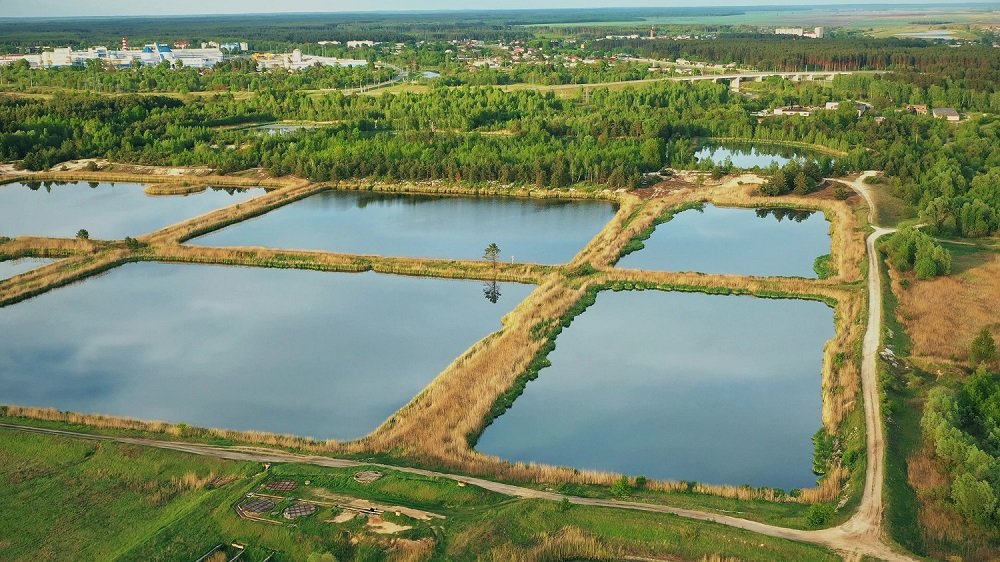
On a West Texas lot a pond is a promise to the city that the lot will pass no more water downstream than it did before the pavement. Most of the year it sits dry. A few times a year it fills, drains through an outlet pipe at a controlled rate and goes dry again. Getting that promise built correctly means the right volume, the right slope on the floor and an outlet structure that releases water at the rate the engineer calculated.
We coordinate the digging, shaping and compaction of basins, both detention and retention, and concrete trade partners build the concrete elements: outlet boxes, weirs, spillways, flumes, headwalls and paved low-flow channels. The earthwork partner moves the dirt. Concrete trade partners pour the parts that must hold their shape in a storm.
How we build a basin to hold the numbers
We start with the grading plan, the volume table and the outlet detail. The basin is staked, stripped and excavated to the floor elevation, and the side slopes are cut at the specified ratio. The floor must slope toward the outlet or the low-flow channel, since a flat floor holds water and breeds weeds and mosquitoes.
The outlet structure is built early, before the embankment closes around it. We set the box at the right invert, connect the pipe and pour the weir wall to the stated crest elevation. Then the embankment is built in lifts and compacted, and the spillway is formed and poured. A survey crew checks volume and elevations before we hand the basin over. Small errors in the crest elevation change the released flow, so the surveyor checks that number twice.
What the soil does to a pond
In Upton County the soils are sandy loam, limestone often shows at the surface and caliche and limestone are the local minerals; similar conditions show up across the Basin. Sandy loam drains quickly, which suits a retention pond designed to infiltrate. It also erodes quickly, so slopes need vegetation, rock or a liner right away. Caliche may be hard to excavate and may crack under cutting, but it makes a firm embankment when properly compacted.
Crane sits at about 2,575 feet elevation in a hot semiarid climate with average annual precipitation of 12.13 inches, and the same dry conditions shape pond design in much of the region. Vegetation struggles to establish without irrigation, so we plan armoring instead of relying on grass. Rock riprap at inlets, concrete aprons at pipe ends and concrete lining in steep sections are common. We also check the groundwater and bedrock elevations before cutting deep, since an unexpected rock layer changes the excavation cost.
Basins come early in the schedule
The basin needs to be built, or at least roughed in, before the pavement because it often serves as a construction sediment trap and because the storm pipes need somewhere to discharge. Interstate 20 widening shows the same logic at larger scale: the first segment runs about five miles from east of JBS Parkway to east of CR 1300, and drainage has to be in place as the main lanes and frontage road conversions go forward.
We schedule pond work to match the weather. A heavy rain on an open pond can erode slopes and fill the floor with silt, so we shape, protect and stabilize each slope as we go. Concrete outlet work is poured on a day with a good forecast and cured before the first storm is expected. Final cleanup, with a re-shot survey and trash rack installation, comes at the end so no equipment has to cross the finished floor.
Ponds for the sites that need them
A warehouse or distribution center creates large impervious roof and pavement areas, and the pond is sized for them. Logistics yards, truck terminals and manufacturing plants add contaminated runoff concerns, which may call for a forebay, a skimmer or a separate containment pond. Schools and medical campuses usually have a pond landscaped as an amenity or a drainage feature.
For public projects, the city or county often owns the pond after construction. Government and municipal buildings projects therefore carry stricter geometry, access and maintenance rules, and the owner's inspector looks closely at the outlet. The Ector County hospital board signed off in 2013 on a $10,035,000 guaranteed maximum price for adding stories to Medical Center Hospital's Center for Health and Wellness, a reminder that healthcare campuses in town add buildings and paving, and with them new drainage volume.
Where we build basins
We work in Odessa and across Ector County and mobilize crews to Midland, Andrews, Monahans, Crane and Kermit. Odessa, the Ector County seat, is reached by Interstate 20, US 385 (Andrews Highway and Grant Avenue), State Highway 191 along 42nd Street and Loop 338. Those corridors are where most commercial land is developed, and where detention ponds are required.
Commercial buyers such as commercial developers favor land along Loop 338 and I-20 is some of the most active. We also take pond work in Odessa proper, where infill lots often have tight footprints and a pond has to be squeezed between a building and a property line. In those cases, concrete walls and underground detention can replace an open basin, and we coordinate the design with the engineer.
The numbers behind a pond
Excavation volume leads. How much material comes out, how far it has to go and whether it can be reused as fill on the same site are the big questions. A pond that cuts and fills on the same lot is cheaper than one that exports spoil. Rock and caliche cost more to cut, and hauling them away costs more still.
Concrete items follow: an outlet box, a spillway and a lined channel add up fast on a complex pond. Fencing, trash racks and safety features are further line items, and so is erosion control. We list each as a separate price so the owner can adjust the design if the number is too high. Value engineering often moves the outlet and reduces pipe, or reuses excavated caliche as embankment, but only the engineer can approve those changes.
Pond work in context
A pond is the end of a drainage system. Storm drain installation moves water to it, and culverts and headwalls pass it under drives and roads. The excavation itself is covered on our pond and basin excavation page, which explains equipment, haul and compaction in more detail.
Ponds also tie to grading. A mass grading plan decides where the low spot sits and how the lot drains to it, and the pond must fit that plan. We coordinate with the grading partner so the basin is cut to match the finished lot elevations.
Keeping people out of the hole
A basin is a deep excavation with sloped sides, and it fills with water when it rains. Open basins during construction get fencing or barricades and stable slopes. We keep equipment away from the edge and use spotters near the slope. Water that collects after a storm is pumped out or allowed to infiltrate before work resumes, and the floor is inspected for soft spots before equipment goes back in.
After completion, the owner often adds a fence, and outlet structures get trash racks and grates. We place any safety features the plans show. Dry basins attract people and animals, and in windy conditions can accumulate blown trash and sand. A maintenance plan helps, and we pass along our as-built to the party that will own it.
Hand us the drainage report
Send the drainage report, the grading plan and the geotechnical findings. We will confirm the basin volume, price the outlet and spillway concrete and map the pour dates against your paving schedule.
Common Questions
How do detention and retention basins differ?
Detention basins keep runoff for a short time and let it out slowly through a restricted outlet. Retention basins keep it much longer, often until it soaks in or evaporates. The drainage plan states which one the site needs.
Can the pond be lined with concrete?
Yes. Concrete lining in the low-flow channel, at inlets and on steep slopes controls erosion and reduces maintenance. We also line full basins where space is tight or where the engineer requires it.
How long does a pond take to build?
Small basins can be done in a couple of weeks, once the ground is cleared. Larger basins with structures take longer. Weather and rock affect it, and we outline both in the schedule.
What inspections are required?
The city or county usually inspects the outlet structure and the final grades. A survey proves the volume. We schedule them in order and fix any deficiencies right away.
Is a fence required?
Some jurisdictions require one, others only for deep ponds. The plans will say. We build what is shown and flag any places where we think a fence is prudent.