
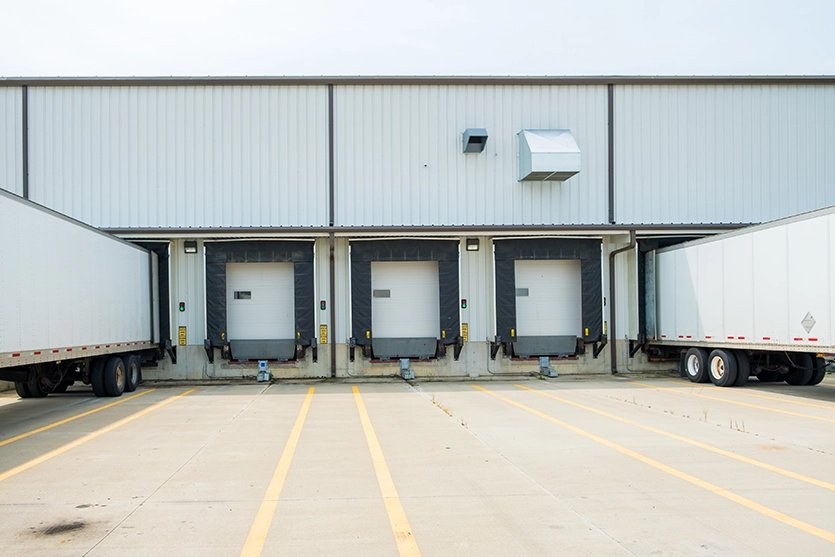
A truck terminal wears out its concrete from the outside in. Tractors turn tight, trailers drop their landing gear on the same spots every night, fuel and hydraulic fluid drip onto the ground, and a cross-dock building moves freight from one trailer to another with forklifts running back and forth across the dock edge all shift. The yard around the building usually matters more than the building itself, and a terminal manager who has fought broken pavement knows exactly what to ask for.
We build slabs, aprons, trailer parking and dock pits for truck terminals and cross-docks in Odessa and along the Basin highways. Concrete placing and finishing is handled by concrete trade partners, and grading, drainage and utilities go to trade partners we coordinate. A terminal lives or dies by how quickly trucks cycle through, so we lay out the pavement to match the movement of trucks first and the movement of freight second.
Concrete is the right material in the places where steel wheels, standing weight and diesel all meet, and we say so plainly when an owner is weighing options.
Pavement that follows the truck path
We start by tracing the truck paths on the site plan: entrance, scale or gate, fueling, staging, dock approach, trailer drop and exit. Each segment sees a different kind of load. Straight runs take moving weight, turns take shear from tight steering, and drop yards take concentrated landing gear loads for hours or days at a time. The design thickness, joint spacing and reinforcing change along the path, and so do the details at the places where a trailer wheel crosses a joint repeatedly.
The dock itself is the most demanding piece. Leveler pits, dock plates, edge angles and bumpers take impact, and the first six feet of apron in front of the doors carries more traffic than the rest of the lot combined. We pour that zone as a heavier section with dowelled joints, and we pitch the surface off the building so water and spills run to a drain rather than back toward the doors. When the dock edge is built right, the building runs quietly for years.
Terminals next to other buildings
Most terminals pair a cross-dock with another function. A distribution center may include a cross-dock lane along one wall. A logistics and fulfillment center may be built beside a truck yard that sends and receives freight. A warehouse with a few doors may serve a small carrier. The difference is usually in how many doors, how deep the apron is and how much space is given to trailer parking.
We lay out each building by its truck count and its freight pattern, not by label. A narrow cross-dock with doors on both sides needs aprons on both sides, a through-lane for tractors and a plan for drainage that does not trap water between buildings.
The buyers are mostly carriers, private fleets and logistics and warehouse developers who build the terminal and lease it. A developer wants pavement that suits many carriers, with generous aprons and a conservative section. A carrier that owns the property knows its own fleet and will often ask for more concrete in the specific places where it has seen failures before. We listen to those histories, because they point to the details that matter on that site.
Pavement and floor services behind a terminal
The yard calls for truck courts and dock aprons and often for wide concrete paving for trailer parking. The fueling area benefits from containment pads and secondary containment, so spills do not reach the soil. Washdown bays and maintenance shops need floors with drains, and some owners add trench drains and concrete drainage in key spots.
Inside the terminal building, the dock floor and the office slab are poured to the same standard as any industrial floor. Where trailers back to doors, the elevation from yard to floor is set carefully so the leveler works through its range without excess strain.
What we pour and what we coordinate
We form, reinforce, place, finish, cure and saw the concrete. That includes dock pits, aprons, trailer pads, fuel island slabs, wheel stops, bollards and the main building floor. Concrete trade partners work in sequence so the pour matches the order trucks will use the facility: the dock first, the fuel island and yard next, the parking last.
The earthwork under the yard, the underground drainage and the utilities are not work we perform ourselves. We coordinate trade partners for them, and we insist on a signed-off subgrade before the forms are set. Terminal sites are usually large, which means a lot of soil movement, and delays there can ripple through the rest of the work. Keeping the schedule clear and the responsibilities written down avoids most of the problems.
What gets reviewed and tested
Terminal projects usually carry civil drawings for grading and drainage, a structural set for the building, and paving details for the yard. Local review includes drainage, driveway access and building permits. Because trucks enter from public roads, driveway permits and sometimes highway access reviews come into play. We check that the entry aprons match the permitted curb cuts and that the pavement thickness meets the design for the highest axle loads.
Weather affects specifications here. Kermit sits at about 2,861 feet elevation with a hot arid climate, averaging 11.71 inches of precipitation a year at Winkler County Airport. Dry, hot conditions raise the risk of plastic shrinkage cracking in large yard pours, so the spec usually requires evaporation control and early curing. Monahans sits on Interstate 20 in northeast Ward County, 36 miles southwest of Odessa, which is a reminder of the distances terminals serve. West Odessa, served by Ector County Independent School District, covers about 62.7 square miles in the center of Ector County, and much of the open land there is attractive for yard use. We mobilize crews to all of these places, and we bring curing blankets, windbreaks and evaporation retarders as standard equipment.
Send the site plan and truck counts
The site plan, door count, trailer parking needs and fueling layout let us sketch the heavy zones. Tell us what traffic runs through now and we will recommend where the thickest pavement belongs.
Common Questions
Should a truck yard be concrete or asphalt?
Concrete holds up better under standing trailer weight and turning traffic, and it resists fuel and oil. Asphalt costs less up front and may suit lightly used outer lots. Many terminals use concrete at the dock and in turns, and asphalt at the perimeter.
How do you keep joints from failing at the dock?
We use dowels or load transfer devices at key joints, thicken the edge near doors and seal joints properly. The first rows of apron joints take the most punishment, so we pay attention to those details.
Can we keep the terminal running during construction?
Often, in phases. We sequence pours so some doors and lanes stay open, set temporary routes and coordinate with the dispatcher. The plan has to be worked out before mobilizing, not during.
What should the apron depth be?
It depends on the longest trailer, the turning radius and the number of doors. Common practice is to give a full tractor-trailer length plus turn room, and the civil engineer confirms with a turning study.
Will fuel and oil damage concrete?
Spills can stain and, over time, soften the surface. A dense, well-cured slab resists them well, and a sealer or containment curb adds protection near fueling and maintenance areas.