
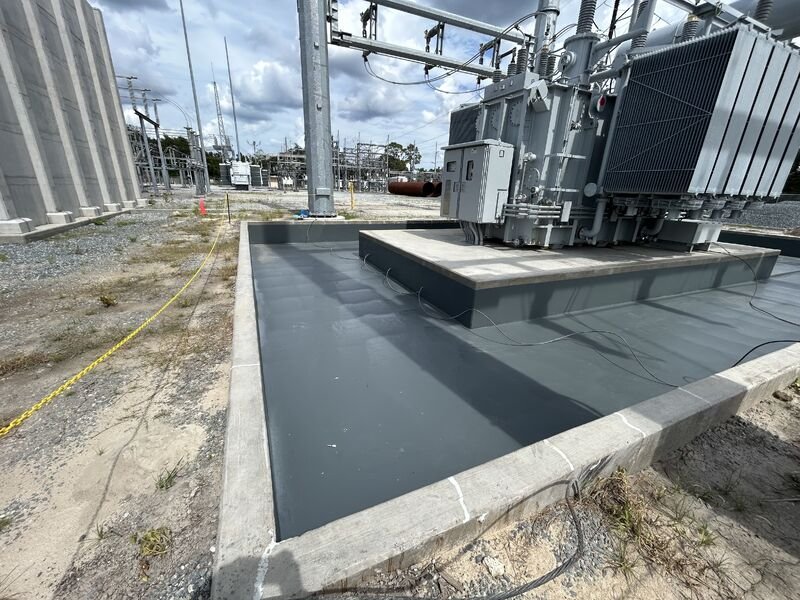
A containment pad exists for the day something leaks. A hose lets go at a transfer point, a tank valve weeps, a pump seal fails, and the liquid has to stay where the owner can find it and pump it out. The concrete is the last line, and it only works if the floor slopes to a sump, the curb is tall enough and the joints do not let fluid through.
We build containment for chemical, fuel, water and produced-fluid handling areas around Odessa. The common forms are curbed pads under tanks and pump skids, truck unloading pads, wash bays, drum storage slabs and full dike floors around tank batteries. The owner or the environmental engineer decides the volume the area must hold. We build to that dimension and mark the volume on the as-built drawing so the number is easy to find later.
Concrete in this service has to be dense, well cured and free of through cracks. That means a low water-cement mix, steady curing under wind and sun, and joints detailed with the right waterstop or sealant. We treat the work as a tight container, not a slab with a lip.
Slope, curb, joint, seal
Subgrade comes first. We compact a firm base, set the slope toward the sump or low corner, and place reinforcing to control cracking. The curb is formed and poured with the slab where the design allows, which avoids a cold joint at the most likely leak point.
Joints are the weak point. Control joints and construction joints get the sealant or waterstop the drawing calls out, set clean and tooled before the concrete is cured. When the owner specifies a coating or liner, we leave the surface to the required profile for the applicator.
Penetrations are kept to a minimum. Every pipe that passes through a curb or floor is a place for fluid to escape, so we set sleeves with sealing collars where the design allows and ask the mechanical trade to route lines over the curb when they can.
Facilities that need liquid control
Fuel and chemical storage, produced-water handling, wash racks for service trucks and unloading pads all need containment. Requests come mostly from oil, gas and midstream operators, followed by industrial and manufacturing owners who handle process chemicals.
The petrochemical complex at 620 N. Grant Avenue traces back to a 1946 natural gasoline company, added a synthetic rubber plant in 1957 and a styrene plant in 1958, and during the 1950s was the biggest operation of its kind anywhere. The area has handled hydrocarbons and chemicals at scale for a long time, and local owners expect containment to be built right, and yard managers will check the floor for cracks the day we hand it over.
What the owner, engineer and agency expect
The containment volume, the curb height and the liner or coating requirements come from the owner's spill plan or the environmental engineer, and from any agency permit that applies to the facility. We do not set those numbers. We ask for them before bidding and price the work to the stamped drawing.
Inspection typically covers subgrade, reinforcing and joint details before the pour. Some owners also ask for a hydrostatic test after cure, where the area is filled with water and watched for loss. We schedule that test into the work so the pad is not put into service early. The record of that test, with dates and readings, goes into the closeout file for the facility manager.
Parts of the same system
Containment ties into pumps and tanks that sit on equipment pads and machine foundations. It drains through trench drains and concrete drainage to sumps and treatment. Along the edges, bollards and site concrete keep vehicles from striking valves and curbs.
A rail transload or yard needs its own approach. An Odessa rail facility on 330 acres, served directly by Union Pacific, has 29,000 feet of track with loops for unit trains and ten ladder tracks, and it moves crude oil and frac sand. Facilities of that scale rely on paved pads and drainage to manage spills at transfer points.
Working beside fluids and fumes
Many containment jobs are poured at active sites. We attend the owner's orientation, follow site permits for hot work and vehicle movement, and agree on which tanks and lines are live. Ready-mix trucks use a marked route away from loading areas.
Fresh sump pits are confined spaces once they are formed. We keep covers and barricades on them, and no one enters a sump without the owner's entry permit. Cutting a cured pad for a late tie-in follows the cutting and coring practices we cover on our concrete sawing, cutting and coring page.
What moves a containment price
Volume and curb height drive concrete quantity. Coatings or liners are the next big cost, and they depend on the product being stored. Sumps, waterstops and special mixes add to labor. Sites with sandy or poor soil need base work before forming begins.
Odessa's surface water comes from O.H. Ivie Reservoir, E.V. Spence Reservoir and Lake J.B. Thomas, with Ward County well fields supplementing it. Water for curing and testing is a real line on a remote job, and we plan for hauling it where hydrants are not available.
Change orders on containment usually come from late design changes. A tank added to the dike, a pump moved or a wash bay widened changes the floor slope and the sump position. Freeze the layout before forming and the number stays honest.
Containment scope and test plan
Send the spill plan or the drawing, with the volume and the product. We will review slope, joints and cure so the area is ready for the hydrostatic test.
Common Questions
How high should the containment curb be?
The height follows the volume the owner must contain, which comes from the largest tank or the applicable rule. Many curbs are a foot or less, but the number depends on the design. We build to the stamped drawing.
Do containment slabs need a coating?
That depends on what is stored. Plain sealed concrete handles some water and fuel service. Aggressive chemicals call for a coating or liner chosen by the owner or the engineer. We prepare the surface for the product they pick.
Can rain be a problem inside a containment area?
Yes. Stormwater collects in a curbed area and has to be released or pumped according to the owner's plan. A sump and a valve or pump arrangement is normal. We build the sump to drain clean and keep it accessible.
Can an existing slab be converted to containment?
Sometimes. The slab must be sound, and a new curb or berm can be added with dowels and sealed joints. A slab with deep cracks or poor base needs repair or replacement first. We inspect the pad before offering a price.
How do you keep wind and sun from cracking the pad?
We pour early, keep the mix controlled, and cover the surface right after finishing with blankets or curing compound. In hot, windy conditions we add fogging or windbreaks. A cracked containment floor is a failure, so curing gets a dedicated person.
Who tests the finished area before use?
The owner or the environmental engineer sets the test. A common method fills the area with water to a marked level and watches it for a period. We drain, clean and hand over the pad once the engineer accepts the result. Keep the test record with the facility file for later audits.