
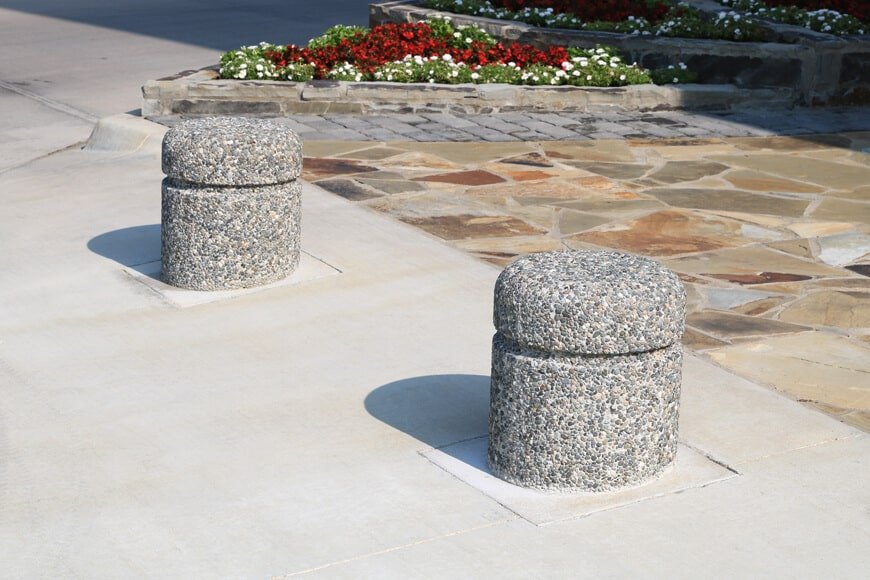
Bollards earn their keep once. A forklift backs out of a bay, a service truck swings too wide at a corner or a driver misses the gas meter, and a steel pipe full of concrete takes the hit instead of the wall. The pipe is only as good as its footing, and the footing is only as good as the hole it sits in.
Site concrete is the small stuff around a building that makes the lot work: light pole bases, sign footings, dumpster pads, equipment pads, curbed islands, wheel stops, fuel island slabs, guard post footings and truck-scale pits. None of it is large. All of it gets hit, driven over or leaned on every day, and a poor one is visible from the road.
We pour these items for shops, yards, stores and plants around Odessa, often as a package after the main slab is done. A single trip of the crew and one pump or chute run covers a long list, which is cheaper than calling a separate crew for each footing.
Lots that earn their keep
Oil is the base of the Andrews economy, and the county has produced more than a billion barrels since its first well in 1929. A county built on oil is full of yards, shops and equipment lots where trucks move all day, and every one of those lots has protection posts, light bases and pads to match.
The I-20 widening through Midland and Odessa is a $424 million TxDOT program that started in 2024, with extra main lanes, new interchanges and one-way frontage roads, and it should be fully open in 2028. Frontage-road changes alter how traffic enters adjacent lots, and driveways, islands and guard posts often get rebuilt to match.
Items we pour and how
A bollard starts as a hole, either drilled or formed, with a steel pipe stood in the middle. We fill the hole with concrete, crown the top so water runs off, and fill and cap the pipe. Light pole bases carry anchor bolts held in a template, set to the pole maker's layout. Pads, islands and curbs are formed, reinforced as needed and finished with a broom.
Footing depth comes from the design and the soil. Crash-rated posts need deeper, wider footings than guard posts that mark a boundary. We build to the drawing and ask the engineer when the site conditions do not match.
Dumpster pads and equipment pads are poured thicker than a sidewalk, with edges thick enough for a loaded truck wheel. Fuel island slabs are sloped to a drain and finished with a heavy broom. Wheel stops and curbed islands are formed and poured as part of the same pass, so the lot has one consistent set of edges.
Layout, plumb and early cover
Every post gets braced on two sides and checked with a level before the first shovel of concrete, because a leaning post stays that way for the life of the lot. We locate utilities before we dig, since a footing hole near a gas line is a risk.
Hot, windy conditions affect small pours too. A bollard footing is placed in the morning, covered with a blanket or compound and checked in the afternoon. Wind can knock a loose brace, and the foreman looks at every post before leaving. We also mark each footing with paint or a flag until it has cured so nobody backs a truck across it.
One mobilization, many small items
We group footings and pads by type and by location so the crew can work along the site in one pass. Layout comes first, with stakes for every item, then drilling or forming, then steel, then the pour. Small items can be poured by chute from a mixer truck or by wheelbarrow, which saves a pump.
Gardendale is about 14 miles north of downtown Odessa, the county seat, and is part of the Odessa metropolitan statistical area. Trips like that are planned so the crew spends its day pouring, not driving, and we combine nearby items on the same visit. A short list of items still needs a mixer truck, so we ask the plant about minimum loads and short-load charges when we price.
Where small concrete joins large
Bollards protect pads and slabs we build elsewhere. They go with equipment pads and machine foundations, containment pads and secondary containment and the slopes in trench drains and concrete drainage. They also line ADA ramps and accessible routes.
For owners in oil, gas and midstream and utilities and energy companies, post protection around meters, valves and tank piping is a routine request. Those owners often send a list of locations tied to a safety audit, and we work through it in the order that suits their calendar.
Where we set posts
Crews are sent to Odessa, West Odessa, Gardendale, Monahans, Andrews, Kermit and the oilfield stretches between them. Oil was discovered on July 16, 1926, in the Hendrick oilfield near Kermit, which started the town's boom, and the equipment yards that followed still need protection today.
Odessa draws water from Colorado River lakes by way of the river municipal water district, and wells in Ward and Ector counties add to it. Water for concrete is hauled where hydrants are not available, and we plan for it on remote lots. Drive times to the far corners of the Basin are included in the price, and we say so on the estimate.
Post and pad list
Send a site sketch with the bollards, bases and pads you need. We will price each item by type, check for utilities and tell you what can be poured in a single visit.
Common Questions
How far into the ground does a bollard go?
The drawing sets it. A guard post at a door may sit a couple of feet down, while a crash-rated unit needs a much deeper and wider base. Soil and the vehicles in play also change the number. We build to the manufacturer's detail.
Do I need bollards at every door and gas meter?
Not always, but they are a common safeguard where vehicles can reach equipment. The fire marshal, the utility or the insurer may require them. We can advise on layout, and the owner decides the final spacing.
What size pipe should a bollard use?
Common sizes run from four to eight inches in diameter, filled with concrete. Heavier traffic calls for thicker walls and bigger pipe. The drawing or the supplier gives the size. We do not change it in the field.
Can you move an existing bollard?
Yes. We cut or pull the old post, patch the hole and set a new one in the right spot. The footing may be removed or abandoned, depending on depth. We check for utilities near the new location first.
Will bollards fail if a truck hits one?
Any post can fail if the impact exceeds its design. Crash-rated systems are tested and engineered for known speeds and weights. Standard guard posts protect against low-speed bumps. Tell us the risk and we help match the system.
What do you need to quote the work?
A site plan with the post and pad locations marked is best. Add the pipe size, the type of use and whether the area is paved. Photos help. We check for utilities, confirm the access route and give a price by item, with a total.