
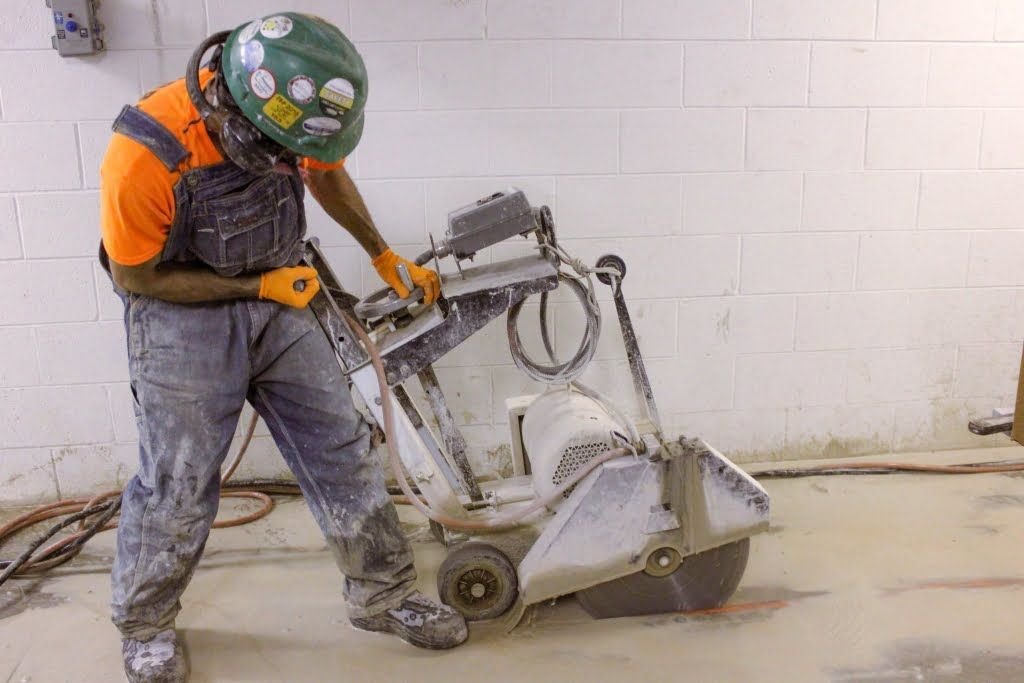
Cutting concrete is the step that lets every other trade in. A plumber needs a trench through a shop floor. A machine installer needs a pit. A new door goes into a block wall. A pump needs a hole through a slab for a suction line. Each of those starts with a saw or a core bit, and each goes better when the cut line is planned and the steel inside the concrete has been found first.
We cut slabs, walls, curbs and pavement around Odessa with flat saws, wall saws and core rigs. Typical jobs include trench cuts for underslab utilities, openings for doors and overhead doors, pipe penetrations, joint sawing in new slabs, expansion joints in old ones and removal of damaged sections before a patch or a replacement.
The method depends on the thickness, the steel and the surroundings. A thin slab on a quiet site gets a quick cut. A thick wall next to occupied space gets a wet cut with slurry control and barriers. In every case, the plan is to cut only what is needed and leave the edges clean enough that the patch will bond.
Cutting, removal and placement responsibilities
Concrete trade partners run the saws and core drills for flat work, trenching cuts and wall openings. We scan the concrete first for reinforcing, conduit and post-tension tendons, mark the cut lines, and set up water and slurry handling before the blade starts.
Where a cut leads to a larger removal, we coordinate trade partners for breaking, hauling and disposal. Where it leads to a new pour, concrete trade partners handle forms, dowels and placement, which keeps the sequence tight and the edges true. On bigger jobs we confirm that the cutting partner has spare blades and backup drilling capacity so a worn bit does not cost a shift.
Where cutting leads next
Most cutting is the front end of another job. A trench cut leads to utilities and a trench drains and concrete drainage install. A cut-out slab leads to concrete repair and restoration. Removal of a whole pad leads to concrete demolition and removal.
In new work, saw-cut contraction joints control cracking. The timing of that cut, early enough to beat the crack and late enough to avoid raveling, is a call made by the foreman on the day.
Owners who call for cuts
Plant maintenance groups, service company shops and contractors tied to oil, gas and midstream ask for cutting most often, because equipment changes quickly. Utilities and energy companies cut for conduit and cable, and industrial and manufacturing owners cut for new lines and pits.
In May 2026 Liberty Energy opened an Odessa campus that puts more than 1,400 employees in one building, with room to test equipment as its power generation business grows. Facilities that test and house equipment change their floors often, and every change starts with a cut.
Silica, slurry and steel
Dry cutting concrete releases respirable silica, so we cut wet or use vacuum collection, post the area and wear the right respirators. Slurry is collected and removed, not left to run into drains or soil.
Hitting a hidden line is the biggest risk. We scan, review the drawings and ask the owner about known conduits and pipes, and we hand-expose when scanning is unclear. Lockout and permit rules on active plant floors are followed before any blade goes into concrete. Overcut corners, where a saw blade runs past the corner of an opening, are avoided or limited when the slab is structural, and we drill the corners first so the cut stops where it should.
Structural cuts and approvals
A cut through a slab is usually minor, but a cut through a beam, a wall or a post-tensioned slab is a structural issue. The engineer must approve those cuts, and the building permit may need an amendment. We ask for the approval before we mobilize.
The Permian Basin spans over 86,000 square miles. The Delaware and Midland basins sit on either side of the raised Central Basin Platform, and Odessa and Midland serve as the headquarters for basin activity. A basin run out of Odessa and Midland works on many sites with different owner rules, so we confirm each site's permit and hot-work requirements before we cut. Many yards and plants also require a safety orientation and a daily sign-in, which we handle when we arrive.
What changes the price
Cut length and depth set the baseline. Blades wear faster in hard aggregate, thick slabs take more time, and wall cuts need more setup. Access, water supply and slurry removal add to the total. Night work and short notice change the price too. A cut that must be finished before a shift starts is priced differently from one that can run all day.
Disposal of cut-out pieces is another line. Small cores go in a bin, while a large slab section needs a loader and a truck. We keep the pieces sized to what the site can handle, and we separate steel from concrete when the hauler asks.
A scan before the cut costs little compared with hitting a line. We include scanning as a line item, and we provide a price per linear foot for the cut and a price per hole for coring, with the breakout on the estimate. If the owner wants a lump sum for a package of cuts, we can offer one once the scan results are in.
Cut list and scan schedule
Mark the cuts on a drawing or in the field and tell us how thick the concrete is. We will scan, set the water plan and book the saw for the hours your shop can spare.
Common Questions
Can you cut a trench in an occupied shop?
Yes. We use wet cutting or vacuum collection, set barriers and limit the cutting to hours that suit the shop. Noise and dust are controlled but not eliminated, so we agree on a schedule with the manager first.
What does scanning find?
Scanning shows the position of rebar, conduit and often post-tension tendons. It does not show everything, so we pair it with drawings and owner knowledge. If a result is unclear, we expose the concrete by hand before cutting.
How deep can you saw?
Depth depends on the blade and the saw. Flat saws handle ordinary slab thickness easily, while thick slabs and walls may need wall saws or wire cutting. Tell us the thickness and we will pick the method.
Do you core through floors for pipes?
We do, from small sleeve holes to larger penetrations. Holes are located from the drawings and marked with the trade. Cores are done wet, and the slurry is removed. We fill and fire-seal only if the scope includes it.
When should joints in a new slab be cut?
As soon as the surface can take a blade without ravelling, usually within hours of finishing. In hot, windy weather the window is short and cracking starts quickly. We plan staff and saws so the joints are cut on time.
Who removes the water and slurry?
We do. Wet cutting produces a gray slurry that cannot go into storm drains or onto soil. We collect it with a vacuum or berm, and either dispose of it as the site rules require or hand it to the owner's waste stream. Ask us about any site rule on discharge.