
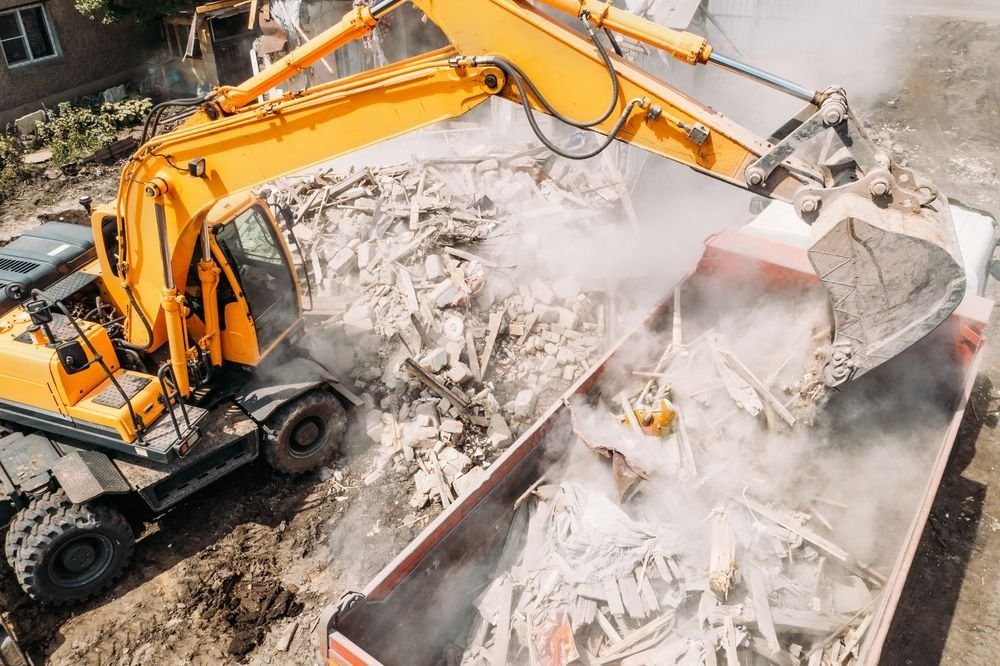
Tearing out concrete looks simple until the first slab turns out to be a foot thick, the rebar is doubled and the utility the owner swore was somewhere else is two inches under the surface. Demolition is a planning job as much as a breaking job, and the plan decides the cost.
We remove slabs, pavement, footings, pads, curbs, walls and old foundations in and around Odessa. The jobs range from a single bay in a shop floor to an entire lay-down yard being cleared for a new building. Common reasons include a failed base, a change of use, new equipment, a site sale or a lot that must be cleared before construction.
A good removal leaves the next trade a clean, stable subgrade. That means breaking to the specified depth, loading out every piece and sorting steel from concrete, then walking the area with the owner to confirm what is left in place. When a patch is cheaper than a full tear-out, we say so.
From saw line to loaded truck
Work starts with a survey of the concrete. We check thickness, reinforcing and any known lines beneath. Then comes cutting the limit of the removal so the edge stays clean, breaking with hydraulic hammers or crushers, and loading the pieces for haul-off. Reinforcing is cut and bundled for recycling when the market allows.
Footings and thick foundations take heavier equipment and more time. For limited work inside a building, we use smaller machines and handheld breakers, and we cover the finish work that follows in concrete sawing, cutting and coring.
Callers are mostly general contractors and CM firms clearing a lot before new construction, owners in municipal and public works replacing pavement, and yard managers who need a bay or pad removed in a weekend. Each wants the same result, a clean surface and a dated finish.
Thickness, steel and the haul
Price follows volume, thickness and reinforcing. Thick slabs and mat steel cost more per square foot. Access matters too, since a small machine inside a building works slower than an excavator on open ground. Haul distance and disposal fees complete the total.
Soils in Upton County are sandy loam with limestone often showing at the surface, and caliche and limestone are its mineral resources. In much of the region, clean broken concrete can often be crushed and put back as base course, which lowers disposal cost. We ask the owner and the engineer whether recycled material is acceptable on the next stage.
What follows the removal
After the concrete is out, the ground needs attention. Soft areas may call for a new base, and concrete repair and restoration covers the cases where only part of a slab goes. New work may start with rebar placement and concrete formwork before the pour.
A removal that exposes a settled area may also lead us to talk about concrete leveling and slab lifting on adjacent panels. We keep those options on the table before the crew leaves the site. The subgrade left behind is checked with a probe or proof roll, and soft spots are flagged for the earthwork trade before forming starts.
Roads that bring the equipment
We mobilize crews and equipment to Odessa and along the corridors that connect it to the other Basin towns. As the Ector County seat, Odessa is reached by I-20, by US 385 along Andrews Highway and Grant Avenue, by SH 191 on 42nd Street and by Loop 338. Those roads shape the trucking schedule for hauling debris, and we plan around rush hours and rig traffic.
Heavy trucks account for about 22 percent of the traffic now on SH 302, and counts between US 285 and SH 115 about doubled from 2015 to 2019. Routes like that are busy with oilfield trucks, so we schedule haul-off outside peak hours when we can. Work near West Odessa and Gardendale follows the same planning.
Plan the removal, then break it
We start by finding out what is below the surface and what the owner wants to keep. The break plan sets the order, the direction and the staging of debris. Dust is controlled with water, and nearby equipment is covered when the wind is up.
Sand and wind are always in the plan. A broken slab leaves loose surface material that blows into neighboring bays, so we wet the area, remove fines and sweep the work edge before the crew leaves. The result is a base ready for the next contractor, not a site to be cleaned again. At the end of each day the crew stockpiles debris away from traffic, covers open pits and leaves the gate in the condition we found it.
Breaking, dust and flying chips
Demolition throws chips and makes noise. We set exclusion zones, use shields and guards, and keep the public and other trades away. Operators work from positions that keep them out of the fall line of the slab. In windy weather we wet the work, hang barriers against blowing dust and delay a break if the neighboring bays cannot be protected.
Silica dust is controlled with water and ventilation. We identify hazardous materials before work begins, since old coatings, sealants or contaminated soils require special handling. Utilities are located, marked and protected, and the first break is made by hand where a line is possible. Anything that looks like a pipe, cable or tank gets a stop, a photo and a call to the owner before work continues.
Removal survey and haul plan
Tell us what comes out, how thick it is and where the debris can go. We will walk the site, price the break and give you a day count so the next crew can be lined up.
Common Questions
How thick is a typical slab we have to break?
Shop and yard slabs run from about four inches to a foot or more, and some have two layers of steel. We core or test the slab first. Thickness and steel decide the equipment we use and the schedule.
Can you recycle the broken concrete?
Often yes. Clean concrete can be crushed to produce base material or fill, which reduces disposal costs. Contaminated concrete cannot be reused. We discuss options with the owner and the engineer before the job.
Do I need a permit to demolish a slab?
Interior slabs and small pads may not need one. Foundations, structural elements and pieces tied to a building usually do. The local permit office can tell you. We help gather the documents for the application.
What do you do about utilities under the slab?
We locate and mark them before work. Where records are unclear, we expose lines by hand and break around them. The owner should tell us about any private lines, since a public locate does not mark them.
Can part of a slab stay while the rest is removed?
Yes. We saw the boundary so the edge is straight and the remaining panel is not damaged by the break. A dowelled joint can then tie the new pour to the old. The cut line is agreed with the owner and the engineer first, since it can set the layout of the new work.
How long does a removal take?
A small pad is a morning. A shop floor can take a few days, and a yard can take a week or more, with haul-off often setting the pace. We give a day count after the survey and update it if the slab turns out thicker than expected.