
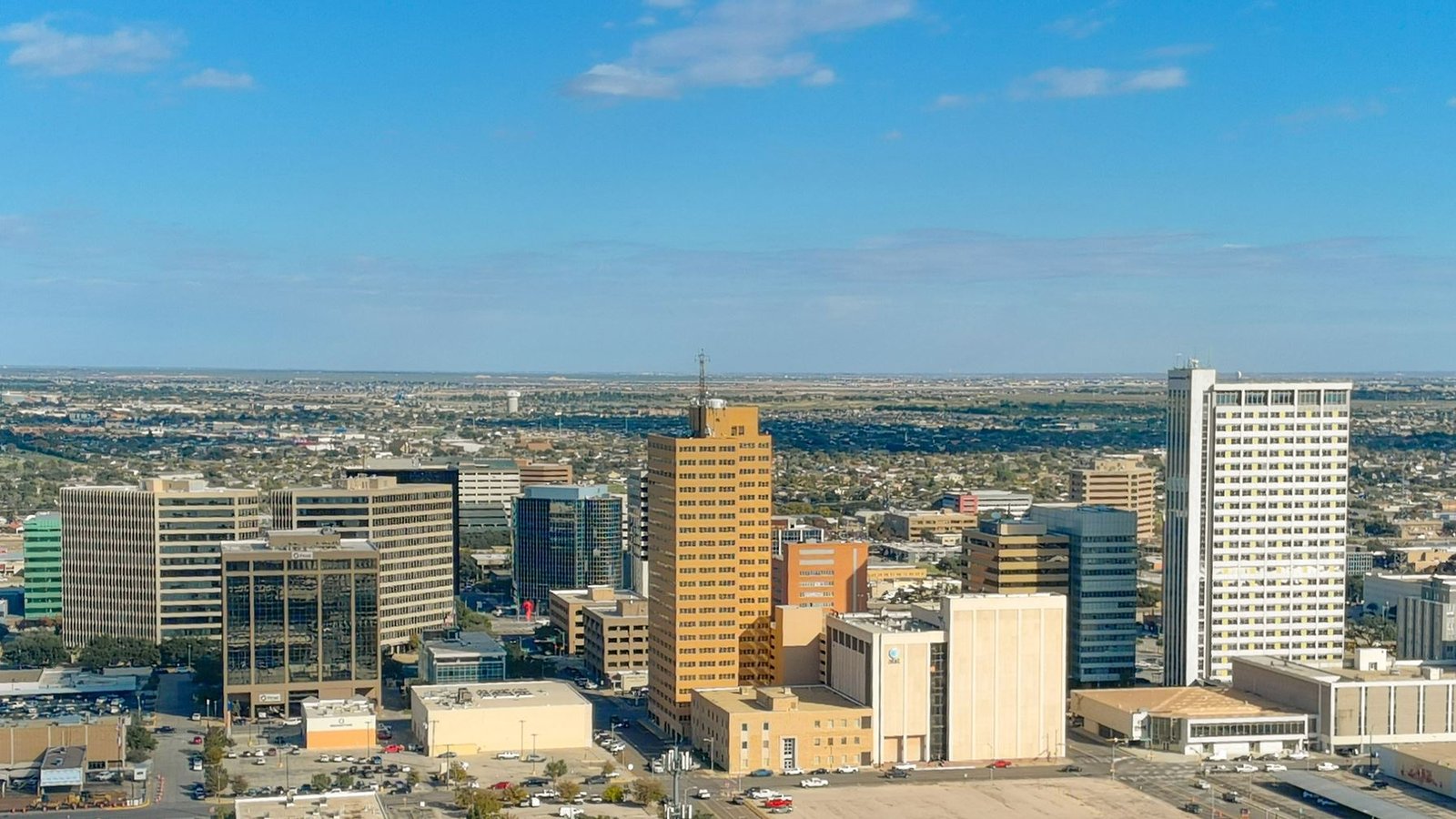
A yard manager in Midland wants a lay-down area that takes loaded trailers the first week and still sheds water after a hard rain. That is the concrete we build: service yards, equipment staging lots, shop aprons and the plain commercial pads that keep a working city moving. We price the dirt, the base and the pour as one job, because a yard slab usually fails at the same spot every time, and that spot is where the trucks turn.
The ground is high and flat, near 2,779 feet in elevation, and Midland Draw cuts across the north end of town. Low ground along a draw changes how we set grades, where the inlets go and how much edge a slab needs, so we walk the site before anyone agrees to a finished elevation. Interstate 20 carries the long haul, and Business I-20 runs down Wall and Front streets along the old US 80 line. State Highways 158, 191 and 349, along with Loops 40, 250 and 268, bring trucks to the yards on the edge of town. A lot close to one of those routes keeps the ready-mix ride short, which counts on a hot day when the clock on the truck is the real schedule.
Utilities and earthwork go to trade partners we line up, and concrete trade partners handle the concrete. We mobilize crews to Midland for owners, general contractors and developers who need a yard, a shop floor or a staging pad built to a drawing and a date.
What moves the price of a yard slab
Axle load sets the section. A lay-down area for pipe racks and forklifts needs less than a truck apron where loaded tractor-trailers brake and pivot, and we size thickness, reinforcement and dowels to the heaviest wheel that will cross the pad. Subgrade comes next. Caliche base that has been proof-rolled and trimmed to grade costs money up front and saves it later, so we separate base work from concrete in the numbers and let the owner see both.
Joint layout, edge thickening at approaches and curing method add to the total. So do night pours in summer, trucking distance and the number of mobilizations if the yard goes in by phase. We offer alternates where a thinner section can serve the lighter corners of a yard, and we say plainly where we would not cut.
Who does what on a Midland job
Concrete trade partners build the forms, pour, finish and saw the slab, then cure it. Utilities and earthwork stay with trade partners we coordinate: the trenching, the subgrade work, the drainage pipe. We schedule them so the base is ready when the concrete trucks are, since an idle pour crew costs the same as a working one.
That split keeps the field simple for a yard manager. One contractor holds the schedule, one party answers for the finished surface, and the pieces that need a specialist go to people who do that work every week. The reinforcing trade partner handles rebar placement, and the forms are built by the same people who will strip them.
Midland and the edges of town
We work across Midland proper and the industrial edges where yards cluster, and we reach the east side of the metro from our Ector County work. Many jobs sit between Midland and Odessa, near the air and space port, where shops and staging yards share roads with airport traffic. If your site is on the Odessa side, our Odessa page covers that ground.
Gardendale to the north and Andrews to the west each feed Midland's supply chain, and crews often move from one to the other in the same week. See Gardendale for the northern yards.
Wind, dust and the draw
Weather records at the airport put annual precipitation near 13.51 inches, hot days that reach 100 degrees F or more on roughly 24 of them, and 58 mornings that start at freezing or colder. That range matters to a pour. Summer slabs need evaporation control, a curing blanket on the surface the moment it can take one, and a finishing crew sized to beat the sun. Winter mornings call for protection and a later start.
Wind-blown sand lands on fresh concrete and on the forms ahead of it, so we keep the placement area clean and cover finished work. Our guide to hot and windy weather concrete explains the measures. Near Midland Draw, we also check where water goes before we trust a drain to carry it.
Buildings that sit on these slabs
Most of our Midland floors serve shops, equipment buildings, parts warehouses and small manufacturing bays. A warehouse floor wants flatness and joint control for forklifts, and the apron outside it wants thickness and slope. Shop floors for heavy repair need extra reinforcement where lifts and jacks concentrate load.
General aviation tenants near Midland Airpark build hangars and ramps with their own demands on slab flatness and door thresholds; our aircraft hangar work follows the tenant's drawings and the airport's rules.
Airport projects and the contractor pool
The air and space port, Midland International, lies midway between Midland and Odessa. On October 29, 2025 the city began building a larger terminal there, adding four TSA checkpoint lanes with room for six, inside a $150 million package of city improvements that is due to finish in 2027. Federal grants cover roughly $29.1 million of the terminal work, and the FAA had already cleared the airport as a commercial space launch site on September 17, 2014.
We do not claim any of that work. We mention it because large public projects draw crews, ready-mix and finishers, and a yard owner who plans a pour for the same quarter should book early and keep dates firm with us.
Services that usually travel with a yard
Yards rarely need only a slab. Trucks that drop pipe or fluids call for truck courts and dock aprons sized to the traffic. Where fluids are handled, we add containment pads and secondary containment that include curbs, sumps and a joint sealant matched to the product.
Sawcutting, curb and gutter, trench drains and bollards all ride along on the same mobilization, so the yard gets finished in one visit.
Who calls us in Midland
Oilfield service companies, midstream operators and industrial owners make up the bulk of the calls. Oil, gas and midstream clients usually bring a drawing and a date, and we build to both. General contractors and developers call for the commercial pads and shop floors that go with a larger building project.
Whoever signs the work order, the questions are the same: what rolls across it, where does the water go, and when can the yard open.
Send the site and the loads
Tell us what drives across the pad, where the lot sits in Midland and when the yard needs to open. We will walk it, check the grades, and talk through a phased pour.
Common Questions
How thick should a Midland truck yard slab be?
It depends on the heaviest wheel load, the subgrade and how often loaded trucks turn on the pad. We ask for the truck types and weights, look at the base, and set thickness and dowels from that. A light staging lot and a fully loaded apron do not get the same section.
Can you pour in a Midland summer?
Yes, with a plan. We schedule early or night placements, control evaporation, cover the slab with curing blankets and run the finishers ahead of the sun. Days that reach 100 degrees F or more are manageable when the work is sequenced for them.
Does Midland Draw affect a yard design?
On sites near the draw, yes. Low ground collects water, so we confirm grades, inlet locations and edge details before we pour. A slab that holds water ages quickly.
Who handles utilities and grading on a yard job?
Trade partners we coordinate do the utilities and earthwork, scheduled ahead of concrete trade partners. You deal with one contractor for the schedule and the finished surface.
How soon can trucks use a new yard slab?
That depends on mix, weather and the loads. We set a release date after cylinder breaks and tell the yard manager which areas open first, so deliveries are not stalled for a corner of the lot.