
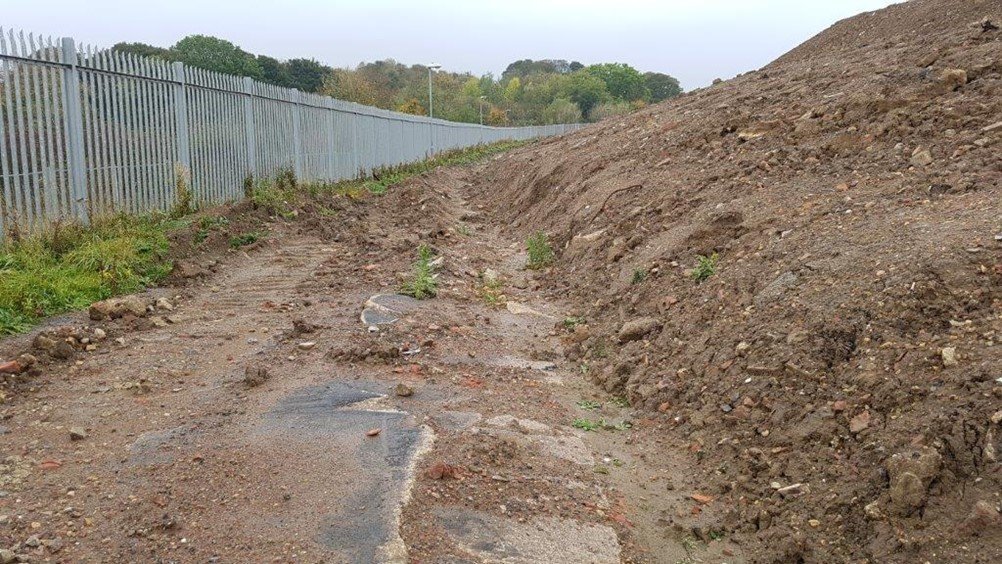
Topsoil in the Permian Basin is thin, and what there is of it takes a long time to come back. A few inches of loam over caliche is all some lots have, and once it is buried under fill or hauled away, a landscape plan that calls for grass or native planting has nothing to work with. Stripping the topsoil and storing it is the step that keeps that option open.
The work is simple to describe. The top layer, usually the first four to eight inches, is scraped off before the cut and fill begins and pushed into a stockpile that is shaped, protected from wind and rain and kept out of the way of the other trades. When grading finishes, the soil is spread back over disturbed areas that will be seeded, planted or left as open ground. Along the way, it keeps clean soil out of structural fill, where organic material is not allowed.
We plan and coordinate stripping and stockpiling on concrete, utility and development projects around Odessa, so the soil is where the landscape crew wants it and the fill is as clean as the engineer requires.
Depth, wind and where to put the pile
The stripping depth comes from a soil survey or a test pit, not a guess. If the topsoil is only three inches thick and the machine takes eight, the pile is mostly subsoil and the landscape contractor ends up with a worse product. Operators work with a laser or GPS so the cut stays at the target depth, and a spotter checks the edge of the stripped area against stakes.
A stockpile in this market has to survive wind. Loose topsoil dries and blows, so piles are kept low, shaped with flat tops, wetted as needed and covered with mulch or a seeded cover on long jobs. Piles sit away from drainage lines and from the busiest haul roads, with silt fence around the toe, and they are laid out so that wind crosses their long side rather than piling dust against a neighboring fence. We mark them on the plan, so another trade does not drive through or borrow from them.
Contamination is the other risk. Stockpiles sit near equipment that leaks, and soil that picks up oil or salt is no longer topsoil. We keep fuel and storage away from the piles and keep a record of where each pile was stripped from. If a pile is going to sit through a summer, we seed it or crust it with a binder, and we look at it after each windy spell to see whether it needs another coat.
Owners who save the soil
Commercial developers and homebuilders and multifamily developers save topsoil because a finished landscape sells a property, and buying imported topsoil late in a project is expensive. They schedule it into the front end of the job, along with clearing.
Many of Odessa's largest employers are oilfield supply and petrochemical companies, and the sites that serve them usually have little landscaping, so the main reason to save soil is reclamation, when a pad or lay-down area is retired and the ground has to be reshaped and revegetated. Having the topsoil stored makes that closeout simpler and cheaper.
Public owners and schools usually specify stripping in the plans, with a stockpile location and a spread depth, and then inspect it. We follow the specification and keep photographs of the stripped area, the pile and the respread surface. Inspectors like a sequence they can trace from the first cut to the final seed, and the photographs are what let them do that without standing in the field for an afternoon. Where the plan is silent, we ask the engineer for a depth and a pile location in writing before the equipment arrives.
Stripping sites across the Basin
Stripping happens on every new site, whether it sits in the city or out along a highway. McCamey sits on U.S. Highway 67, about five miles east of the Pecos River in southwestern Upton County, and a job out there starts with a long mobilization and a decision about whether to save soil that is thin to begin with.
Closer in, the work follows the major projects. TxDOT is putting $424 million of improvements into I-20 through Midland and Odessa, adding main lanes, new interchanges and reconfigured ramps, with the work expected to be fully open to traffic in 2028. Development along the I-20 and Loop 338 corridor follows, with new lots opened beside the improved roads, and each of those lots starts with a strip.
Buildings that begin with a strip
Education projects are good examples. Ector County ISD's $398,255,000 bond, set for a May 7, 2022 vote, was split into Proposition A for $215,255,000 (a career and technical facility, campus repairs and technology) and Proposition B for $183,000,000 for a new high school in northeast Odessa. A new school campus on open land needs its topsoil stripped before grading, saved for the athletic fields and landscaping, and tested for the use it will see.
A self-storage facility or a warehouse has less landscape and needs less soil, but the strip still matters. Topsoil left under a slab or a pavement section decomposes, settles and causes failures, so every building pad starts with the organic layer removed.
What comes before and after
Stripping usually follows site clearing and grubbing, which removes brush and roots, and comes before mass grading. It overlaps with import, export and haul-off when surplus topsoil has to leave the site or when missing topsoil has to be brought in.
At the end, spread soil is protected with erosion control until it is stable. Odessa College put a $325 million Vision 2030 bond package to voters in May 2025, including a $60.1 million new workforce training facility and a $48.3 million fine arts and performance venue, and campus projects like those involve landscape areas that need topsoil. We keep the record of stripped depth, pile volume and spread depth so the numbers can be reconciled.
Tell us how much of the lot gets landscaped
Send the site plan and the landscape sheet, along with the schedule for clearing and grading. We will lay out where to strip, how deep, where to store the soil and what the respread will cost.
Common Questions
How deep do you strip topsoil here?
Usually four to eight inches, set by a soil survey or test pit. Where the soil is thin over caliche, the cut is shallower. We confirm the depth on site before the machine starts.
Can the stockpile stay for a long project?
Yes, with care. We shape it, protect it from wind with water, mulch or seeding, and keep it away from traffic. Piles that sit for months can lose their quality if they are allowed to blow away or mix with fill.
Do we need topsoil at all on an industrial lot?
Often not for landscaping, but the strip still removes organic material from under pads and pavement. If no one will use the soil later, we can haul it off or use it in berms, depending on the owner and the plan.
What does it cost to strip and stockpile?
The price depends on area, depth, pile distance and whether the soil is re-spread. A short push to a pile on the same lot is the cheapest option. Hauling soil to another site or buying topsoil later costs more.