
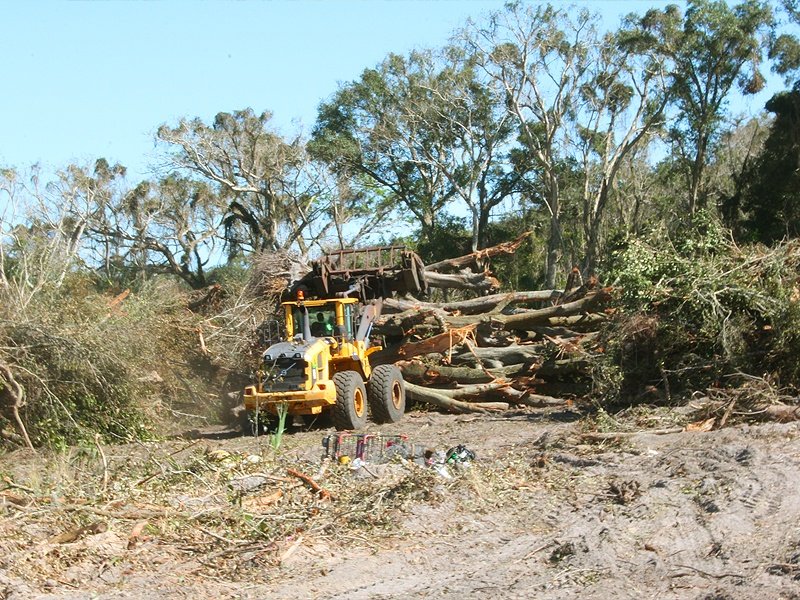
Clearing sounds like the easy part. Cut the brush, haul it off, move on. On a Basin lot it is where a project learns what it is built on. Mesquite roots run deep, old fences and abandoned pipe turn up under the sand, trash piles hide in drainage swales and the top layer of soil is rarely the soil the engineer wants under a slab. Clearing and grubbing is the first real survey of the site, done with a machine.
We coordinate site clearing and grubbing for yards, building pads, access roads, pipeline and utility corridors and public projects. Earthwork partners with dozers, excavators and haul trucks do the removal. Concrete trade partners arrive after them with the layout, the forms and the concrete, so the schedule between clearing and the first pour is as short as the permits and the weather allow.
Clearing sets the clock
Nothing else starts until the ground is open. Surveyors need clean lines to stake, utility crews need a path and the geotechnical team needs access to drill. We aim to clear early and in the order the next trades will need, starting with access and the building pad, then the utility corridors and finally the edges.
Wind is the scheduling factor here. A cleared, dry Basin lot is a dust source, and a dry spell turns the surface to powder that blows into neighboring property. We tie clearing to the next phase so ground does not sit open for weeks, and we hold water trucks on the job when the forecast calls for wind. If a long delay is expected, we stabilize with mulch or a stabilizer rather than leave bare soil. Clearing that waits for a long permit review is a risk to the owner and the neighbors, and we flag it when we see it.
Who does what in a clearing package
Earthwork partners clear, grub, strip and haul. We coordinate them, mark the limits and make sure their work matches the plans and the permits. We also manage the sequence with the survey crew and the geotechnical engineer.
Concrete trade partners handle the concrete side of clearing: temporary construction entrances, wash pads, haul road surfaces, washout areas and the permanent aprons that the clearing makes room for. We do not claim to perform earthwork ourselves. What we bring is an eye on what the concrete crews will need once the ground is open: a level pad, a clean edge, good access for trucks and room for forms. Starting with that view saves a second mobilization.
What clearing leads into
Clearing is the front end of a longer chain. Mass grading reshapes the cleared ground to the plan, and utility potholing and locating confirms what is below before the machines dig deeper. For the buildings that follow, building pad preparation covers the compacted fill that supports the slab.
On larger developments the clearing is part of land development infrastructure, where roads, utilities and lots get cleared and built in phases. We coordinate the phases so cleared acres do not outpace the work that follows.
Hazards in cleared ground
Clearing exposes things that were hidden. Old oilfield equipment, pits, wells, fences and buried pipe may all be present. We walk the site with the owner, mark known hazards and stop work if a crew finds something unexpected. Pipelines and power lines overhead and below require locates and clearances. No machine works inside the clearance limits of an overhead line without the owner's permission and a spotter.
Heat is the other danger. Machine operators and laborers work in the sun with little shade, and the summer index climbs quickly. We schedule heavy work early, provide water and rest breaks and watch for signs of heat illness. Rattlesnakes and other wildlife live in brush, so crews use boots and gloves and look before they reach. Dust control protects workers' lungs and the neighbors' property.
What a clearing package includes
The package starts with the limits: where to clear, where not to, and which trees or features are to be saved. Then comes brush removal, tree removal, grubbing of roots to a stated depth, demolition of small structures and fences and stripping of the top layer of soil. Debris is hauled to an approved disposal site or processed on site if the owner allows it.
Ward County is mostly flat, between 2,400 and 2,800 feet, with live sand dunes in the north, and conditions like that change what clearing means. In dune sand, stripping the stabilizing vegetation can release blowing sand, so we leave as much cover as the plan allows. In caliche country, grubbing is short, and the focus shifts to removing the loose surface and exposing the hard layer the engineer wants to see.
Where clearing costs come from
Acreage and vegetation density drive the base price. A light mesquite flat is cheap per acre, and a lot full of old tanks, concrete and trash is not. Disposal fees and haul distance often outweigh the machine time, so we ask for the nearest approved site early. Hazardous materials found in the ground, such as contaminated soil or old drums, are not part of the clearing price and are treated as separate items.
Topsoil can be a credit or a cost. If the site needs it for landscaping, we stockpile it. If not, it is hauled off or spread. We also price erosion and dust control, because a permit usually requires them. The best way to control the price is to define the limits and the disposal plan at the start, and the second best is to hold a pre-clearing walk with the owner and the earthwork partner.
Where clearing work comes up
We take clearing work in Odessa and mobilize across the Basin. State Highway 302 covers 83.2 miles, starting at US 285 in Reeves County and passing Kermit, Notrees and West Odessa before it meets Loop 338 and I-20 at Odessa. TxDOT's Permian Promise project calls for a divided four-lane highway over about 59 miles of it, running from US 285 west of Mentone to FM 2019 east of Notrees. A project of that kind needs wide corridors cleared well ahead of grading.
For private owners, including oil, gas and midstream operators, along the Kermit, Wink and Monahans corridor and in Rankin, clearing often precedes yards, tank batteries and shops. Rankin is served by US Highway 67 and State Highways 329 and 349, and heavy equipment moves on those roads to reach the work.
Permits and stormwater rules
Large clearing jobs trigger stormwater permitting, and the owner or contractor of record must have a pollution prevention plan in place before the soil is disturbed. Silt fences, inlet protection and stabilized entrances belong on the plan, and inspections are required after rain. We help the owner keep the plan current as the work advances.
Other approvals depend on the site. Floodplain work may need a permit from the city or county. Work near a state road needs a TxDOT driveway or right-of-way permit. Demolition of structures needs a permit, and some sites require a survey for protected species. The University of Texas Permian Basin is turning its central quad into Fiona's Court, which will have a stage, seating, fire pits and water features by February 2027, and campus work like that goes through its own review. We find out which reviews apply before the first machine arrives.
Walk the lot with us
Send the survey, the limits of work and the disposal preference. We will walk the site, flag the hazards and give you a clear sequence that gets the pad ready for survey, utilities and the first forms.
Common Questions
Do you remove stumps and roots?
Grubbing removes roots to a stated depth, usually a foot or two. Deeper roots are removed where a foundation or pipe needs them out. The earthwork partner uses the right machine and the engineer approves the depth.
What happens to the brush?
It is hauled to an approved site, chipped for use on the property or burned where local rules allow. Burning is rare because of wind and fire risk, so we plan on haul-off.
Can we save some trees?
Yes. We mark the trees to keep, fence the drip line and keep machines out. Trees survive better when grade changes near them are avoided.
How do you control dust?
Water trucks, stabilizers, limiting open acreage and timing. The plan names the method, and we adjust it to the wind.
How soon can concrete follow?
After clearing, the site needs rough grading, compaction and testing, so concrete is usually weeks away. On a small yard, the sequence can be quick if the geotechnical work is done.