
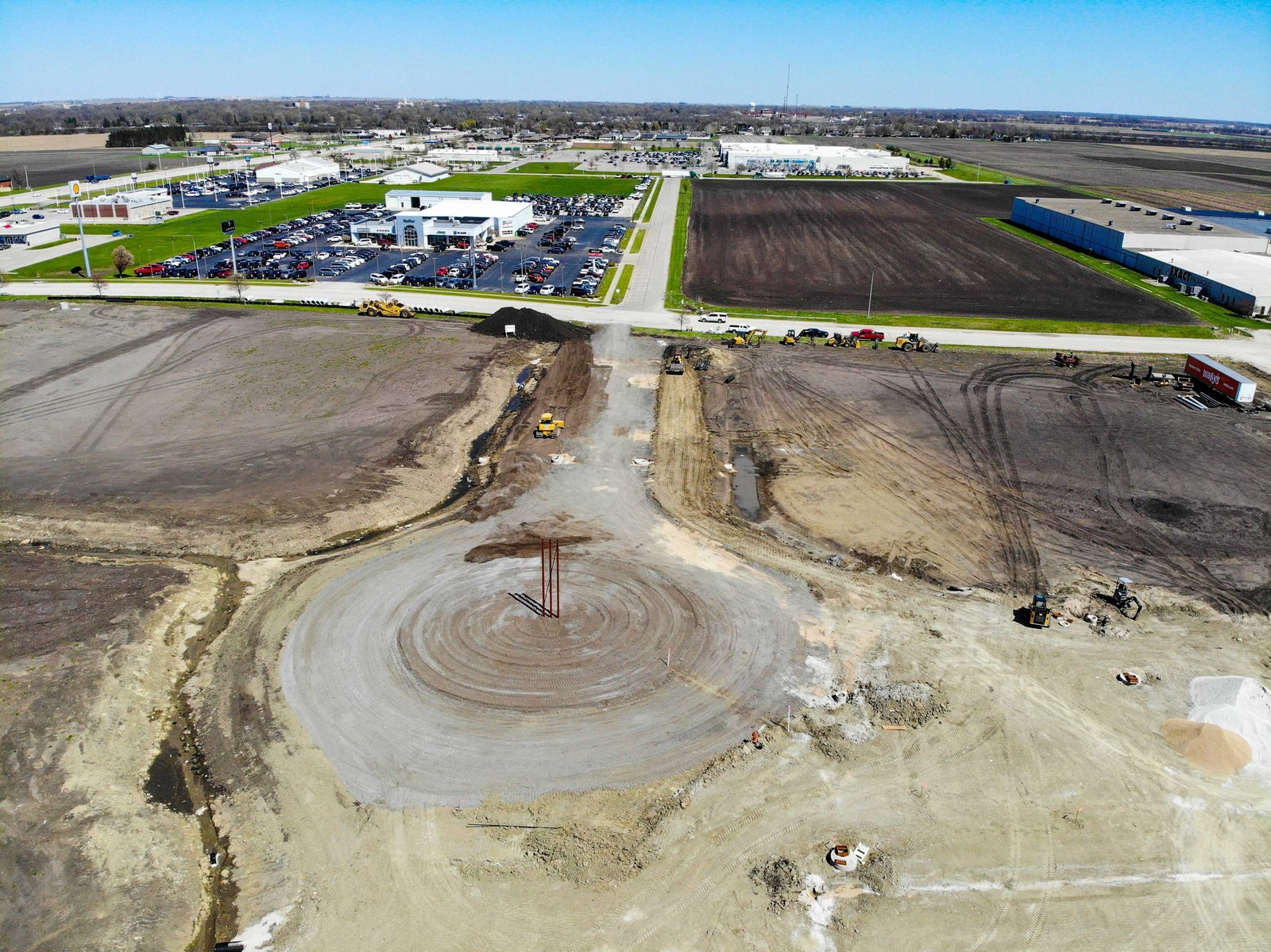
On a flat Basin lot, a few inches of grade decide whether water leaves the yard or sits at the dock doors. Mass grading is the earthwork that sets those inches over the whole site at once. It moves large volumes of soil from high spots to low spots, shapes the pad for the building, builds the ditches and basins and leaves a surface ready for fine grading, utilities and base.
We coordinate mass grading for service yards, industrial pads, commercial sites, subdivisions and public projects around Odessa. Earthwork partners with scrapers, dozers, graders and compactors do the cutting and filling. Concrete trade partners prepare for the concrete that follows, so the finished surface suits the slab, the apron and the drainage that the engineer designed.
Coordination, not earthwork, is our part
The machines and operators belong to our earthwork partners. We do not claim to perform the earthwork. We set up the job, review the grading plan, mark conflicts with the slab plan and keep the schedule between grading, testing and the first pour.
Where we add value is the concrete view. We know what a finished slab pad needs: a firm, level surface with proper moisture and density, and edges that extend past the building line. We know where thickened edges and slab depressions will fall, and we ask that the grade allow them. When the grading plan and the structural plan do not agree, we raise it before the dozers are working. An hour of coordination early saves a week of regrading later.
What the ground gives you
West Odessa's soil is shallow gravelly loam over caliche and gypsum, with caliche pits scattered across the southwestern part of the community. That mix has trade-offs. Caliche, once broken and compacted, makes a good fill and base, so on-site cut can often be reused. But gypsum is soluble and can cause settlement if water gets to it, so the geotechnical engineer may call for moisture control and a barrier under pavement.
Wind and dust are the practical hazards. A graded lot with no cover blows, and a graded lot with water on it turns sticky and unworkable. We schedule water trucks and compaction together and shape the grade so that a rain event drains instead of ponding. Balanced earthwork, where cut matches fill, is the most economical design. When it does not balance, import and export are needed, and each adds haul cost. The plan should say which way the site leans before the first bid.
Why grading is busy here
Grading demand follows the Basin's growth. In 2026 Liberty Energy brought more than 1,400 employees, formerly spread over several local sites, into a new Odessa operations facility that the Odessa Development Corporation helped make possible. Facilities of that scale need acres of graded pad, yard and access, and they show how industrial and manufacturing owners are consolidating operations onto larger sites.
Healthcare is another driver. Medical Center Hospital in Odessa has 402 beds and is a Level III Trauma Center; it opened in 1949 as an 85 bed hospital and grew through a three-story addition and two seven-story towers. It employs 1,977 people, the second-largest employer in Odessa. Each phase of that growth involved earthwork for new buildings, parking and drainage, and continued expansion in the area will require more. Our healthcare hospital page explains how we work with owners on campuses like these. Mass grading starts the program for all of them.
Sequencing the dirt
Grading follows clearing and precedes everything else. The usual order is strip, rough cut and fill, compact and test, set drainage, and then fine grade. We try to finish the large cuts and fills in dry months, when compaction is easiest and haul trucks do not bog down. In the Basin, that is most months, but a single heavy rain can set a project back several days.
The schedule hinges on testing. Each lift of fill is tested for density and moisture before the next goes on, and the testing agency must be on site when the work happens. We coordinate the lab schedule with the earthwork crew. Weather windows, hauling restrictions and the availability of water are other constraints. When the grading is done, we survey the pad, compare it to the plan and hand the site to the utility and slab crews. See fine grading for what comes next.
Pads for what gets built
A warehouse needs a large, flat pad with consistent bearing, a graded apron for trucks and a drainage path from the building to a basin. A manufacturing plant adds heavier loads, equipment pads and containment areas. Offices, schools and clinics need pads that suit smaller footprints but demand tighter tolerance at the slab.
Truck yards and laydown areas care about a different surface: one that drains quickly, resists rutting and supports concentrated axle loads. In these cases the grading plan and the paving plan are linked, and we coordinate them. Along the Interstate, West Odessa sits north of I-20 with access from exits 104, 108, 112 and 113, and sites there are often graded to meet frontage road elevations. We check the finished grade against the road at the driveway before the earthwork ends.
Plans, permits and approvals
The responsible city or county reviews the grading drawings. For large sites, the approval package also includes stormwater permitting and a pollution prevention plan. The geotechnical report sets compaction, moisture and lift thickness, and the specifications set tolerances on finished grade. Floodplain and drainage reviews may apply, and work near state roads needs TxDOT approval.
We help owners prepare the submittals and keep copies on the site for inspectors. As-built grades are surveyed and compared to the plan, and any deviation is explained to the engineer before it gets covered. The owner receives a record of the compaction tests and the survey, which helps later when someone asks what is under the slab. For subdivisions and larger developments, see land development infrastructure, where grading is part of the larger improvement plan.
Start with the grading plan
Send the grading plan, the earthwork quantities and the soils report. We will check the pad elevations against the slab plan, schedule the compaction testing and tell you what the site needs before the first dozer starts.
Common Questions
How much does mass grading cost per acre?
It depends on the volume moved, the haul distance and the soil. A balanced site costs far less than one that imports or exports. We prefer to price from the grading plan quantities and the geotechnical report rather than guess.
Can on-site caliche be used as fill?
Often, yes, if it meets the specification. The engineer approves it after testing. It compacts well when moisture is right, but it does not like to stay wet.
How do you handle wind and dust?
With water trucks, limited open acreage and prompt stabilization. The stormwater plan names the measures, and we adjust them to the weather.
When can utilities start?
After rough grade is set and tested. Deep utilities may start before the final fill if the sequence is planned for it. We coordinate this with the utility partners.
What tolerance should the pad meet?
The specifications set it, often a fraction of a foot for rough grade and tighter for fine grade. Slabs and floors need tighter tolerance than yards, and we plan the final pass accordingly.