
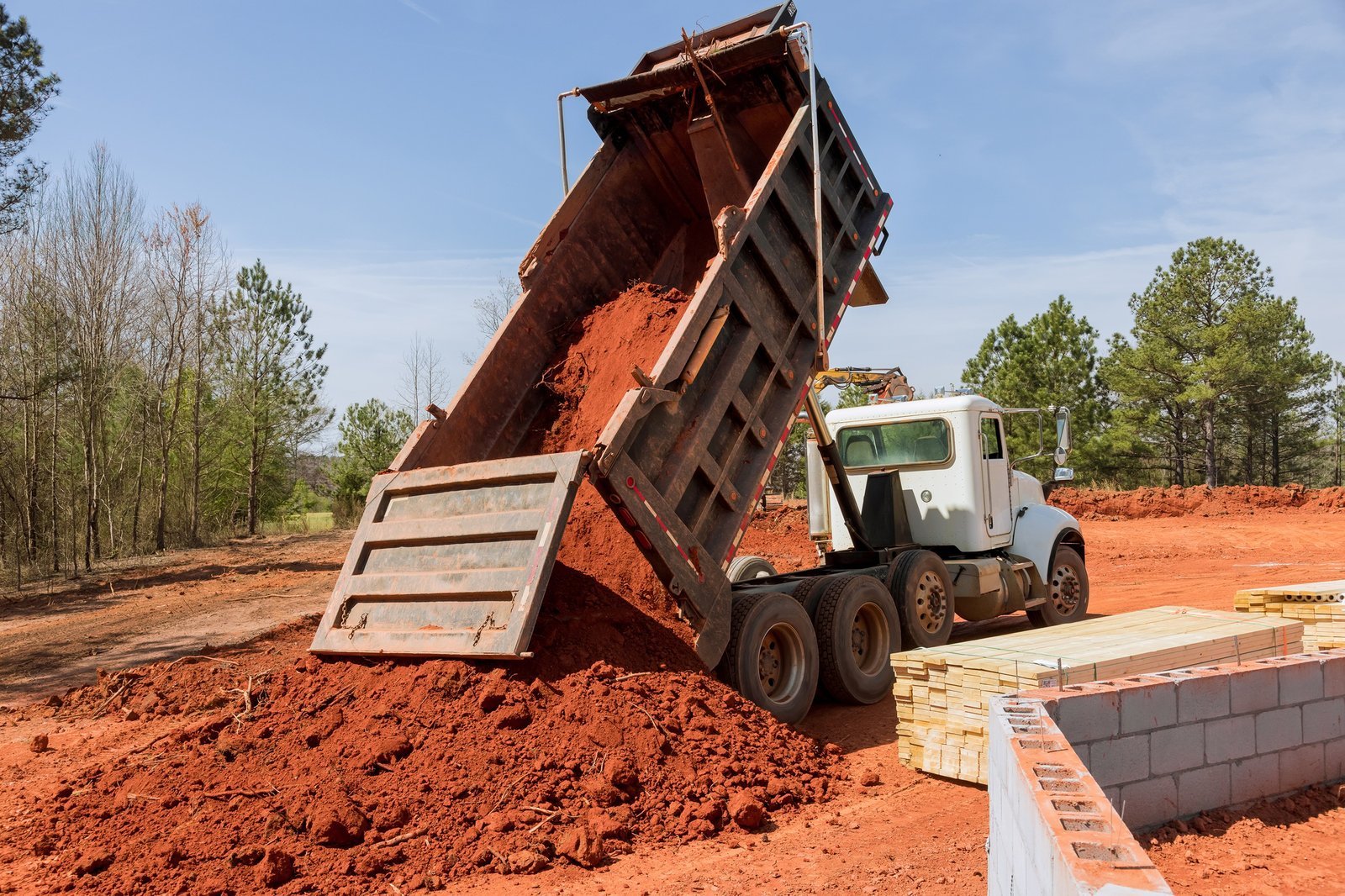
Every earthwork plan has two columns: dirt that stays and dirt that moves. Import is the dirt that has to come in, such as select fill, crushed base, topsoil or sand. Export, or haul-off, is the dirt that has to leave, such as spoil from a footing trench, unsuitable soil from a pad or the old base from a yard being rebuilt. The money in a grading job often sits in the difference between those columns.
Before it is a digging question, moving material is a trucking question. A tandem dump holds a limited load, a round trip takes a measurable time, and a dumpsite or a borrow pit has hours, tickets and weight limits. A yard that has to export four hundred loads in a week needs a route, a dump permit and a truck count that agree.
We plan and coordinate imports and haul-offs for concrete, utility and grading projects around Odessa, so material arrives on spec and leaves with the paperwork the owner needs.
Trucks, tickets and a tight sequence
The truck count is worked backward from the digging rate. If the excavator can load a truck in four minutes and the round trip is forty, ten trucks keep it busy. Too few and the machine sits; too many and trucks queue on the road. We build the count into the daily plan and adjust after the first day's numbers.
Imports run the other direction: the fill has to arrive when the pad is ready to receive it, not before, because a stockpile that sits in the wind loses moisture and gains dust complaints. We coordinate delivery windows with the gate, the spotter and the compaction crew. Every load gets a ticket, and tickets are reconciled against quantities at the end of each day.
Source approval, disposal and weight limits
Imported fill needs an approved source, a sample and a submittal, as the engineer's specification requires. Exported soil needs a destination that accepts it. Clean native soil is straightforward. Material with oil, salt or unknown contamination is another matter and goes through the owner and an environmental consultant first.
Trucks must respect legal weight limits and route restrictions. Odessa draws its water from lakes on the Colorado River by way of the Colorado River Municipal Water District, with Ward and Ector county wells adding to it, which is a reminder that a dumped load on the wrong ground can reach a resource that matters. Dumpsites are checked and haulers keep paperwork for each load.
Owners who need material moved
Oil, gas and midstream owners need pad material in, and pit or tank-bottom soil out, often on a short call. Pads for new equipment need caliche or select base brought in quickly, then dressed and compacted. Weekend and night deliveries are common, and we schedule for them when the yard manager needs a pad before the equipment arrives.
Industrial and manufacturing owners have demolition spoil and excavation spoil from plant expansions. They want one contractor to plan the trucks so plant traffic is not disturbed, and to document what left the site.
Haul-off and its neighbors
Hauling is rarely a stand-alone job. It supports demolition and site prep, which creates spoil, and excavation, which creates more. It also supports cut and fill earthwork, where the goal is to keep the haul as short as possible.
When the numbers say a site cannot balance, the haul becomes a design question and we raise it with the engineer. A modest change in finished grade can erase a large number of truck loads. Where that is not possible, topsoil stripping and stockpiling keeps good material on site for later use, which cuts both the export and the later import.
Trucks on public roads and tight gates
Truck traffic is a hazard for pedestrians and other drivers. We set a haul route that avoids schools and congested crossings when possible, post signs at entrances and use flaggers where trucks enter a live road. Loads are covered or wetted to keep dust and spillage off the pavement, and tires are cleaned at the stabilized entrance.
On the site, spotters work whenever a truck backs. Drivers keep to the plan, and fatigue is watched on long hauls.
Routes in and out of Odessa
Haul times depend on the road network, and the nearby communities each have their own approach. West Odessa is bounded by Interstate 20 on the south, State Highway 302 on the north, FM 866 on the west and the city of Odessa on the east, and the community is reached from exits 104, 108, 112 and 113. Trucks heading to West Odessa pick the exit that sits nearest the site and avoid cutting through neighborhoods.
Across in Midland, Interstate 20 and its business route, the loops and several state highways give haulers more choices. When a job sits between Odessa and Midland, we plan the route to use the loops and the interstate, not the main streets.
Who trucks and who checks
Trucking is provided by haulers we qualify and schedule, who carry the insurance and the equipment. We manage the routes, the tickets, the quantities and the quality checks. Concrete trade partners pour on the surface the hauled material prepares.
That arrangement lets us add trucks quickly when a schedule tightens and drop them when it eases, without owning a fleet that sits idle. It also gives the owner one source for the haul log, with dates, loads and destinations. If an auditor, a lender or a city inspector asks where the spoil went, the answer is a printed log and not a recollection.
Count the loads before the first truck rolls
Send the grading plan and the quantities, and tell us where material is coming from or going to. We will set a truck count, a route and a ticket system, and price the haul by the load.
Common Questions
How do you estimate the number of truckloads?
We convert bank cubic yards to loose yards using the soil's swell factor, then divide by the truck's capacity. A tandem dump carries roughly ten to twelve yards, a belly dump more. The number is checked against actual tickets after the first day, and the count is revised if the haul turns out shorter or longer than planned.
Can we reuse soil from the site instead of importing?
Often. If the soil meets the specification after screening, drying or blending, it saves the import cost and the trucking. The engineer must approve it in writing, and the testing lab confirms each lift.
What happens to contaminated soil?
It stays on site, stockpiled on plastic and covered, until the owner's consultant identifies it and picks a disposal route. We do not mix it with clean material, and we do not move it without paperwork.
Who pays for dump fees?
The bid states it. We prefer a clear allowance or a unit price per load, so the owner knows who carries the risk if the dumpsite changes its rates.
Do you provide caliche or only haul it?
We source it through approved suppliers and haul it to the pad. The source, gradation and price are shared with the owner before the first load, so the base meets the specification.