
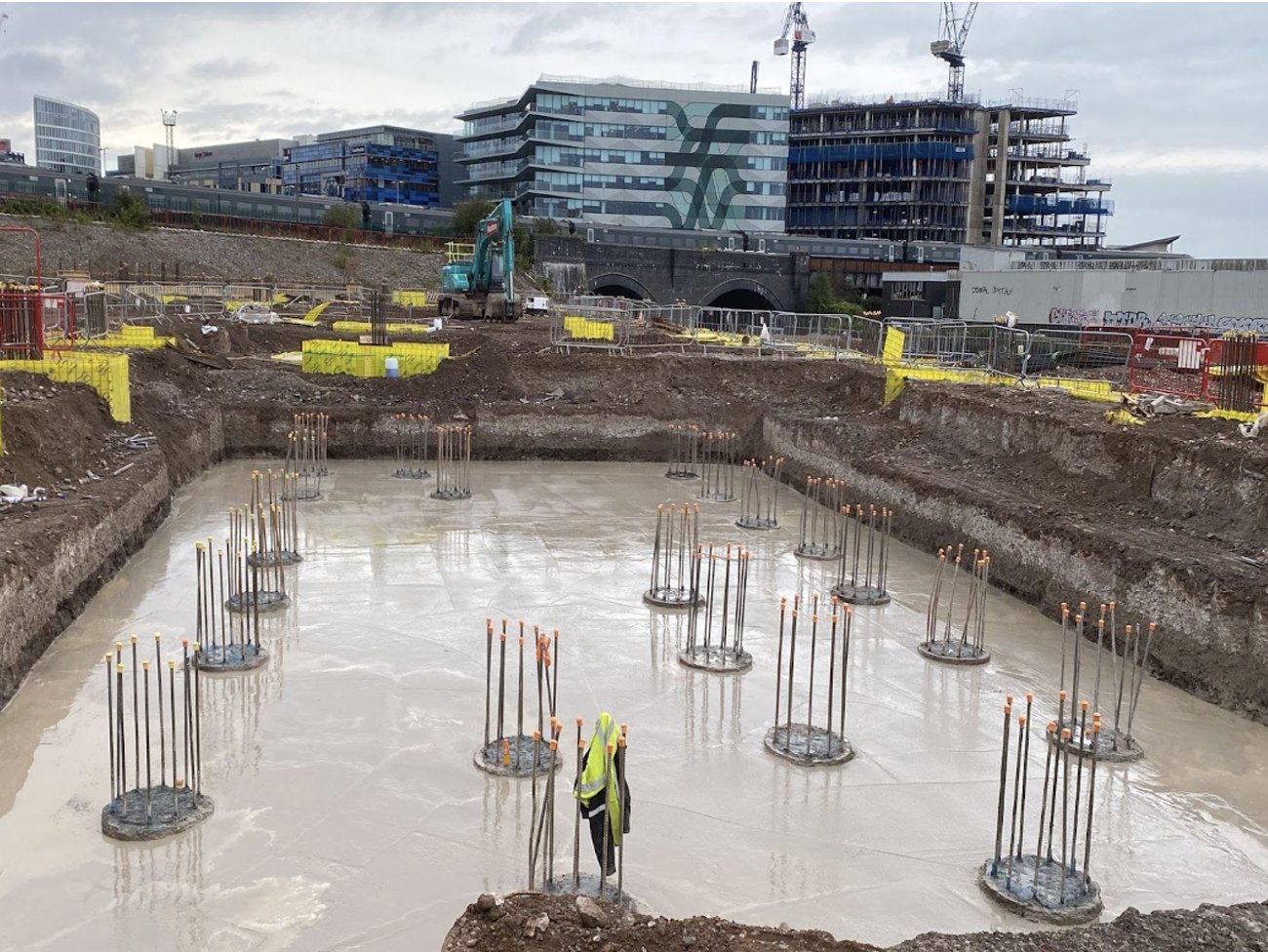
Ector County is level to rolling ground on the lower shelf of the Great Plains, between 2,500 and 3,300 feet in elevation, and almost none of it is prime farmland. That makes it good ground to build on and uninteresting ground to farm. It also means a site rarely arrives at the elevation the design wants. A yard sits a foot high on one side, a drainage swale needs to run through the middle, and the building pad has to be at one number.
Cut and fill is how those differences get settled. Ground that stands too high is excavated, ground that sits too low is filled in compacted lifts, and the goal is to move as little material off the site as possible. Done well, the haul stays short, the pad passes its density tests the first time and nobody pays to buy dirt that was already on the property.
We plan and coordinate cut and fill for yards, pads, roads and drainage on commercial and industrial sites around Odessa, working with earthwork trade partners who run the equipment.
Sequence on a short schedule
Earthwork opens a project, so every later date depends on it. The cut and fill is phased to match whatever comes after it: the building pad first if the steel is waiting, the yard second, the drainage last. A haul road goes in on day one so loaded trucks are not cutting their own ruts through the work.
Yard managers and general contractors often want a pad ready in days, not weeks. That works when the quantity takeoff is done before the equipment arrives and the testing lab is booked for the first lifts. We schedule density testing the same way we schedule trucks, because a lift that waits on a test sits idle and may need to be wetted again.
Haul traffic and open cuts
Cut and fill puts loaded trucks, scrapers and compactors in the same space as surveyors, testers and other trades. We set up one-way haul routes, keep pedestrians outside the swing of equipment and require spotters wherever a truck backs toward a work area. Dust gets controlled with water, since a cloud over a haul road hides a person as well as a truck.
Open cuts and slopes follow the trench and excavation rules for depth and sloping, and a competent person inspects them each day and after rain. Tall fills get edge protection. A site that is orderly at 6 a.m. is usually still orderly at 4 p.m.
Where the money goes
The price of earthwork follows quantity, haul distance and the number of times a yard of dirt gets handled. A balanced site, where the cut fills the low spots, costs the least. A site that has to import select fill or send unsuitable soil away costs more, and the gap can be large because trucking is the biggest single line.
Compaction is the second driver. A pad that needs ninety-five percent density in eight-inch lifts takes more passes and more testing than a yard with looser requirements. We price unit rates for import, export and rework so that a change in quantity moves the price in a way the owner can predict.
Where we mobilize
We mobilize crews and trade partners to sites in Odessa and out along the main routes. Odessa's road system runs on Interstate 20 and Business I-20 (2nd Street), US 385 (Andrews Highway), SH 191 (42nd Street), Loop 338 and Spur 450 (Kermit Highway), and those same roads decide haul times for dirt and for equipment. A pad on Loop 338 gets a different haul plan than one on the Kermit Highway.
We also work in West Odessa and the I-20 and Loop 338 corridor, where lots are large, fencing is sparse and the access road may be the only thing that needs building before the first scraper arrives.
Specs, testing and approvals
The geotechnical report names the fill material, the lift thickness, the moisture range and the density. Plans give the finished contours, and the city or county reviews grading and drainage before work starts. We read all of it, then agree with the engineer on how fill is tested, how often and who pays for retests.
Disturbed ground of an acre or more brings stormwater permit duties, which we handle with the contractor of record. The Loop 338 freeway plan from TxDOT, which would roughly double the corridor width from about 200 feet to 400 feet, is a good reminder that public work near a site can change its grades, easements and haul routes.
Owners who ask for cut and fill
Industrial and manufacturing owners ask for pads for new process equipment and expansions that cannot interrupt a running plant. Commercial developers need a graded pad and pad-ready lots on a tight timeline so tenants can start.
Public owners bring a different set of needs: tested fill, documented lifts and a clean record for the inspector. Whatever the owner type, the cut and fill plan comes down to the same thing, which is a surface that drains, holds the load and arrives when the slab crew does.
What we run and what we coordinate
Earthwork equipment and operators belong to trade partners we vet and schedule. We manage the quantities, the sequence and the quality checks, and we are on site when the first lift is placed. Concrete trade partners take over to place and finish the concrete once the pad is accepted.
That split has a practical benefit for the owner. One point of contact owns the earthwork, the base and the slab, so a failed density test is fixed by the same group that sets the pour date, and nobody has to sort out whose problem it is.
Work around cut and fill
Cut and fill sits between clearing and finishing. Before it comes stripping and stockpiling of topsoil. After it comes fine grading and, for roads, road subgrade preparation.
When the soil under a fill is poor, over-excavation and recompaction replaces the weak layer first, and the fill goes on top of ground that has been proved.
Start with the site plan and the soil report
Share the survey, the proposed grades and the geotechnical report, and tell us when the slab crew is due. We will check the balance of cut and fill and set a haul plan for your pad.
Common Questions
How do you know if the site will balance?
We build a quantity takeoff from the survey and the plans, then compare the cut volume against the fill volume with an allowance for shrink and swell. If the numbers are close, we adjust finished elevations slightly. If they are not, we price import or export up front.
Can onsite caliche be used as fill?
Often it can, where the engineer's report allows it. Caliche compacts well and drains, but it has to be broken down and screened for size, and we test it like any other fill. We ask the engineer to approve it in writing before we place it.
How thick are the lifts?
The geotechnical report decides. Eight inches loose is common, and thinner lifts are used with lighter compactors. Each lift is tested before the next one goes on, which is what keeps a deep fill from settling later.
Does wind affect the schedule?
It affects how much water we use. Dry fill loses moisture fast on a windy day, so a water truck stays with the compactor to keep the material in range. High wind can also stop scraper work when dust blocks the operator's view.