
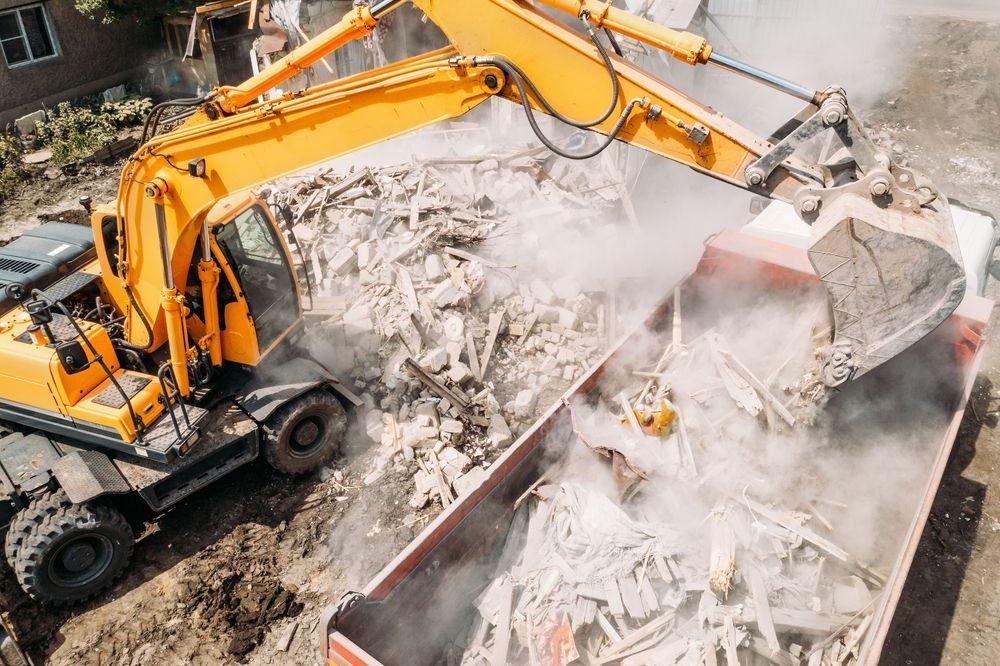
Most Odessa lots are not blank. They hold an old shop with a cracked slab, a tank pad no one remembers pouring, a line of fence posts, a few concrete footings and half a yard of buried pipe. A new building cannot go up until all of that is gone, and the order in which it leaves decides whether the grading crew starts on time.
Demolition and site prep clears the ground for new work. It includes removing structures, slabs, foundations, paving and fencing, disconnecting and capping utilities, pulling buried tanks and pipe, crushing or hauling the debris and leaving a graded, clean surface for the earthwork crew. It ends with the site in a condition a surveyor and an engineer can build from.
We plan and coordinate demolition and site prep for commercial and industrial sites around Odessa, using licensed demolition partners for the knockdown and concrete trade partners for concrete removal where it fits the scope.
Order of removal
Utilities come first. Power, gas, water, sewer and communication lines are located, shut off and capped before a machine touches the building. Then the structure is stripped, any hazardous materials are abated, and the shell comes down. Slabs and foundations are broken and removed last, because the building protects the work until then.
Debris sorting runs alongside. Clean concrete goes to a crusher where it can be reused as base. Steel goes to a recycler. Everything else goes to a landfill with the paperwork the owner needs. We schedule trucks to match, so debris does not pile up and slow the site, and we sequence removal so the earthwork crew can start on one end while demolition finishes on the other. A yard manager with a deadline cares about that overlap more than about any single task, because it is what turns a six-week job into a four-week one.
Owners who clear sites
Industrial and manufacturing owners tear down old process areas, tanks, foundations and sheds to make room for new equipment, often next to operating units. Work in those areas follows plant safety rules and permits, and the demolition plan has to protect the live process next door.
Commercial developers clear old retail, offices and homes for redevelopment, with the pressure of a closing date and a lender. They want a clear plan for removal and a cost to the foot, so the project pro forma holds. Redevelopment sites also carry questions about neighboring walls, shared fences and easements, which we sort out with a survey before the first machine moves.
A town that has been rebuilt many times
The Loop 338 corridor study describes its southwest segment from West I-20 to South US 385 as 3.7 miles long. Before moving demolition equipment to a previously developed parcel, we confirm the entrance, removal route and boundaries of existing construction.
Odessa's petrochemical complex began operating in 1957 to 1958 as a fully integrated synthetic rubber plant, one of the area's early large industrial installations. Sites with that kind of past often have buried foundations, old piping and unknown fill, so site prep starts with records, borings and a walk with someone who remembers what stood there.
Connected services
Demolition usually leads to other work. Concrete demolition and removal handles slabs, footings and paving. Site clearing and grubbing removes brush and roots. Import, export and haul-off moves the debris and the replacement fill.
When a site is ready, mass grading takes over. Having one coordinator across all of these keeps the end of demolition and the start of grading in the same plan, with no gap in which the site sits idle.
Wind, sand and hidden things
Monahans Sandhills State Park is about 5 miles from Monahans, 31 miles from Odessa and 55 miles from Midland, and wind reshapes its dunes, sometimes overnight. The same wind lifts dust off a demolition site, so wetting the work, keeping debris piles low and screening open edges matter, especially near neighbors and roads.
Hidden items are the other risk. Old tanks, sumps, pits, pipe and foundations show up after the surface is gone. We probe and scan before the heavy work, stop when something odd appears, and call the owner. Anything that looks like it held fuel or chemical is tested before it is moved. Heavy slabs are cut into sections that the loader can lift, and rebar is cut free before trucks are loaded, so loads are legal and nothing falls on the road.
Permits and notices
Demolition needs a permit from the city or county, and a notice to the state when asbestos may be present. A survey for asbestos and other regulated materials is done before the building comes down, and abatement is performed by licensed firms. Utilities need written disconnection confirmations, which we keep in the file.
Stormwater rules apply once the surface is disturbed, so erosion controls go in before demolition starts. Dust, noise and truck traffic follow local ordinances, and we post notices and contact numbers at the site entrance.
What the demolition scope lists
The scope names each structure, slab and foundation to be removed, the depth of removal for footings, the treatment of utilities, the disposal path for debris and the final surface condition. It states who surveys for hazardous materials and who pays for the unexpected.
It also states what stays. Trees, fences, monuments and neighbor property are marked and protected. A clear list of what remains avoids the disputes that start when something valuable disappears with the debris.
How far the crews go
We mobilize demolition partners to Odessa and surrounding communities. Ward County averages about twelve inches of rainfall a year, with average January lows near 29 degrees F and average July highs near 98 degrees F, and those extremes shape the working day: early starts in summer, frost-free hours in winter.
Distance is a cost, so we group work in the same area where we can and use local haulers for disposal. The industrial and oilfield service district in Ector County is the most common setting for yard cleanouts.
Walk the lot with us before you price the build
Send the address, any old drawings and the new site plan. We will walk the lot, list what has to come out and give you a removal cost that includes disposal.
Common Questions
How long does demolition take?
A small shop can come down in a few days, with a week or two for slab removal and cleanup. A larger plant can take months. The schedule depends on abatement, utilities and the amount of concrete to remove.
Is an asbestos survey required?
On nearly all commercial and industrial buildings it is, ahead of demolition. The survey identifies regulated material, and licensed firms remove it. We coordinate the survey and the notices.
What happens to the concrete?
Clean concrete goes to a crusher and returns as base material, which cuts disposal costs. Concrete with rebar is separated, and reinforcing steel goes to a recycler.
Can you demolish near operating equipment?
Yes, with a plan. We set exclusion zones, use methods that limit vibration and dust, and coordinate with the plant's operations and safety staff.
How is the site left?
Graded and clean, with debris removed, holes backfilled and compacted, and erosion controls in place. We hand a photograph record and, if the scope calls for it, a survey of the cleared area.