
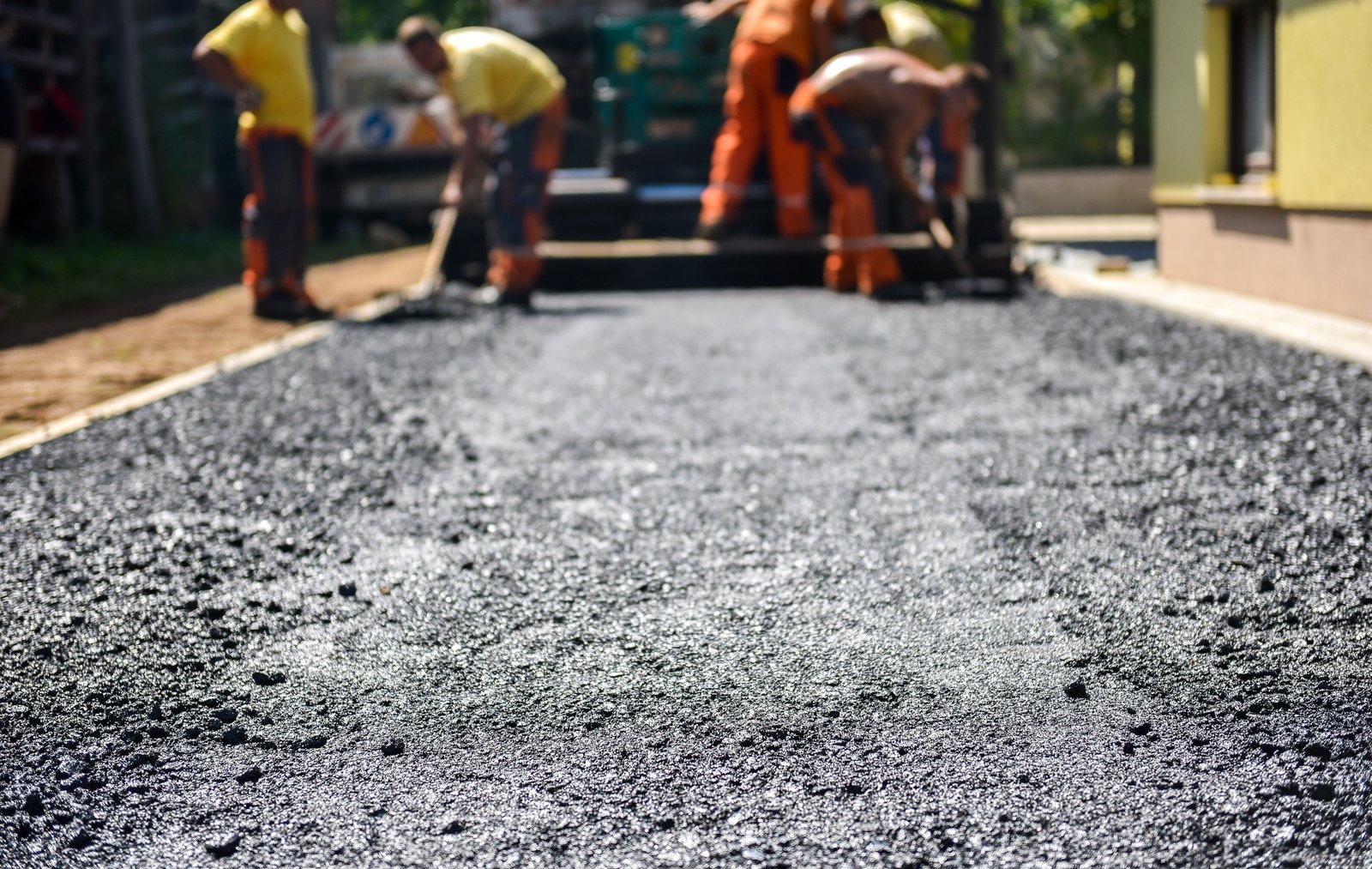
July heat softens asphalt, and the base under it takes the blame. Any yard manager who has watched a loaded tractor-trailer turn on a hot lot has seen the wheel marks that stay in the surface for the rest of the summer. Asphalt is a flexible surface, and it only works when the base underneath it is firm enough that the pavement is never asked to carry load on its own.
Base preparation is everything between the finished subgrade and the first lift of asphalt. It means a compacted aggregate base course of the thickness the design calls for, graded to the final slope, proof rolled and tested, then primed or tacked to receive the mix. Tolerances are tight because a base that is high or low by half an inch is a pavement that is too thin or too thick in the same place, and asphalt shows both.
We plan and coordinate base preparation for parking lots, plant drives, truck lanes and yard surfaces around Odessa, and we hand a tested, graded base to the paving contractor in a condition they can accept in writing.
Owners who pave over a base we prepare
Commercial developers prepare parking fields for retail, office and medical sites, where cost per square foot matters and the schedule runs to a tenant opening. The base is the biggest hidden cost in that budget, and a clean base lets the paving crew move across the lot at speed.
Municipal and public works buyers pave streets, lots and trails, and they inspect the base before accepting it. Industrial owners combine asphalt for the light-traffic areas with concrete for the truck aprons, so a good base plan often covers both surfaces in a single sequence, with a clear line between where one ends and the other begins. The owner of an office building with a customer lot usually pays more attention to the look of the pavement, and the owner of a plant to how long it lasts.
Who builds the base
Grading, aggregate placement and compaction are carried out by trade partners we coordinate. We take responsibility for the plan, the stakes, the testing sequence and the handoff to the paving contractor. Asphalt itself is placed by paving specialists, and the base is not ours to hand over until the paver has walked it.
When a project has concrete elements such as curb, gutter, dumpster pads or truck-dock aprons, concrete trade partners place and finish them at the base elevation, so the asphalt can tie into them cleanly. The connections between asphalt and concrete are where drainage problems often start, and one party owning both sides prevents arguments. Before the asphalt arrives, we walk the edge with the paving foreman and agree on where the surface will end, how it will be sealed against the concrete and where water will go.
Work on both sides of the paving
Base preparation follows road subgrade preparation and fine grading, and it comes before the asphalt contractor. Where the owner wants a rigid surface instead, concrete paving uses the same base with a different surface. In heavy-use areas, owners choose concrete for the aprons and asphalt for the lanes, which makes the base plan one project with two finishes.
Curbs and drainage structures, including curb and gutter, are set before the base is placed, so the base is built against them and the pavement drains toward the inlets.
Where Odessa pavement carries weight
The road system tells the story. Odessa's roads include Interstate 20 and Business I-20 (2nd Street), US 385 (Andrews Highway), SH 191 (42nd Street), Loop 338 and Spur 450 (Kermit Highway), and each of those carries trucks from the oilfield, the plants and the distribution yards. Parking and drive surfaces that connect to them see the same traffic at slower speeds and with more turning, which is harder on pavement than straight highway driving.
Airports show the standard. Odessa-Schlemeyer Field is a city-owned general aviation airport about 5 miles northeast of Odessa with three asphalt runways, the longest 6,200 feet, at an elevation of about 3,003 feet. Aircraft ramps and taxiways around such fields rely on the same principle, a base thick enough to protect the subgrade and a surface that sheds water.
From stone to tack coat
We start with the subgrade proof roll, since a base on soft ground is a wasted base. The aggregate is placed in lifts of controlled thickness, wetted to the right moisture and compacted. Grades are checked with a laser or GPS rover and corrected before the next lift. The final surface is rolled and tested for density, and the paving contractor is invited to walk it.
Just before paving, the base may be primed to bind the top layer or swept and tacked to bond the asphalt. Dust is a problem in this climate, so we keep a water truck handy and sweep ahead of the paver. We photograph the base with a tape and a stake so the thickness is recorded for the file. Heat and wind both dry the stone quickly, so compaction happens early in the day when moisture is easier to hold, and we recheck any section that sat unrolled for more than a couple of hours.
What the work includes
A typical scope names the base material and thickness, the density and test frequency, the grade tolerance, any geotextile or geogrid, the prime or tack coat and the hold point before paving. It also lists who provides survey control and who pays for retests.
A 300 million cubic feet per day Iron Mesa gas processing plant is planned at Goldsmith in Ector County, about 15 miles northwest of Odessa beside an existing 160 million cubic feet per day plant, with startup scheduled for the first quarter of 2027. Large facilities like that bring plant roads, parking and truck lanes, each needing a base plan of its own. We spell out in the scope which areas get asphalt, which get concrete and where the two meet.
Hand the paver a base that is signed off
Send the paving plan, the pavement section and the schedule. We will check the base thickness, set the testing plan and tell you when the base will be ready for the paving crew.
Common Questions
How thick should the base be under asphalt?
Follow the pavement section specified for the loading. It may call for four inches in a light-duty lot or at least a foot beneath heavy truck traffic. Probing and survey checks confirm that the installed thickness matches that section.
What material is used for the base?
Crushed stone, crushed caliche or recycled concrete, depending on the specification and what is available. The engineer approves the gradation, and we test it as it is placed.
Why does a base need to be tested if it looks hard?
A base can look hard on top and be soft below. Density tests and proof rolls find weak spots that the eye misses, and fixing them now is cheap compared with patching asphalt later.
Is a tack coat the same as a prime coat?
No. Prime penetrates an unbound base to bind and protect it. Tack is a thin sticky layer between old and new asphalt or between lifts. We use whichever the specification names.