
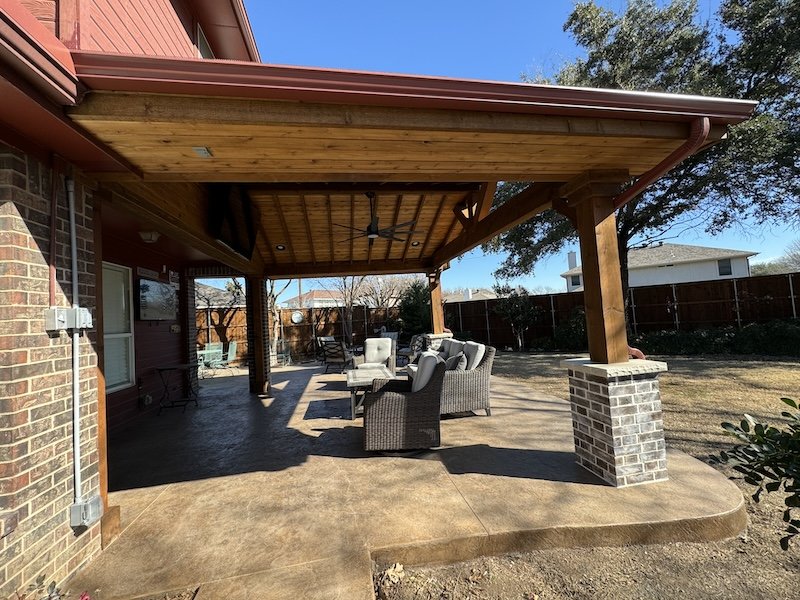
Colored and stamped concrete has a narrow job in this market. It dresses up the places customers walk through: the entry to a medical office, the plaza in front of a bank, the patio at a restaurant, the walkway between school buildings. It is flatwork first, with a pattern pressed in or a color added. If the base, the joints or the cure are wrong, the pattern will not save it.
The Basin is hard on decorative surfaces. Summer sun fades pigment and bakes the surface, wind pulls moisture out of a fresh pour, and blowing sand scours sealers. A pattern that looks right on a brochure has to be placed at the right hour, stamped before the concrete stiffens, and sealed with a product that survives a sandy, hot environment.
Concrete Contractors of Odessa handles decorative work as a small part of a larger site package. For each decorative slab, the concrete contractor handles placement, finishing, color application, stamping and texture, with sealer coordination included in that package. We keep it plain and durable, which is what most Odessa owners actually want from an entry or a walk.
Decorative placement and finish responsibilities
Concrete trade partners handle the forming, placing and finishing of the slab. That includes pigment in the mix or dry-shake color applied by hand, release agent, stamping mats or texture skins, joint cutting and sealer application. We handle the work from subgrade check to the final coat.
Utilities and earthwork around the project are handled by trade partners we coordinate. If a water line needs relocating or a grade needs to be changed before the decorative pour, we raise it with the general contractor early. Decorative flatwork is especially unforgiving of late changes because a patch will never match the original color.
Placing a decorative slab
The sequence is strict. Forms and base are checked, reinforcing is set, and the mix is ordered with a consistent source and a slump that suits stamping. Color is added to every truck in the same manner, or dry-shake is applied at the right moment so the surface cures evenly. A change in water at the truck is the quickest way to get patchy color.
Stamping begins when the surface will take the mat without sticking or slumping. Release agent keeps the mat clean, and the crew moves quickly with tampers and a second set of mats. Joints are cut in the pattern wherever the design allows, then sealed. The finished slab is cured with a compatible product and left alone until the sealer goes on.
How decorative work fits with the rest of the site
Most decorative surfaces are part of sidewalks and flatwork, and they need the same attention to slope, joint spacing and edge detail. Where the pattern leads to a door, the surface must follow the rules in ADA ramps and accessible routes, since a textured path with a changing slope can trip a visitor.
Parking and drive areas that surround a decorative entry usually use plain broom finish concrete paving. We design the transition so the stamped band is a distinct strip and does not carry vehicle loads unless the base was built for it. A decorative crosswalk on a main entry drive, for example, needs a heavier section than a patio.
Where decorative concrete is requested
Offices, hotels, banks, clinics, churches, restaurants and schools are the usual customers. Entries, courtyards, smoking and break areas, pool decks and walkways are the usual locations. Retail owners may ask for a colored band to mark the main entry and a plain broom finish for the rest.
Decorative work also shows up in public plazas and park paths. Municipal owners care about maintenance cost, so we propose finishes that can be pressure-washed and resealed without a special crew. A simple pattern with a durable color beats an elaborate one that is hard to repair.
Heat, slip and surface safety
Decorative work happens in the open air, usually in warm weather, and most Odessa owners schedule it around the trades that follow. Crews need shade and water, and fresh concrete under direct sun can burn skin through wet clothing. We start early, rotate finishers and keep the pace steady rather than rushing the last half of the pour in the hottest hour.
Sealers and release agents are chemicals, and we handle them according to the product data sheets with the right gloves, ventilation and storage. For the finished surface, slip resistance matters. A glossy sealer on a ramp or near a pool is a hazard. We offer slip-resistant additives and textures for those areas and choose a sheen that suits the use.
Climate and water in the local picture
The Odessa-Schlemeyer Field station lists a July average high of 95 degrees, a June average high of 95.5, a January average low of 31.6 and annual precipitation near 12.93 inches. Decorative concrete in that range gets cooked in summer, chilled on winter nights and rarely rained on. Sealers need UV resistance, and the pour schedule has to avoid the afternoon peak.
Growth also changes the landscape. Ector County received $17 million from the State of Texas to connect West Odessa residents to Ector County Utility District water lines, since wells in the area are drying up as the community becomes more urban. As West Odessa shifts from private wells to piped water, homes and small businesses tend to invest in patios, drives and walks, and that increases the demand for flatwork with a clean finish.
Color, repair and upkeep
Color matching is the biggest practical concern. Concrete changes shade with temperature, mix and cure, and a repair patch will not match a ten-year-old surface exactly. We tell owners that up front, and we recommend a pattern that hides repairs, such as a slate or flagstone stamp with random joints.
Maintenance is simple but not optional. Sweep, wash with a neutral cleaner and reseal on the cycle the sealer maker gives. In sandy conditions, resealing comes sooner. An owner who handles it as part of ordinary property care gets a surface that looks good for many years.
Pick a pattern and we will plan the pour
Send the site plan and tell us which areas need color or texture. We can bring sample panels, name the sealer, and map out a pour day that avoids the hottest hours.
Common Questions
Does stamped concrete last in Odessa conditions?
Yes, with the right base, joints and sealer. The sun and sand wear sealers faster than in milder places, so plan on resealing at intervals. The concrete itself is the same material as plain flatwork.
How much does color fade?
Integral color stays in the concrete, but the surface can lighten as sealers wear and the cement paste weathers. Dry-shake color is thinner and wears faster. We explain both and arrange sample panels through the concrete partner when asked.
Can stamped concrete be used on a drive or truck apron?
Light vehicle drives, yes, with a base and thickness designed for them. Truck aprons and yard paving should stay plain and heavily reinforced. Decorative patterns hold up poorly under repeated heavy axle loads.
Is stamped concrete slippery?
It can be when wet, particularly under a glossy coat, so we add grit to the sealer wherever people walk on wet ground and pick texture over smooth patterns near water.
When can I walk on a new decorative slab?
Usually the next day for foot traffic, but sealing happens later, after the concrete has cured and dried. Vehicles come later still. We give a calendar when the pour is scheduled.