
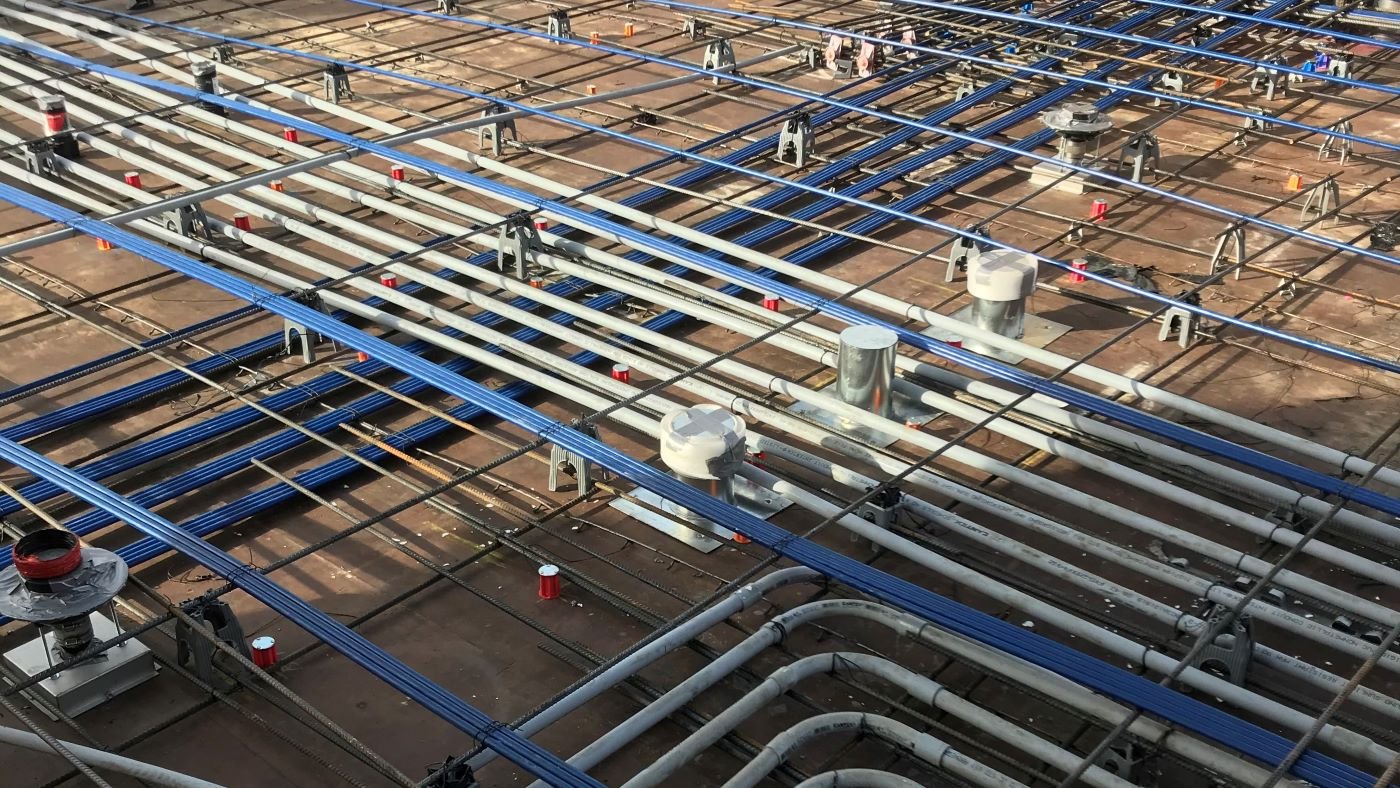
Steel strand pulled tight inside a concrete slab holds a great deal of stored force, and anybody who works near it needs to know where it is. That is the main thing to understand about post-tensioned construction. The slab is thinner and stronger than a conventional one, and it covers longer spans, but the tendons inside it are under tension for the life of the building. Drilling, coring or cutting a post-tensioned slab without scanning first is a good way to hurt someone.
Concrete Contractors of Odessa builds post-tensioned floors, both on grade and elevated, for commercial and institutional owners. In this market the main uses are large floors where fewer joints are wanted, parking areas, medical and office buildings, and some engineered foundations on ground that varies. The engineer designs the system. A specialist supplies and stresses the tendons. We form, place the deck concrete, coordinate the stressing window and keep the site safe around it.
Many owners first hear about post-tensioning from a structural engineer who is trying to save thickness, reduce cracks or open up the floor plan. We explain the trade, because it adds a few steps to the schedule and a few rules to the site that conventional reinforcement does not.
Rules for working near tendons
Tendon safety is the first thing we cover on a post-tensioned job. Before the stressing crew arrives, we mark the tendon locations on the deck, set up an exclusion zone behind the jacks, and keep everyone not directly involved out of that zone during stressing. A tendon that slips or a jack that fails can throw steel with real force.
After the slab is stressed, the rule continues: no cutting, coring or drilling without locating the tendons by scan or by as-built drawings. We keep the placement drawings, mark the slab edge with tendon locations, and pass the information to the owner at turnover. The same document goes in the file when a future tenant wants to run a new floor penetration. Layout paint on the slab fades, so the scan or the drawing is what counts, and we encourage owners to keep both. We also brief the other trades on site, from the plumber to the electrician, so nobody drills a floor on a guess.
Ground, loads and project planning
Ground matters for a slab on grade. At McCamey, in the late 1920s, a plan to build a one million barrel earthen storage tank failed because the limestone under it could not carry the weight of the crude. It is a useful story for anyone asking a slab to carry something heavy over uncertain ground: the base has to be understood before the design is chosen. Post-tensioned slabs are sometimes used where the soil is variable, because the tendons help the slab bridge soft spots and resist shrinkage cracking.
Elevated post-tensioned decks add planning questions about shoring, stressing strength and the order in which bays are poured. A parking deck, a medical building podium near the Medical Center district or an office floor each carries its own sequence. A podium that sits under occupied floors has a tighter sequence than a stand-alone slab, because the stressing has to be finished and approved before the next trade loads it. We map the sequence with the structural engineer and the stressing specialist before the schedule is fixed.
Forming, placing and stressing
We set the forms to the shop drawings, then the tendon crew lays chairs, ducts or sheathed strand according to the plan. Drape and spacing are checked with a tape and a level before the inspector arrives. Rebar sits around the tendons at slab edges, penetrations and column strips, and our rebar placement crew ties it so that nothing displaces the strand.
The concrete is placed with care around congested areas and vibrated to avoid voids at the anchorages. Cylinders are cast and broken to confirm the strength required for stressing, usually a few days after the pour. Once the engineer approves the numbers, the stressing crew pulls the tendons and records the elongation of each. We then fill the pockets and finish the edges. The pocket grout is mixed to the specified strength and cured like any other structural repair, and the slab edge is sealed so that moisture does not reach the tendon ends. A pocket that is left half-filled is one of the quiet failures in this kind of work.
Who does what on a post-tensioned job
Concrete trade partners set the forms, place and finish the concrete, cast the cylinders and handle curing. The tendon supply, the shop drawings and the stressing belong to a specialty contractor, and we work alongside them rather than claiming that scope. Utilities and earthwork are handled by other trade partners we coordinate.
That division is useful to the general contractor, because everyone knows who answers for what. If a duct is damaged, the stressing crew and the concrete crew find out together, and the engineer decides what to do. A pour that is delayed by an inspection or a late tendon delivery is reported at once. For deck structures that tie into a larger frame, see our work in cast-in-place structural concrete.
Buyers who ask for post-tensioning
Healthcare and education owners use post-tensioned floors for long spans and good vibration performance. Odessa's largest employers in the city's 2021 financial report included Ector County ISD at 4,163 and Medical Center Hospital at 1,977, so schools and healthcare owners are a natural fit for this system when they expand.
Commercial developers use it for retail and office pads where fewer joints help the floor finish. Parking owners use it for decks. Industrial owners use post-tensioned slabs on grade when warehouse floors need to be big and relatively free of joints, which is common for commercial developers who want a clean floor plate. We look at the use first and the system second.
Ask us about your slab system
Share the structural drawings or the engineer's concept sketch. We will tell you how the deck would be formed, where the tendon crew fits in the sequence and what safety rules we would set for the other trades.
Common Questions
Why use post-tensioning instead of regular rebar?
Tendons put the concrete into compression, which lets the engineer reduce thickness, widen the spacing between joints or span farther between supports. The tradeoff is more coordination, specialty labor and safety rules after the slab is stressed.
Is it safe to core a post-tensioned floor after turnover?
Only after the tendons are located by scan and the engineer approves. We leave tendon location records with the owner at turnover, because tenants and maintenance crews will need them years from now.
How long does a post-tensioned slab take compared to a regular one?
The pour is similar, but stressing adds a day or two once the concrete reaches strength. Elevated work also needs time for shoring and bay sequencing. We include the stressing window in the schedule from the start.
Is post-tensioning more expensive?
Material and specialty labor cost more, but the savings in concrete volume, joint work and sometimes foundation size can offset it. The answer depends on span and use. We price the alternative with the same scope so the comparison is fair.
Who stresses the tendons?
A specialty post-tensioning contractor, working to the engineer's shop drawings. We coordinate their access, set the strength hold point and make the slab ready for them.