
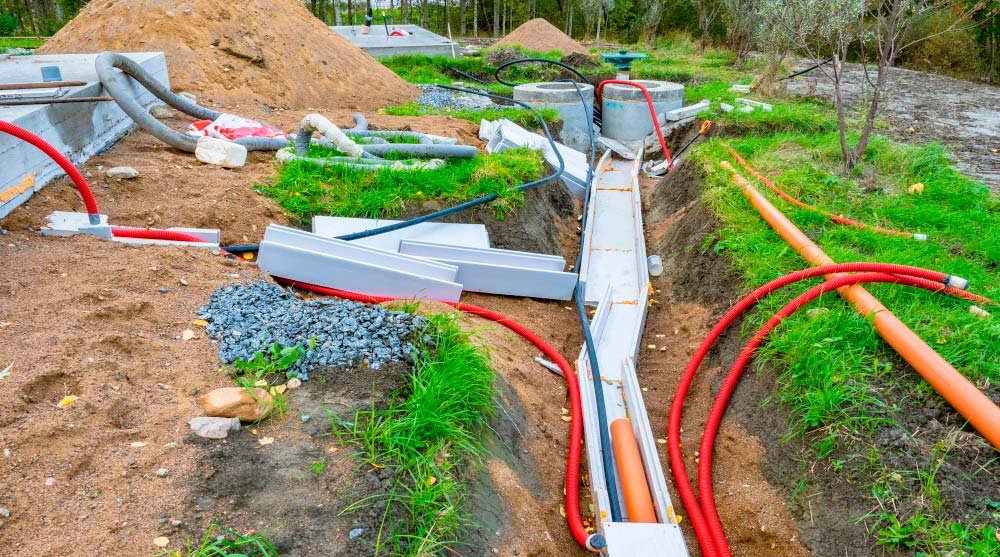
Fiber is the line most owners remember last. The yard office needs internet, the gate needs a camera, the scale house needs a data link and the new shop needs a pathway to the main building. By the time those needs are listed, the pavement is down. A trench through a new apron costs many times what the same trench cost before the slab was poured, so the best moment to install conduit is when the ground is still open.
We coordinate conduit and fiber trenching for industrial yards, commercial lots, school campuses and public corridors. Trenching and conduit partners cut the trench, lay the duct and set the handholes. Concrete trade partners restore the concrete, form and pour handhole collars and pads, and make the surface match the slab around it, so a trench stays a line on the as-built and never shows up as a ridge in the pavement.
Where fiber and conduit runs matter
We take conduit and fiber work in Odessa and Ector County and mobilize crews to Gardendale, roughly 14 miles up the road from downtown Odessa, and to Andrews, Monahans, Crane and Kermit. Gardendale belongs to the Odessa metropolitan area, and the service yards and facilities along its roads need links back to Odessa offices and operations centers.
Ector County is gently rolling to flat ground on the lower Great Plains shelf, between 2,500 and 3,300 feet in elevation, and that open terrain suits long straight trench runs. Gardendale and Andrews projects benefit from it, because a trencher can cover long distances quickly where rock and wet ground are not in the way. Our work is to arrange the access, locates and restoration so those long runs do not become a patchwork of unfinished trench.
Pathways for the buildings that use them
Industrial plants and warehouses need pathways to scales, cameras, gate operators, handheld scanners and office networks. Schools and medical buildings need conduit for access control, nurse call and fire alarm panels. Retail centers need conduit for security and point-of-sale networks.
Government and municipal buildings often carry traffic signal, camera and sensor conduit along streets. Odessa-Schlemeyer Field handles general aviation inside Odessa, and Midland International Air and Space Port sits midway between Odessa and Midland; airfields rely on conduit pathways for lighting, navigation aids and communications under taxiway and apron pavement. Each building type has its own conduit sizes, quantities and spacing, so we begin with the owner's technology plan and work backward to the trench.
Permits, locates and right-of-way
Most conduit work needs three things: a locate request, a right-of-way or utility permit when the trench enters a public corridor and an inspection of the conduit and trench before backfill. Fiber owners or carriers may add their own construction standards for depth, bend radius, handhole spacing and tracer wire.
Crossing a road adds more. TxDOT or the city may require bored crossings, specific casing sizes and pavement restoration to their detail. We confirm the requirement during the permit request and carry the cost into the bid. The adopted building code and the electrical code govern low-voltage pathways inside the building, and the local permit office reviews the building connection. Utility owners are asked to mark their lines before work, and we repeat the request if work stops for more than the ticket life.
What changes the cost per foot
Rock is the biggest swing. A rocky trench takes a different machine and far more time than a sandy one. Next comes surface type: trenching across grass is cheap, across asphalt requires saw cutting and patching, and across a thick concrete slab requires cutting, breaking, removing and repouring with dowels. Boring under a road is slower than trenching but avoids pavement repair.
Duct size and count follow. A single small duct is cheap; a bundle with spares costs more but saves a future trench. Handhole count and traffic rating also matter. A handhole in a truck lane needs a heavy-duty lid and a reinforced collar. We price unknown ground as a unit rate per foot of rock, and we list restoration separately so the owner can compare the proposal with another bid on equal terms.
Sand, wind and open trench
Fiber trenches are narrow and shallow, and the sandy loam common across the Basin collapses easily. We slope or shore where depth requires it, and we keep spoil away from the edge. Wind drives sand into open trench and into conduit ends, so we cap every duct at the end of the day.
Records matter even more than the trench. A fiber route is only useful if someone can find it, and in a hot industrial yard the surface can change within a year. We record depth, offsets to fixed features and handhole locations, and mark the route with tape and tracer wire. Where a trench crosses a future expansion area, we deepen it and add a spare duct. Utility potholing and locating explains how we verify existing lines before the machine starts, which is especially important on crowded oilfield service lots.
From trench to restored surface
The work begins with layout and locate. The trench is cut to depth with a clean bottom, the conduit is laid with the required spacing, joined and capped, and a pull string or tracer wire is installed. Handholes go in at corners and at long-run intervals, set to grade on a compacted base. The trench is backfilled in lifts and compacted, warning tape is placed above the conduit and the surface is restored.
On concrete surfaces, we saw cut straight lines, remove the section, drill dowels into the edges and pour the patch at the original thickness. We finish and cure it like the slab it joins. Our related electrical duct banks page covers the heavier concrete-encased version of the same job, and we often combine the two on a plant site.
Owners who run fiber and conduit
Odessa Economic Development targets alternative energy and fuels, logistics, warehousing and distribution, manufacturing, and technology and research industries, and each of them leans on data links. Logistics and warehouse developers need them for yard systems and security. Industrial and manufacturing owners need them for controls and monitoring.
Oil remains the economic foundation in Andrews, where wells drilled from 1929 onward have produced over 1 billion barrels, and operators there link wells, tank batteries and offices. Water also factors in: Odessa takes its supply from Colorado River lakes through the regional water district, while wells in Ward and Ector counties add to the supply, and that infrastructure carries its own telemetry. Public owners add sensors and signals to the list. In each case, we install pathways at a size and count that leave room to grow.
Plan the pathway before the paving
Give us your site plan and the network diagram. We will propose the route, the duct count, the handhole locations and the pour sequence, and we will mark where leaving a spare conduit is cheapest.
Common Questions
Can we add conduit after the pavement is down?
Yes, but it costs more because the pavement has to be cut, removed, and patched. When you can, install spare conduit with the original construction.
How deep does conduit need to be?
Depth follows the specification and the owner or carrier standard. Heavy traffic areas often need more cover. We confirm the depth on the plan and adjust where utilities cross.
Do you pull the fiber?
No. The telecom contractor or carrier pulls and splices the fiber. We provide the pathway, the handholes and the restoration, and we coordinate access so their crew is not delayed.
What is a handhole and where does it go?
A handhole is a buried box that gives access to the conduit for pulling and splicing. It goes at corners, long straight runs and building entrances, and the engineer sets the spacing.
How do you keep the patch from cracking?
We cut clean lines, use dowels to tie the patch to the old slab, pour at the same thickness and cure under wind-blocking covers. Joints are cut to match the pattern around the patch.